AI & Banking
AI and the Decision Engine: Predictions in the Middle of the Loop, Not at the End
Part 3/5: Predictions are inputs, not results. What a decision record contains, which four decision types exist, and what the language model should not do.
•
acceleraid Editorial Team
•
6 min read

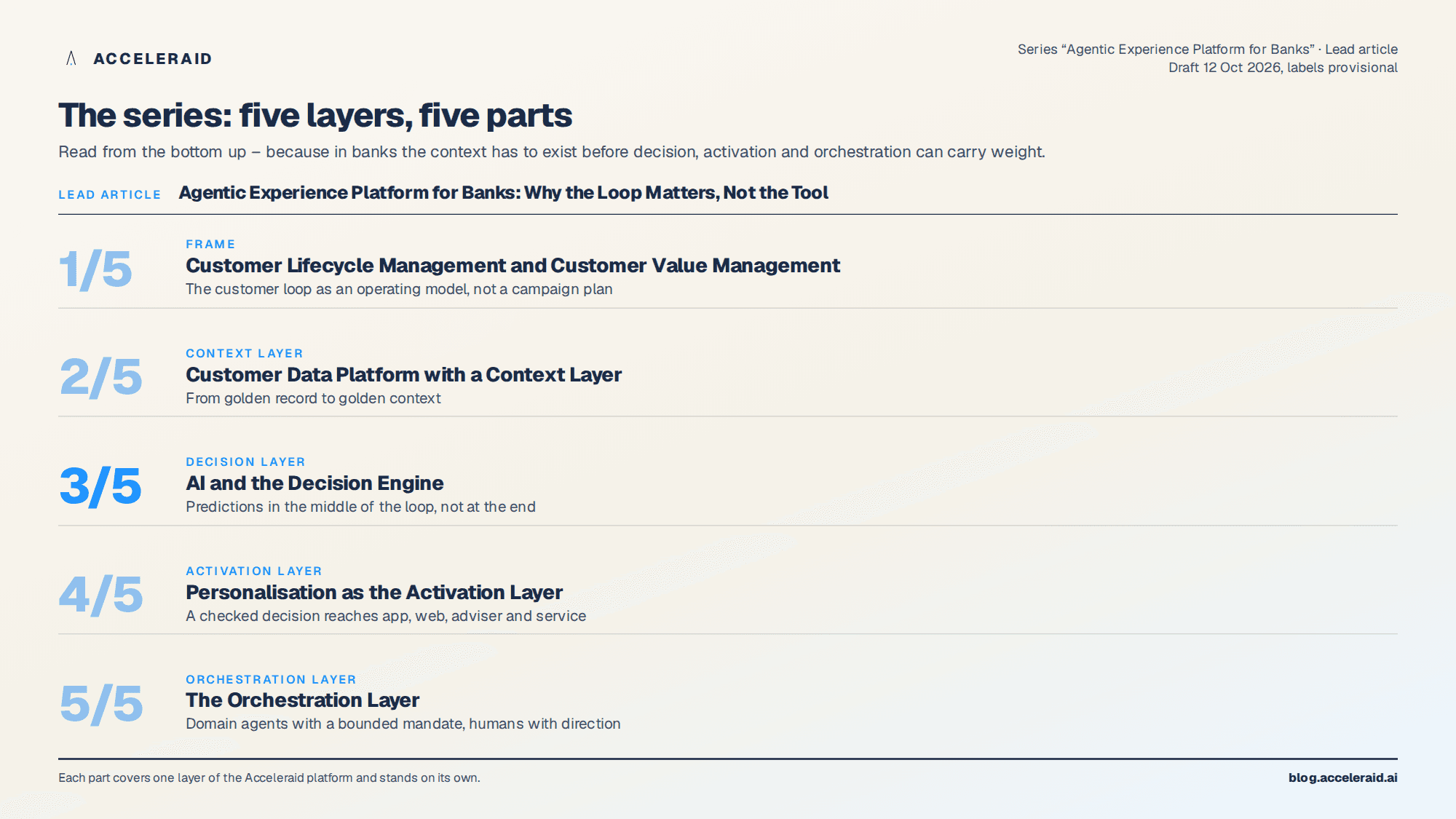
Series Agentic Experience Platform for Banks · Part 3 of 5. The lead article describes the five layers, Part 2 the context layer. This part goes to the middle of the loop: the decision engine.
In many accounts of AI in banking, the prediction sits at the end: a model calculates a churn probability and the campaign reacts to it. In an agentic experience platform the prediction sits in the middle. It is an input to the decision, not its result. Between the score and the action lie rules, goals, limits and a record that captures why something was decided. This part describes what this layer does and why the language model plays a supporting role in it.
What goes into the decision
The decision layer of the Acceleraid platform receives five kinds of input from the understand step: churn risk, product affinity, contact readiness, risk and fraud signals, and membership of a cluster of similar situations. None of these inputs is a decision. A high churn risk does not say whether a call, an offer or deliberate silence is the right response. It only says the case deserves attention.
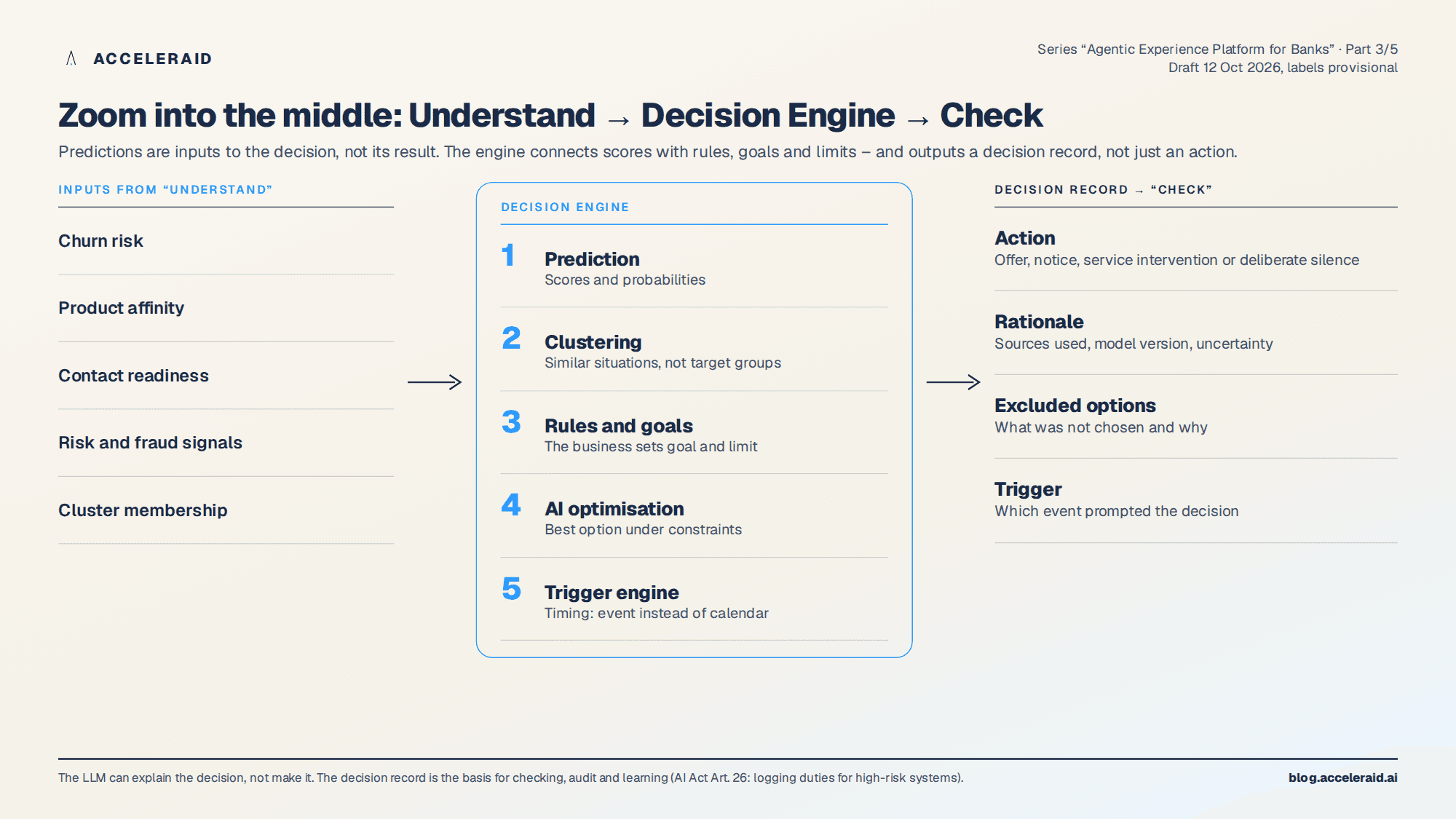
The engine itself connects five building blocks. Prediction supplies scores and probabilities. Clustering assigns the case to similar situations, not to target groups; the difference is that a situation passes and a target group stays. Rules and goals come from the operating model described in Part 1: the business sets the goal and the limit. AI optimisation picks the best among the permissible options, measured against the objective function and under constraints such as contact budget and suitability. The trigger engine sets the timing: an event, not a calendar.
The output is not a command but a decision record with four parts: the action itself, which can also be a deliberate omission; the rationale with sources used, model version and uncertainty; the excluded options with the reason for their exclusion; and the trigger. This record goes to the check step. It is also what an auditor reads later.
The example from Part 2 makes this tangible, hypothetical as it was there: a customer's salary credit does not arrive. The predictions report a medium churn risk, a high affinity for an instalment loan and low contact readiness, because a service case ran three weeks ago. The rules exclude the credit offer because a marketing objection exists and suitability is unchecked. Among the remaining options, deliberate silence or a notice via the adviser, the optimisation picks the notice, because the expected customer value in a possible emergency outweighs the risk of an unwanted approach. The trigger is the event, not a selection run. In the decision record the credit offer appears as an excluded option with its reason, and that very entry is what later shows the engine applied the rule rather than being right by chance.
Why the decision record is not optional
For some decisions this record is required by law. The AI Act classifies systems for assessing the creditworthiness of natural persons and for credit scoring as high-risk applications (EU AI Act, Annex III). Deployers of such systems face obligations for human oversight, monitoring of operation and retention of automatically generated logs (EU AI Act, Article 26). A decision layer that reconstructs these logs after the fact from log files does not serve the purpose; it has to produce the record at the moment of decision.
For all other decisions, which is to say the far larger share of notices, offers and omissions, the same record is the precondition for the loop to learn. Without the excluded options nobody knows whether the engine was right or merely lucky. Without the model version a deterioration cannot be attributed. Without the trigger it remains unclear whether timing or content drove the response.
Four decision types, four levels of scrutiny
Not every decision needs the same control. We distinguish four types, ordered by the risk to the customer, not by the effort for the bank. The classification is a proposal for discussion with business and compliance; the examples are hypothetical.
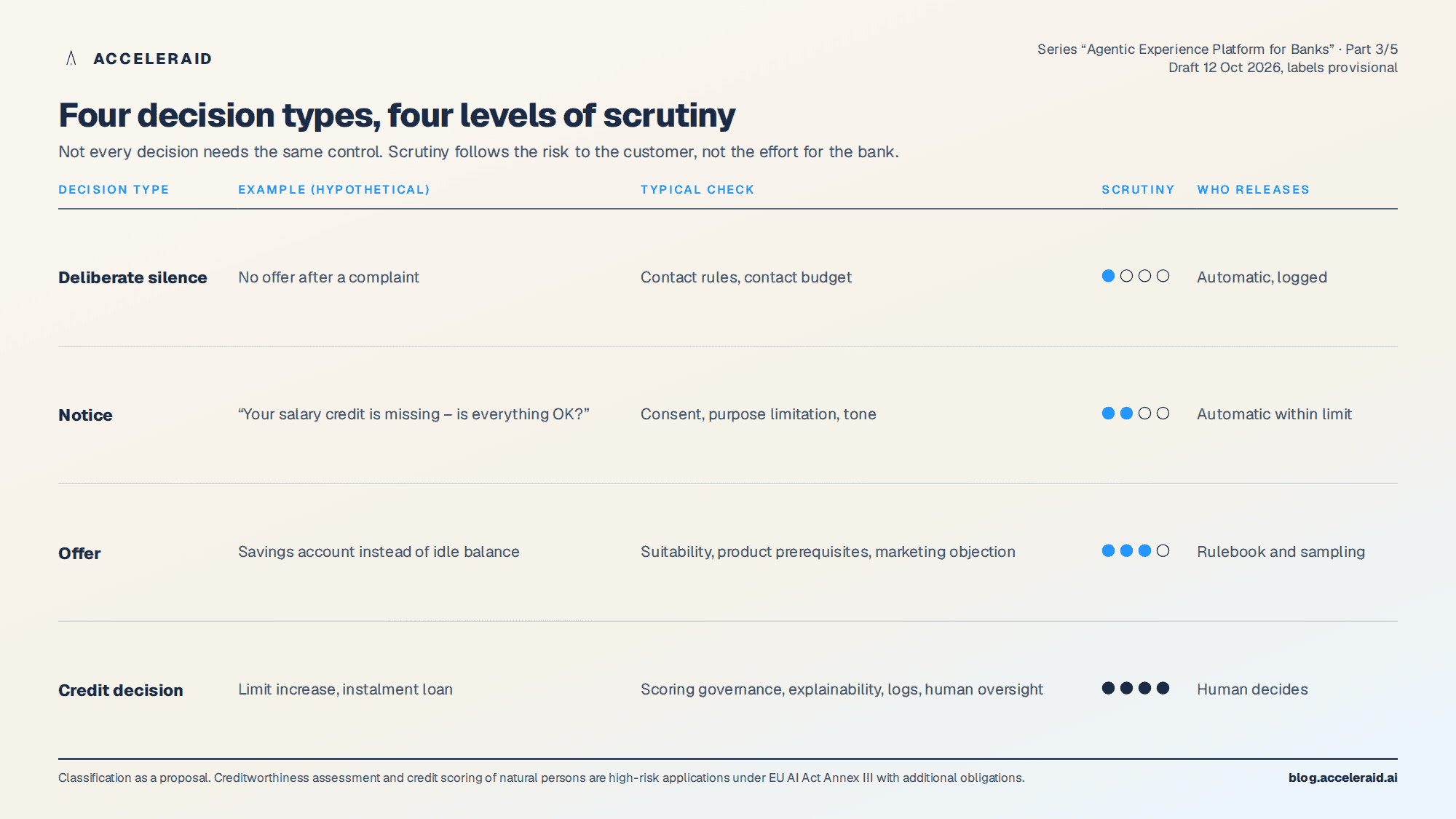
Deliberate silence is the most frequent decision and the least noticed: no offer after a complaint, no approach when the contact budget is spent. It is made automatically and logged. The notice informs without selling: your salary credit is missing, is everything all right? Here the engine checks consent, purpose limitation and tone and acts automatically within a limit. The offer requires suitability, product prerequisites and respect for a marketing objection; it runs by rulebook with sample checks. The credit decision, finally, stays with a person; the engine prepares, explains and documents, but does not decide.
This gradation also matches what customers accept. In the latest Salesforce survey, 38 percent of customers are comfortable with an agent creating personalised content, but only 17 percent with it making financial decisions for them (Salesforce). A decision layer that has not built in this boundary loses trust faster than it gains efficiency.
The role of the language model
It is striking that the description of the engine so far has not mentioned a language model. That is deliberate. Scores come from statistical models trained on the bank's data whose behaviour can be measured. Rules come from the business. Optimisation is mathematics under constraints. The language model has two jobs in this layer, and both sit at the edge: it can translate the rationale of a decision record into plain language, for the adviser as much as for the auditor, and it can turn unstructured signals such as a service note into structured features that are then treated like any other input.
What the language model should not do is make the decision itself. Not because it could not, but because its decision cannot be checked, versioned and reproduced the way a rule's or a score's can. Gartner expects at least 15 percent of day-to-day work decisions to be made autonomously by agentic AI by 2028 (Gartner). In a bank that share is only defensible if every one of those decisions rests on a record a person can read. We described the architecture for this in the customer brain roadmap.
What follows in the next part
A checked decision record is not yet an experience for the customer. It has to arrive in the channel, in the app, on the adviser workplace, in service, and the outcome has to flow back. Part 4 covers personalisation as the activation layer.
Five takeaways
Predictions are inputs to the decision, not its result; between score and action lie rules, goals, limits and a decision record.
The decision record contains action, rationale, excluded options and trigger; for high-risk applications it is mandatory, for all others the precondition for learning.
Four decision types need four levels of scrutiny: silence and notices run automatically, offers by rulebook, credit decisions with a person.
Customers draw the same line: agents may create content, but only a small minority accepts them making financial decisions.
The language model explains and structures; it does not decide, because its decision is not as checkable and reproducible as a rule or a score.
Illustration: AI-generated. AI-assisted content: We use AI technologies and automated agents in the creation of our articles, including from Microsoft, Google, OpenAI, Anthropic and other providers. Topics, editorial direction and final approval remain with our team.
Keep reading
More articles

AI & Banking
Agentic Experience Platform for Banks: Why the Loop Matters, Not the Tool
Treasure AI, golden context, 15 CDP use cases: why in banks the time from signal to checked action matters, not the tool. Opening article of the series.

CLM & CVM
Customer Lifecycle Management and Customer Value Management: The Operating Model for Agents
Part 1/5: CLM supplies the rows, CVM the objective. Why agents without an operating model optimise for clicks, and what belongs in each cell of the matrix.

Data & Technology
Customer Data Platform with a Context Layer: From Golden Record to Golden Context
Part 2/5: Three contexts, five functions, four kinds of memory. What turns a data field into a context object, and what the agent should not see.
