AI & Banking
Agentic Experience Platform for Banks: Why the Loop Matters, Not the Tool
Treasure AI, golden context, 15 CDP use cases: why in banks the time from signal to checked action matters, not the tool. Opening article of the series.
•
acceleraid Editorial Team
•
9 min read

Series Agentic Experience Platform for Banks · Lead article. Five parts follow: Customer Lifecycle Management and Customer Value Management as an operating model, Customer Data Platform with a Context Layer, AI and the Decision Engine, Personalisation as the Activation Layer and the Orchestration Layer.
In January 2025, Treasure Data and Artefact published a guide with 15 use cases for customer data platforms in banking, insurance and investment management. Its central promise was the familiar one: a 360-degree view of the customer, built up in maturity stages from two weeks to more than six months (Artefact). Fifteen months later the same vendor renamed itself Treasure AI and wrote that the question is no longer whether you have a customer data platform, but how fast the loop from data to decision to action closes (Treasure AI).
That is more than a rebrand. It shifts the yardstick: what counts is not how complete the customer picture is, but how long it takes from a signal to a checked action. For banks this shift is delicate, because between signal and action sit obligations a retailer never meets: purpose limitation, suitability, advice duties, marketing objections, supervision. This series sets out what an agentic experience platform has to deliver in a bank so that the loop gets faster without those obligations slipping out of view. This lead article lays out the model; the five parts each go deep on one layer.
What actually changes behind the new term
Treasure AI describes its platform in four layers: a data layer that unifies profiles and events, a context layer that turns them into a readable understanding of the customer, an agent layer in which domain agents run analyses and campaigns, and an interface layer for teams. The vendor cites 400 enterprise customers and billions of profiles as its base and reports that a segment analysis which used to take five days now takes under eight hours with agents (Treasure AI). These are vendor claims without independent verification, but the direction is not in dispute: the work is moving from data integration to decision-making.
The industry itself shows how overdue that step is. In an Adobe-commissioned survey of 150 customer data platform users in spring 2026, 98 percent called the platform essential for an agentic future, yet only 12 percent ran AI agents as a core capability today; in three years that is expected to be 66 percent. Only 27 percent trusted their data warehouse to deliver profiles, segments and the next best experience in real time (Adobe, CDP Study 2026). So there is a gap between intent and operation, and it is not a model gap. It is a data and operating-model gap.
Scott Brinker named that gap precisely in October 2026. Customer context and company context exist in the real world; systems context is the part of it that is represented in systems in an actionable form, and that is usually a small slice. The goal of context engineering, he writes, is to expand that slice (chiefmartec). For a bank that means: the agent is only as good as the context it is allowed to read.
Five layers, one governance track
Within this frame we describe the Acceleraid platform in five layers. The mapping of modules is our own and in places provisional; the logic is not.
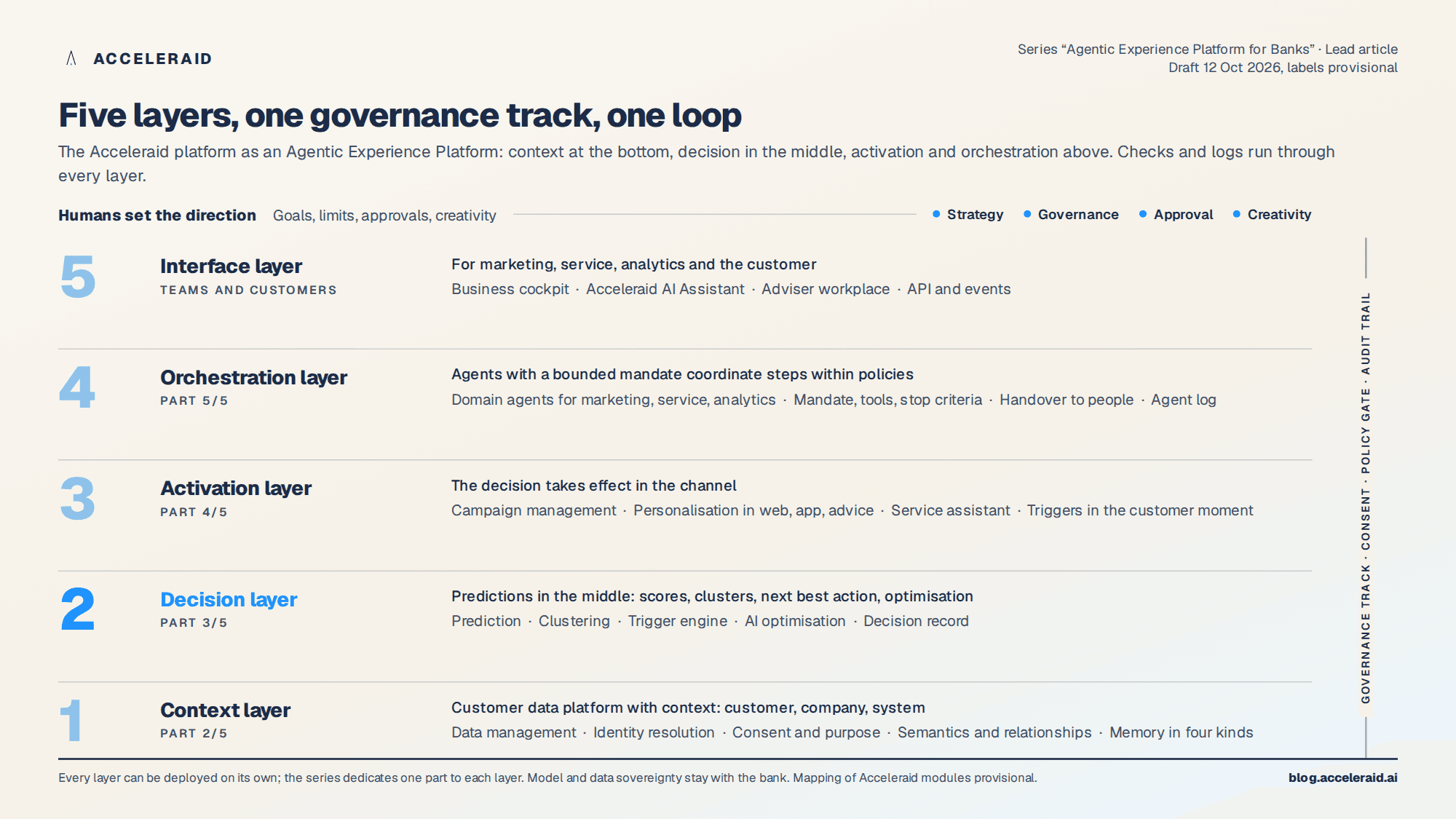
The context layer is the customer data platform with context: data management, identity resolution, consent and purpose, semantics and relationships, and a memory that distinguishes between short-term working state, episodes, facts and rules. The decision layer connects predictions, clusters and triggers with goals and limits, and outputs not just an action but a decision record with a rationale. The activation layer makes the decision take effect in the channel: campaign management, personalisation in the customer moment, the service assistant, the adviser workplace. The orchestration layer coordinates domain agents with a bounded mandate, tools, stop criteria and handover to people. The interface layer, finally, is what teams and customers see: the business cockpit, the Acceleraid AI Assistant, the adviser workplace, APIs and events.
Two things set this model apart from the vendor picture. First, a governance track runs through every layer: consent, policy checks, logging and model monitoring are not a layer of their own but a property of each layer. Second, above everything sits the line that four-layer diagrams leave out: humans set the direction. Strategy, governance, approval and creativity stay with people; agents run the loop within those limits. That is not a reassuring formula. It is the condition under which a bank may deploy agents at all, as we set out in our piece on the kill switch.
The loop has six steps, not five
Treasure AI describes the customer loop in five steps: collect, unify, understand, decide, engage. In a bank, the step that decides whether an action is permissible is missing. We add it: check, between decision and action.
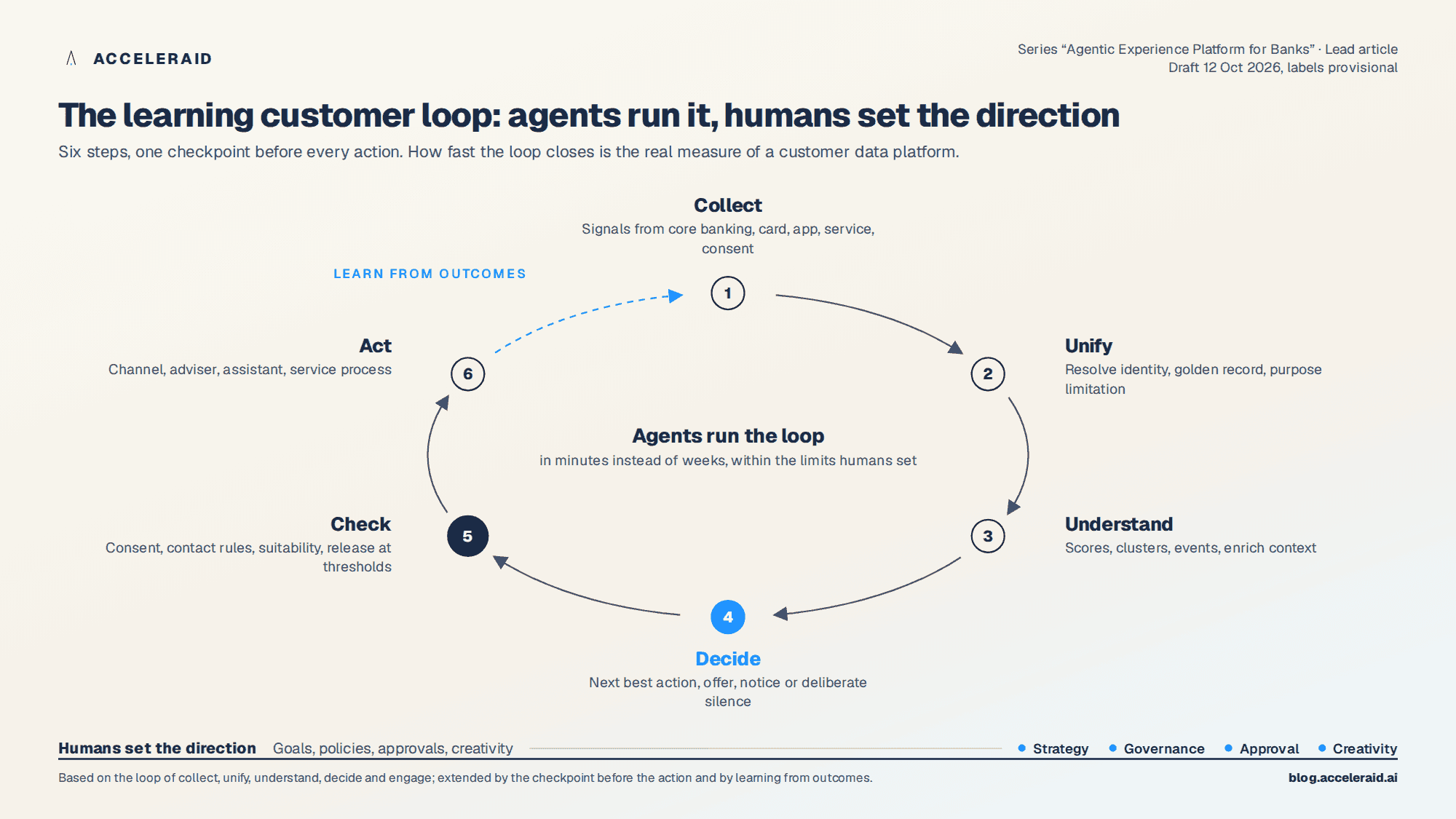
Checking means: is consent in place for this purpose, is the contact budget free, does the product fit the suitability profile, is there a marketing objection, does the decision cross a threshold above which a person has to release it. In most cases this step runs automatically in milliseconds, because the rules exist as data. What matters is that it exists as a step in its own right and is logged. Only then can the loop become fast without speed turning into a compliance risk. Customers themselves draw this line clearly: in the latest Salesforce survey, 72 percent say it is important to know whether they are communicating with an AI agent, and only 17 percent would be comfortable with an agent making financial decisions for them (Salesforce).
The second addition is learning. In the 2025 guide, "run and evaluate" is the last of six implementation steps, in other words a project step (Artefact). In the loop, learning is feedback: response, non-response and objection flow back into collection as signals, and rules and models are adjusted accordingly. An agent that does not close this loop repeats mistakes faster.
Where the 15 use cases sit in the loop
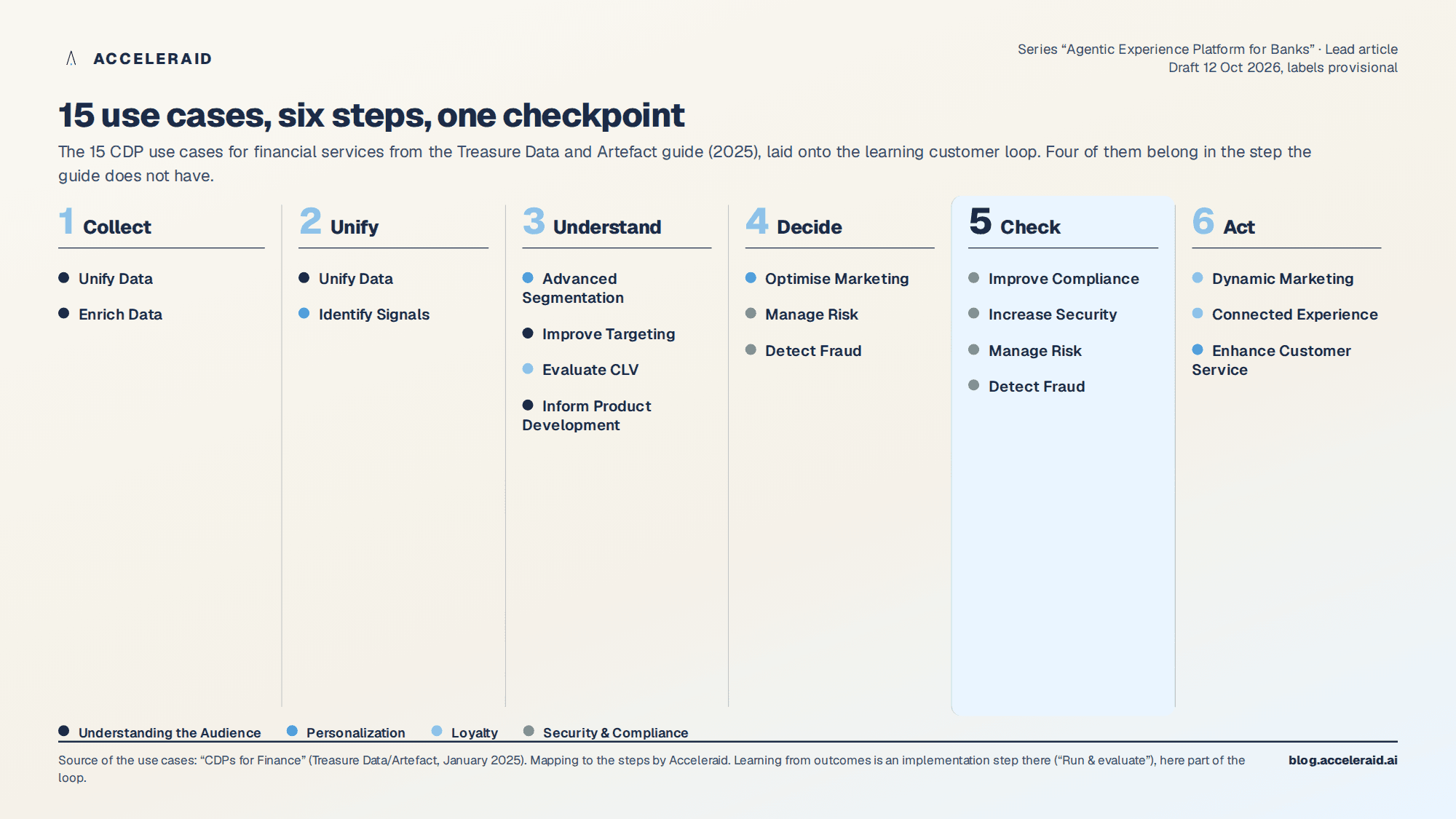
All 15 use cases in the guide can be mapped onto these six steps. The result is telling: four of them, improve compliance, increase security, manage risk and detect fraud, belong wholly or partly in the step the five-step model does not have.
The guide itself supplies the strongest argument against fixating on the tool. Without a corresponding operating model, it says, a customer data platform remains an expensive piece of software (Artefact). For agents the same holds in sharper form. As early as June 2025, Gartner expected more than 40 percent of agentic AI projects to be cancelled by the end of 2027 because of escalating costs, unclear business value or inadequate risk controls (Gartner). All three reasons are operating-model reasons.
What this means for a bank in practice
A hypothetical example makes the difference visible. A customer has received a regular salary credit for 14 months; in October it does not arrive. In a campaign logic nothing happens until the next selection runs in six weeks, and then she may receive a credit offer because her balance has dropped. In the loop, the missing credit is collected as a signal, combined with identity, meaning and permission into a context, the decision engine proposes a notice rather than an offer, the check establishes that customer care is permitted but marketing has been objected to, and the adviser receives the suggestion with its rationale on her workplace. Whether she calls is her decision. What the customer answers flows back.
Nothing in this sequence requires a new core banking system. It requires context to be readable, rules to exist as data and decisions to be logged. That is exactly the order we described in our series on the customer brain; the agentic experience platform is the operating form in which that brain works.
Three prerequisites before agents run the loop
Three prerequisites follow from the example, and each has to be met before any agent goes live. First, rules must exist as data: contact policy, suitability rules, purpose limitation and marketing objections cannot live in work instructions; they have to be machine-readable and versioned, otherwise the check step cannot run automatically. Second, every decision needs a record that contains the trigger, the sources used, the model version, the excluded options and the rationale. For high-risk applications such as creditworthiness assessment, the AI Act already requires deployers to retain automatically generated logs and to ensure human oversight (EU AI Act, Article 26); for every other decision, the same record is what allows business and compliance to examine what the agents are doing at all. Third, the loop needs a way back from the channels: every response, non-response and objection has to reach the context layer as an event, otherwise learning remains a statement of intent.
None of these three prerequisites is an AI topic in the narrow sense. All three are data architecture and operating model. That is the real message behind one vendor's rebrand: whoever wants to spin the loop faster has to build the unglamorous parts first.
The series
Each part covers one layer and stands on its own. We read from the bottom up, because in banks the context has to exist before decision, activation and orchestration can carry weight.
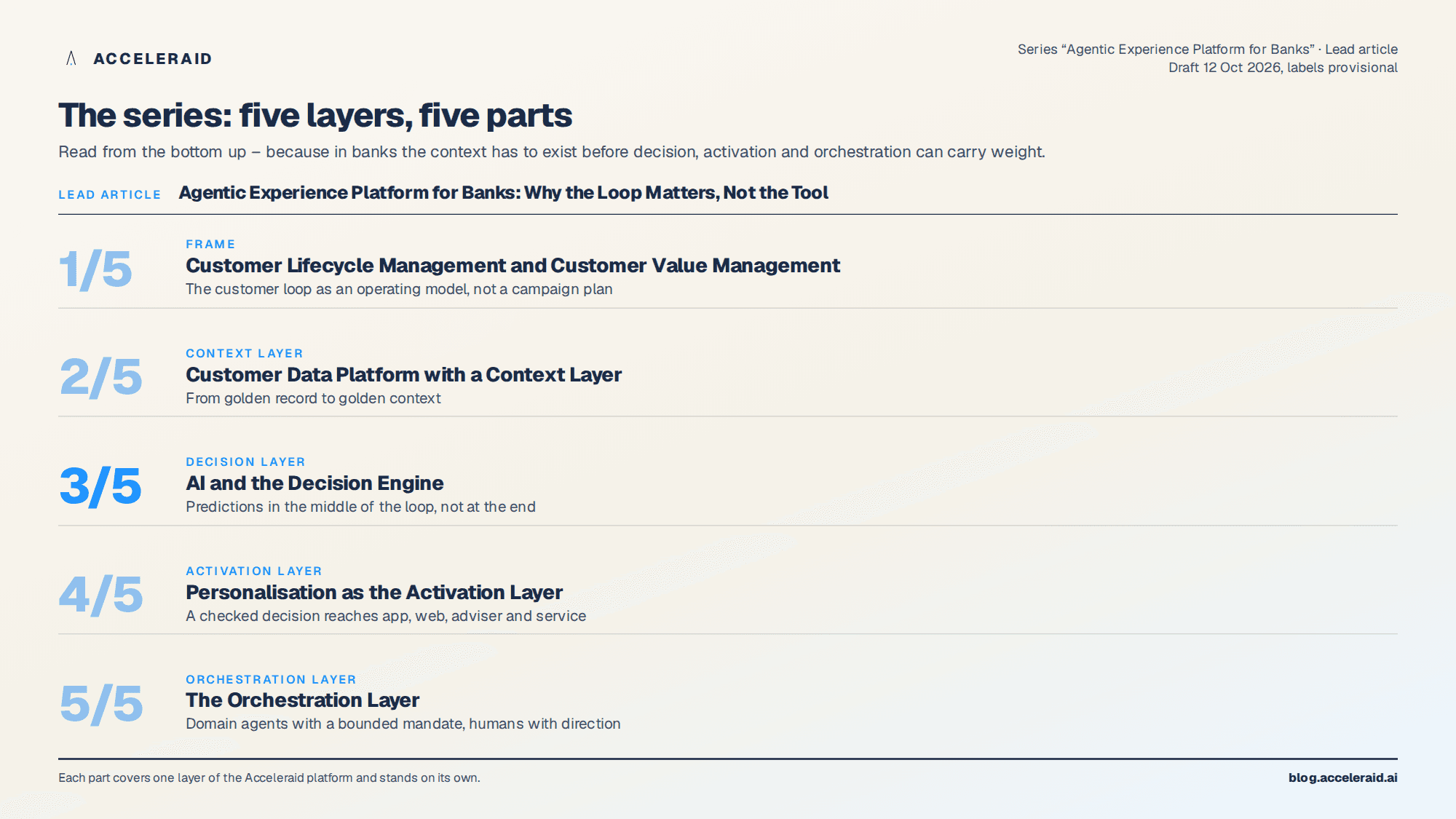
Part 1 sets the frame: customer lifecycle management and customer value management as the operating model that gives agents their rows and cells. Part 2 goes into context: from golden record to golden context. Part 3 covers the decision engine with predictions in the middle. Part 4 shows how personalisation as the activation layer brings a checked decision into app, web, advice and service. Part 5 closes with the orchestration layer: domain agents with a bounded mandate, humans with direction.
Five takeaways
The yardstick for a customer data platform is shifting from the completeness of the customer picture to the time from signal to checked action.
In banks the loop has six steps: between deciding and acting sits checking, as a step in its own right that is logged.
Governance is not a layer but a property of every layer; humans set the direction, agents run the loop within the limits.
The gap between intent and operation is a data and operating-model gap, not a model gap; the Adobe survey, the Gartner forecast and the 2025 guide all point the same way.
Learning is not a project step but feedback inside the loop; without it, an agent merely repeats mistakes faster.
Illustration: AI-generated. AI-assisted content: We use AI technologies and automated agents in the creation of our articles, including from Microsoft, Google, OpenAI, Anthropic and other providers. Topics, editorial direction and final approval remain with our team.
Keep reading
More articles
AI & Banking
Agentic Experience Platform for Banks: Why the Loop Matters, Not the Tool
Treasure AI, golden context, 15 CDP use cases: why in banks the time from signal to checked action matters, not the tool. Opening article of the series.

CLM & CVM
Customer Lifecycle Management and Customer Value Management: The Operating Model for Agents
Part 1/5: CLM supplies the rows, CVM the objective. Why agents without an operating model optimise for clicks, and what belongs in each cell of the matrix.

Data & Technology
Customer Data Platform with a Context Layer: From Golden Record to Golden Context
Part 2/5: Three contexts, five functions, four kinds of memory. What turns a data field into a context object, and what the agent should not see.
