CLM & CVM
Customer Lifecycle Management and Customer Value Management: The Operating Model for Agents
Part 1/5: CLM supplies the rows, CVM the objective. Why agents without an operating model optimise for clicks, and what belongs in each cell of the matrix.
•
acceleraid Editorial Team
•
6 min read

Series Agentic Experience Platform for Banks · Part 1 of 5. The lead article describes the five layers and the six-step customer loop. This part sets the frame within which agents are allowed to work at all.
Whoever introduces an agentic experience platform is not buying a strategy. They are buying the ability to execute an existing strategy faster. If there is none, agents execute whatever is easiest to measure: clicks, opens, conversions this month. The Treasure Data and Artefact guide says so with unusual candour: without a corresponding operating model, a customer data platform remains an expensive piece of software (Artefact). For agents this holds in sharper form, because they do not wait for someone to approve the campaign.
The operating model banks have for this has been called customer lifecycle management and customer value management for years. We sorted out the terms in Many acronyms, one goal. Here the question is what they actually do inside the loop: one supplies the rows, the other decides which cell is worth it.
Customer lifecycle management supplies the rows
Customer lifecycle management assigns every customer to a stage: onboarding, activation, usage, growth, win-back. That sounds schematic, but it is the single most important input for an agent. The same observation means something different in each stage. An idle balance during onboarding is normal, in the usage stage it hints at a second banking relationship, in win-back it is a warning sign. An agent that does not know the stage treats all three cases the same and is wrong twice.
The stage also determines what is permitted. In the first weeks after account opening, product promotion before verification is complete is not just unwise but impermissible; after a complaint, a contact block applies that the agent may not negotiate away. These rules live in the rows of the operating model, not in the agents' prompts.
Customer value management decides which cell is worth it
Customer value management answers the second question: which measure, in this stage, for this customer, is worth the effort, measured by expected customer value over time and not by this quarter's conversion. The perspective is grounded in numbers. In its banking trends for 2026, Capgemini cites a Salesforce survey in which 38 percent of customers switched institutions because of dissatisfaction with service, and its own data showing that 73 percent of card customers are motivated by personalised offers and rewards (Capgemini). Both argue for measures at the right moment, not for more measures.
For agents, customer value management translates into an objective function with constraints: maximise expected customer value while respecting contact budget, suitability and purpose limitation. If that objective is missing, the agent sets its own, and it is almost always response rate. That is the mechanism behind Gartner's forecast that more than 40 percent of agentic AI projects will be cancelled by the end of 2027 because of unclear business value or inadequate risk controls (Gartner).
A usable objective function has three properties. It calculates over a horizon that fits the customer relationship, in banking years rather than quarters. It scores a wrong contact negatively, because a complaint or a closed account costs more than an additional sale brings in. And it allows deliberate silence as an outcome: in many cells of the matrix, the value-maximising measure is to do nothing. An agent whose objective lacks this third property will always do something, because acting is measurable and refraining is not.
The matrix the business fills in
Lay the lifecycle stages against the steps of the loop and you get a matrix. Every cell is a rule the business sets before an agent executes it. The examples are hypothetical; the structure is not.
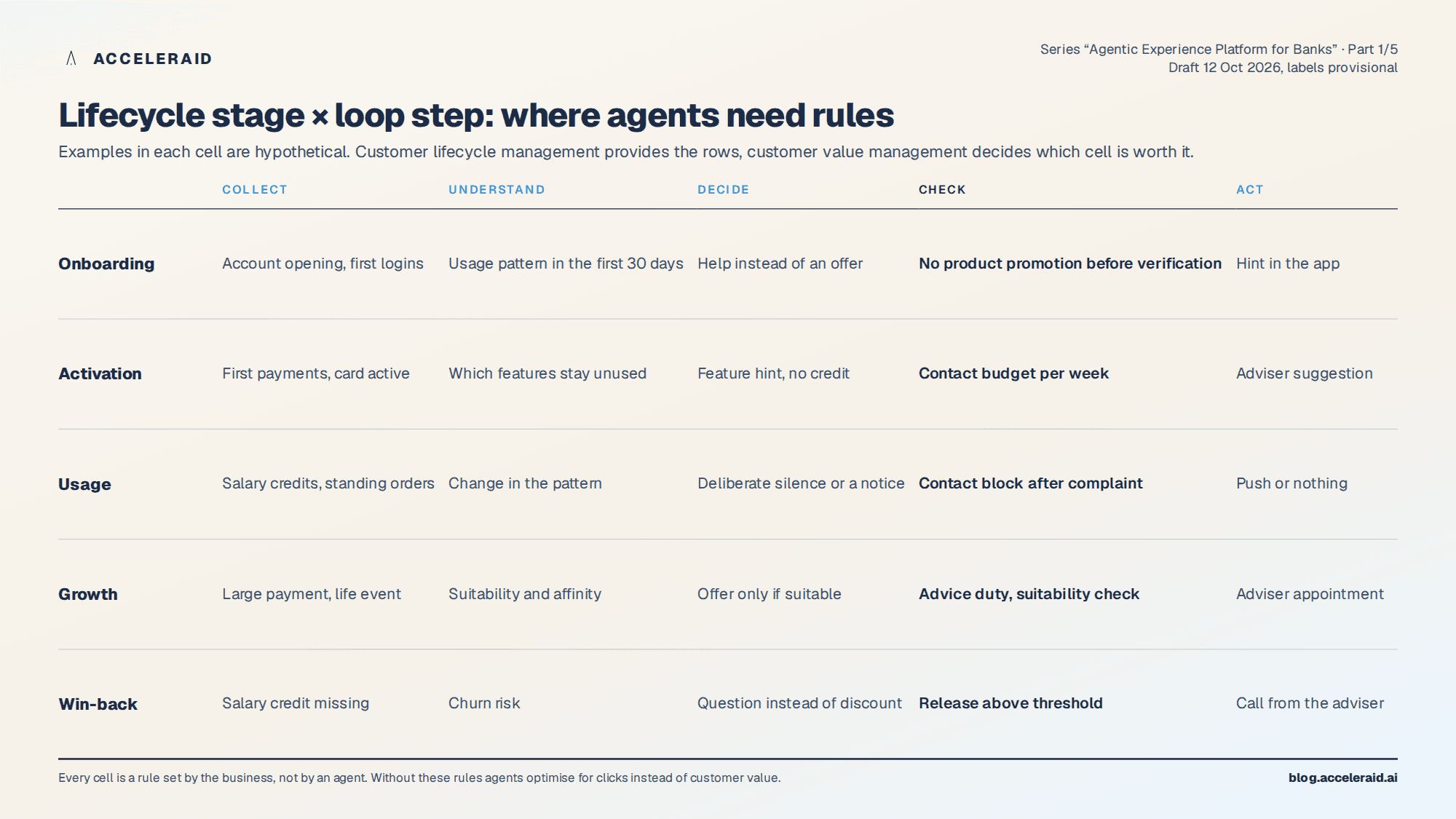
The check column is the one missing from vendor diagrams and the one that decides permissibility in banks. In the onboarding row it reads: no product promotion before verification. In the usage row: contact block after a complaint. In the growth row: advice duty and suitability check before any offer. In the win-back row: release by a person above a defined threshold. None of these rules is new. What is new is that they have to be machine-readable, so that an agent can apply them in milliseconds and an auditor can later verify that it did.
A hypothetical example from the usage row: a customer's payment pattern changes, standing orders are cancelled, the salary credit continues. Understanding here means recognising the change; deciding means choosing between deliberate silence and a notice; checking means respecting the week's contact budget and a possible marketing objection; acting means either doing nothing or showing a short notice in the app. The agent may prepare all four steps. Which cell gets which answer, the business decided beforehand.
From campaign plan to operating model
The real change is not in the technology but in the cadence. A campaign plan asks: which segment gets which offer in November? An operating model asks: what happens when this signal occurs for any customer? The first question is answered once a quarter, the second once and then continuously for every individual case. Capgemini expects 75 percent of banks to deploy AI agents in customer service within the next two to three years (Capgemini). Which of those banks benefit will be decided by whether the second question was answered first.
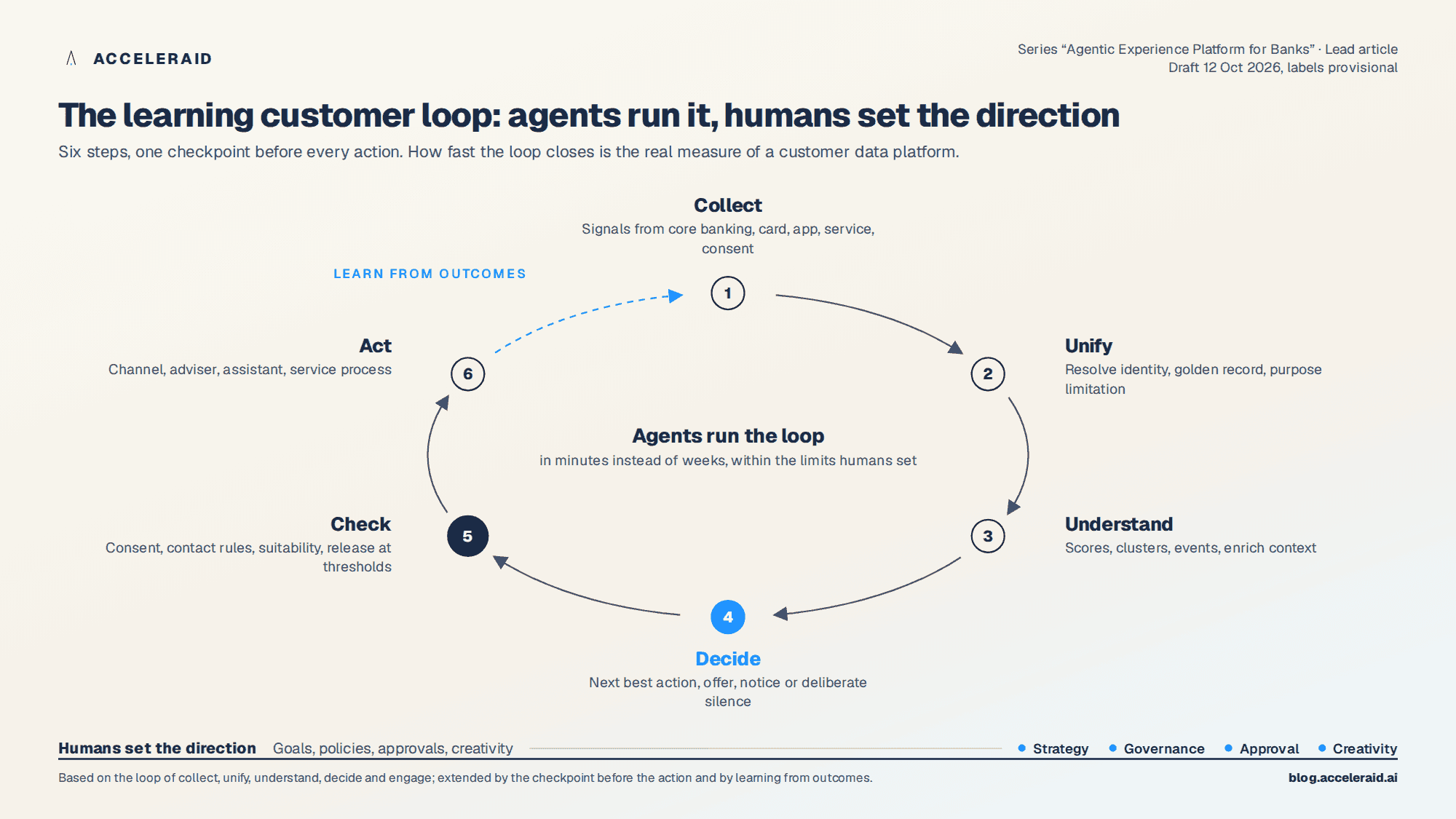
Three things therefore belong in every implementation before the first agent. First, the matrix: lifecycle stages, loop steps, rules per cell, versioned and with named owners. Second, the objective function: what is customer value in this bank, over which horizon, with which constraints? Third, measurement: every measure is offered to part of the target group and withheld from a comparable part, so that the incremental effect becomes visible and the loop can learn. We described this principle in detail in our CLM framework for banks.
What follows in the next part
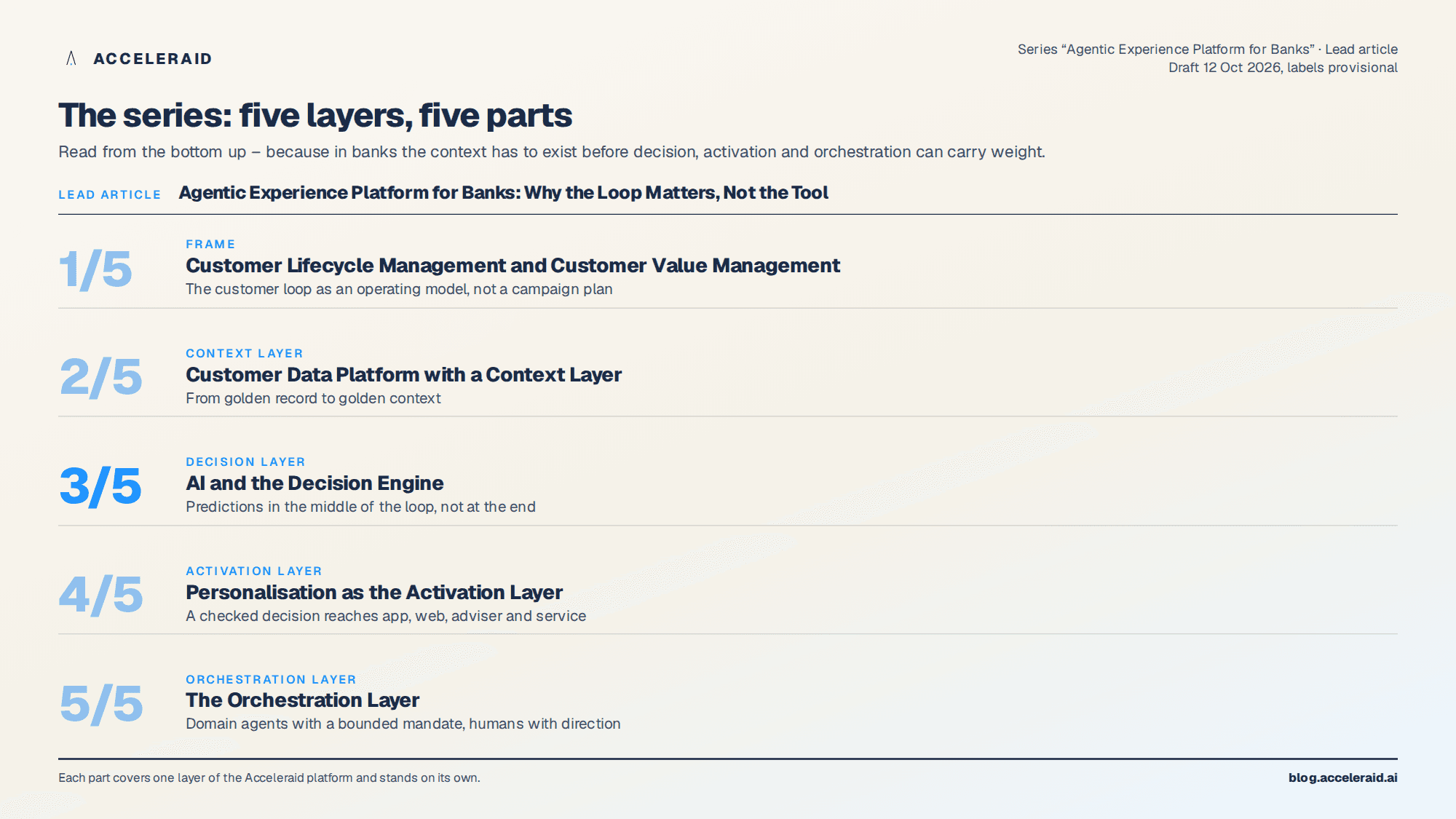
The matrix is only as good as the context with which the agent finds the cell. Which stage applies, which signal is present, which permission exists, all of that has to be readable at the moment of decision. Part 2 therefore covers the customer data platform with a context layer: from golden record to golden context.
Five takeaways
An agentic experience platform executes a strategy faster; it does not replace one. Without an operating model, agents optimise for whatever is easiest to measure.
Customer lifecycle management supplies the rows: the same observation means something different in each stage, and each stage carries its own permissions.
Customer value management supplies the objective function: expected customer value over time under constraints, not response rate this month.
The matrix of lifecycle stage and loop step is the business's rulebook; the check column decides permissibility and has to be machine-readable.
Moving from campaign plan to operating model is a change of cadence: from a quarterly selection to a rule for every individual case.
Illustration: AI-generated. AI-assisted content: We use AI technologies and automated agents in the creation of our articles, including from Microsoft, Google, OpenAI, Anthropic and other providers. Topics, editorial direction and final approval remain with our team.
Keep reading
More articles

AI & Banking
Agentic Experience Platform for Banks: Why the Loop Matters, Not the Tool
Treasure AI, golden context, 15 CDP use cases: why in banks the time from signal to checked action matters, not the tool. Opening article of the series.

CLM & CVM
Customer Lifecycle Management and Customer Value Management: The Operating Model for Agents
Part 1/5: CLM supplies the rows, CVM the objective. Why agents without an operating model optimise for clicks, and what belongs in each cell of the matrix.

Data & Technology
Customer Data Platform with a Context Layer: From Golden Record to Golden Context
Part 2/5: Three contexts, five functions, four kinds of memory. What turns a data field into a context object, and what the agent should not see.
