For banks, card issuers and finance apps
Not a helpdesk bot. A virtual advisor
that knows your customer.
A virtual advisor in the banking app is an AI assistant that works on the individual customer's data: transactions, limits, due dates, benefits, consents. It explains what the numbers mean, suggests the next step and acts within the bank's rules. A helpdesk bot knows your FAQ; the advisor knows your customer.
✓
Answers from customer data, not just help articles
✓
Acts within your rules and hands over to people
✓
PII filter before every model call, hosted in Frankfurt


Ask your advisor
Example
Question
Can I afford the Lisbon trip before my next statement?
Card account · logged in
Answer
Yes. After the €842 due on October 20, you have €2,140 left in this cycle. Shall I set up a travel budget?
Based on your account data · logged
○
Illustrative concept
Your rules
Personal Finance Management
Next Best Action
Top of Wallet
Transaction data
EUDI Wallet
Virtual advisor
Customer Data Platform
Hosted in Frankfurt
Consent first
28%
of banking and credit card app customers use the virtual assistant at all
+18 points
higher satisfaction among assistant users (736 of 1,000), but satisfaction collapses for complaints and fraud
48%
of customers receive timely alerts related to their transactions
Comparison
Chatbot for the bank or AI advisor in the banking app?
The reframing that changes most in conversations with banks: both systems understand language. Only one understands the customer, because it runs on their data.
Data basis
Help articles, product pages, forms
Plus transactions, limits, statements, benefits, consents from the CDP
Typical question
“How do I change my PIN?”
“How much can I still spend this month?”
Stance
Reactive, avoid the ticket
Proactive, raises due date, trip, subscription, overspending
Actions
Link to a form
Set reminder, activate travel mode, show subscriptions, prepare appointment, within your rules
Handover
Hotline number
Handover to staff with conversation history and context, immediately for fraud and complaints
Governance
Hardly needed
PII filter, permission check per action, audit-proof logging, human decides when there is risk
Place
Support widget
In the app next to the money, plus web, WhatsApp, Teams
Metric
Ticket deflection
Resolved requests, engagement, payment behavior, products per customer
The advisor answers service questions too, with the account in view. Service is included; advice is the difference.
Use cases
Six advisor use cases to start with.
Each use case starts with a question customers ask anyway and ends with an action you permit.
Due date and statement
“What is due on the 20th, and is my balance enough?” The advisor does the math, reminds in time and shows what is left in the cycle.
KPI: on-time payments
Travel
Flight detected on the card. Fees, insurance cover, card use abroad, activate travel mode. Before the trip, not at the gate.
KPI: cross-border spend
Subscriptions
“What do I pay monthly for subscriptions?” List, price changes, ending trials, help to cancel.
KPI: retention
Lost card
“I can't find my card.” The advisor blocks the card according to your rules, triggers the replacement and hands over to staff immediately if fraud is suspected.
KPI: time to block
Savings
“How much can I put aside this month?” Forecast from income, fixed costs and due dates, with a suggestion for the right own product.
KPI: products per customer
Product question
“Is the gold card worth it for me?” An answer based on actual spending behavior, not the product brochure.
KPI: conversion
Data context
Why the advisor knows the customer: CDP and context layer.
The language model is interchangeable. The difference is created before it: in the Customer Data Platform and in the context layer that keeps identity, intent, permission and memory together per customer.
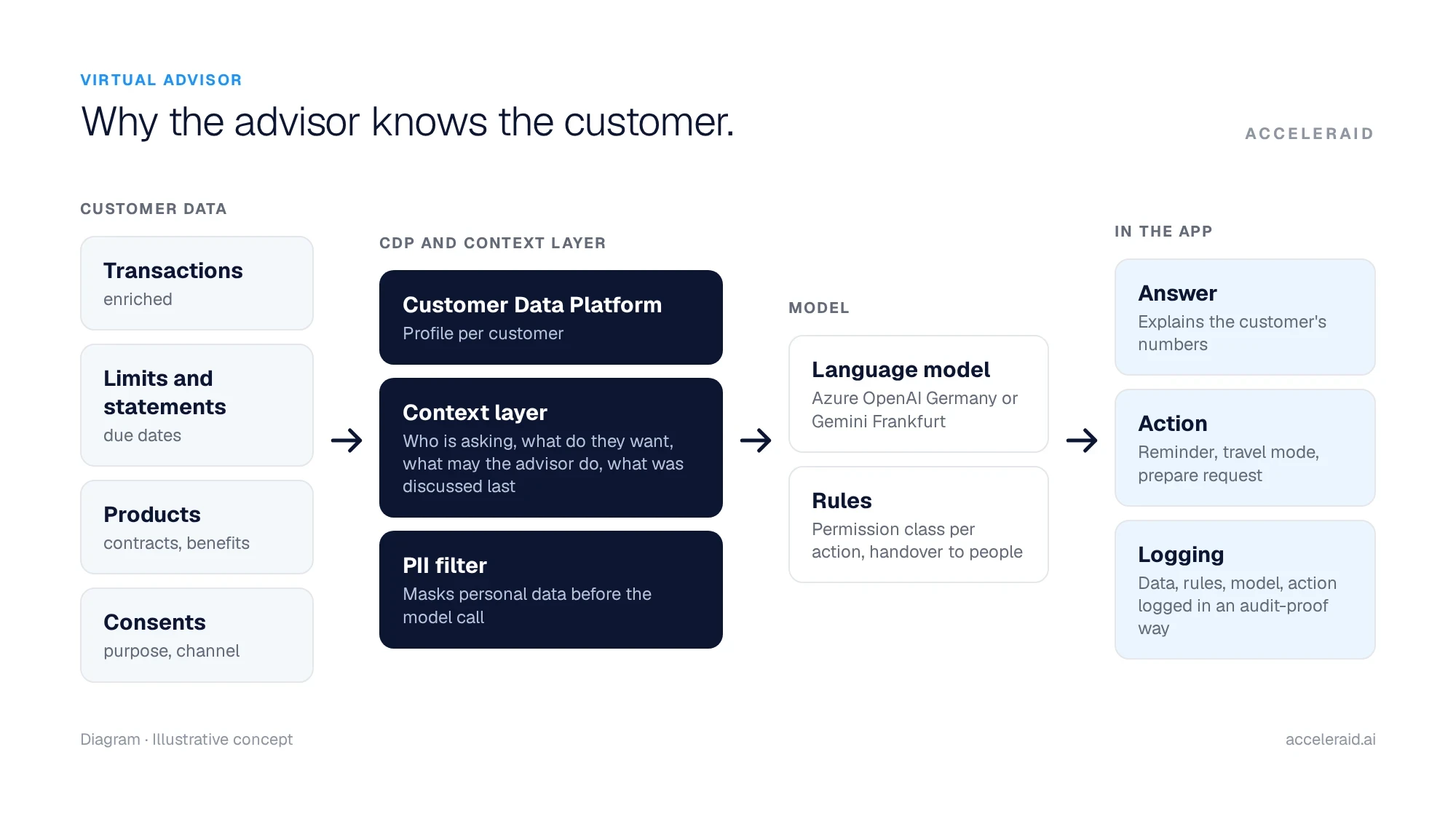
From customer data to answer: CDP, context layer, PII filter, model, rules, action.
Customer Data Platform
enriched transactions, limits, statements, products, service contacts, consents
Context layer
who is asking, what do they want, what may the advisor do, what was discussed last
PII filter and model
personal data is masked before the model sees the request; model choice Azure OpenAI Germany or Gemini Frankfurt, others on request
Governance
People decide. The advisor documents.
An advisor that is allowed to act needs limits that are visible. Four principles we define with every bank.
Permissions per action · Permitted, explained, excluded
Every action is assigned to a class: the advisor may execute (reminder), may prepare (appointment request), may only explain (terms and contracts). Your business team maintains the list.
Handover · Fraud and complaints go to people immediately
That is exactly where, according to J.D. Power (2026), satisfaction with assistants collapses. The advisor recognizes these requests and hands over with history and context instead of answering in loops.
Logging · Every answer traceable
Which data, which rules, which model, which action: every dialog step is logged in an audit-proof way. This keeps every answer traceable for customers, data protection and supervisors.
Limits · No investment advice without approval
The advisor answers product questions based on behavior and product rules. Anything that would be advice in the regulatory sense is flagged and handed over to qualified staff.
Integration
One advisor, four channels, one logic.
The advisor lives where customers already are. Advisory logic, rules and logs are the same across channels.
App
In the banking app
SDK or API
component in your app, your design
Proactive cards
due date, trip, subscription as a hint before the question
Login context
authenticated customer, full data basis
Web
Online banking and website
Logged in
same scope as in the app
Not logged in
product and service questions without customer data
Handover
into the logged-in area or to staff
Messaging
Verified number
matched to the customer after your approval
Scope
alerts and service questions, actions by permission class
Log
as in the app
Teams
For your employees
Service copilot
the same customer context for advisors and service
Knowledge base
products, processes, regulation
Handover
customer dialog lands with the employee, history included
What is the difference between a chatbot and a virtual advisor?
Which data does the advisor need?
How is GDPR upheld when a language model is involved?
What may the advisor do on its own?
How does handover to staff work?
How is the advisor measured?
How long does implementation take?
Read on