For banks, card issuers and finance apps
Personal Finance Management for banks,
with AI in your app.
Personal Finance Management (PFM) for banks means the banking or card app explains customers' money and suggests the next sensible step. ACCELERAID connects CRM and transaction data to a Customer Data Platform and AI-powered Customer Lifecycle Management. The result: insights, nudges and a virtual advisor inside your existing app.
✓
Runs inside your existing app, no rip-and-replace
✓
Insights, nudges and advice from the same data
✓
Hosted in Frankfurt, PII filter, SOC 2 Type I certified


Your advisor
Example
Customer question
“Can I afford the trip before my next statement?”
Flight to Lisbon booked with the card.
Answer in the app
Yes. After the €842 due Oct 20, you have €2,140 left.
No foreign currency fee when you pay abroad with your card.
○
Illustrative concept
Your rules
Personal Finance Management
Next Best Action
Top of Wallet
Transaction data
EUDI Wallet
Virtual advisor
Customer Data Platform
Hosted in Frankfurt
Consent first
46%
want a financial health score, 45% want insights from spending patterns
Starting point
Personal Finance Management for banks starts where the app is open.
Customers open their card app several times a week and see a list of transactions. Everything the bank knows about those transactions stays unused. Three reasons why that never turns into engagement:
01 · Data without meaning
Transactions, limits, due dates and subscriptions are all there. Nobody translates them into “What changed, what does it mean, what should I do?”
02 · Campaigns instead of moments
Offers run by segment and calendar. The right moment – a booking, a payday, a border crossing – is missed. According to Personetics (2026), a new personalized offer takes 13 weeks on average.
03 · Bots without customer context
Helpdesk bots answer questions about the bank. The customer's question, however, is “What does this mean for me?” That needs their data.
How it works
PFM in the banking app: your data, our CLM, your app.
We connect CRM and transaction data to the ACCELERAID Customer Data Platform, a context layer and the CLM engine. Delivery happens where the customer is: app, push, email and the in-app advisor.

Data flow from core systems into the app. Signals from the app flow back into the models.
Your data
CRM and customer master data, card transactions, limits, statements, app and service events.
ACCELERAID CDP + CLM
One consented profile, context layer (identity, intent, permission, memory), journeys and Next Best Action.
In your app
Insights and trackers, nudges, offers at the right moment, virtual advisor.
Use cases
PFM use cases built for cards and accounts.
Not a budgeting app bolted on. Features that use what a card issuer already knows, each measured by one KPI.
Spending insights
Categories, merchants, trends. “What changed, what does it mean, what should I do?” instead of a transaction list.
KPI: app sessions per month
Due-date forecast
What is due when, and how to stay interest-free or split wisely. Predictable instead of surprising.
KPI: on-time payments
Subscription tracker
Recurring charges, price increases, ending trials, with help to cancel.
KPI: retention
Travel mode
Fees, insurance cover and tips, triggered by the flight booking on the card.
KPI: cross-border spend
Installment and upgrade offers
Spot the right moment for an installment offer or card upgrade and address it. The bank decides on limit and installment.
KPI: acceptance rate
Savings nudges
Surplus detected or a large purchase ahead? Suggest the right own product: savings, deposit, upgrade.
KPI: products per customer
Comparison
Helpdesk bot or virtual advisor?
Both answer questions. Only one knows the customer. The difference is not the language model but the data behind it.
Knowledge base
FAQ and help articles
FAQ plus transactions, limits, statements, benefits, consents
Typical question
“How do I block my card?”
“Can I afford the trip before my next statement?”
Stance
Reactive, waits for a ticket
Proactive, flags due dates, trips, subscriptions, overspending
Actions
Links to forms
Reminders, travel mode, pointers to suitable offers, within your rules
Place
Support widget
In the middle of the app, next to the money
Metric
Ticket deflection
Engagement, payment behavior, products per customer
CLM loop
From signal to action and back.
PFM is not a dashboard but a loop: activate, deepen, grow, retain. Every customer reaction is a new signal for the next decision.
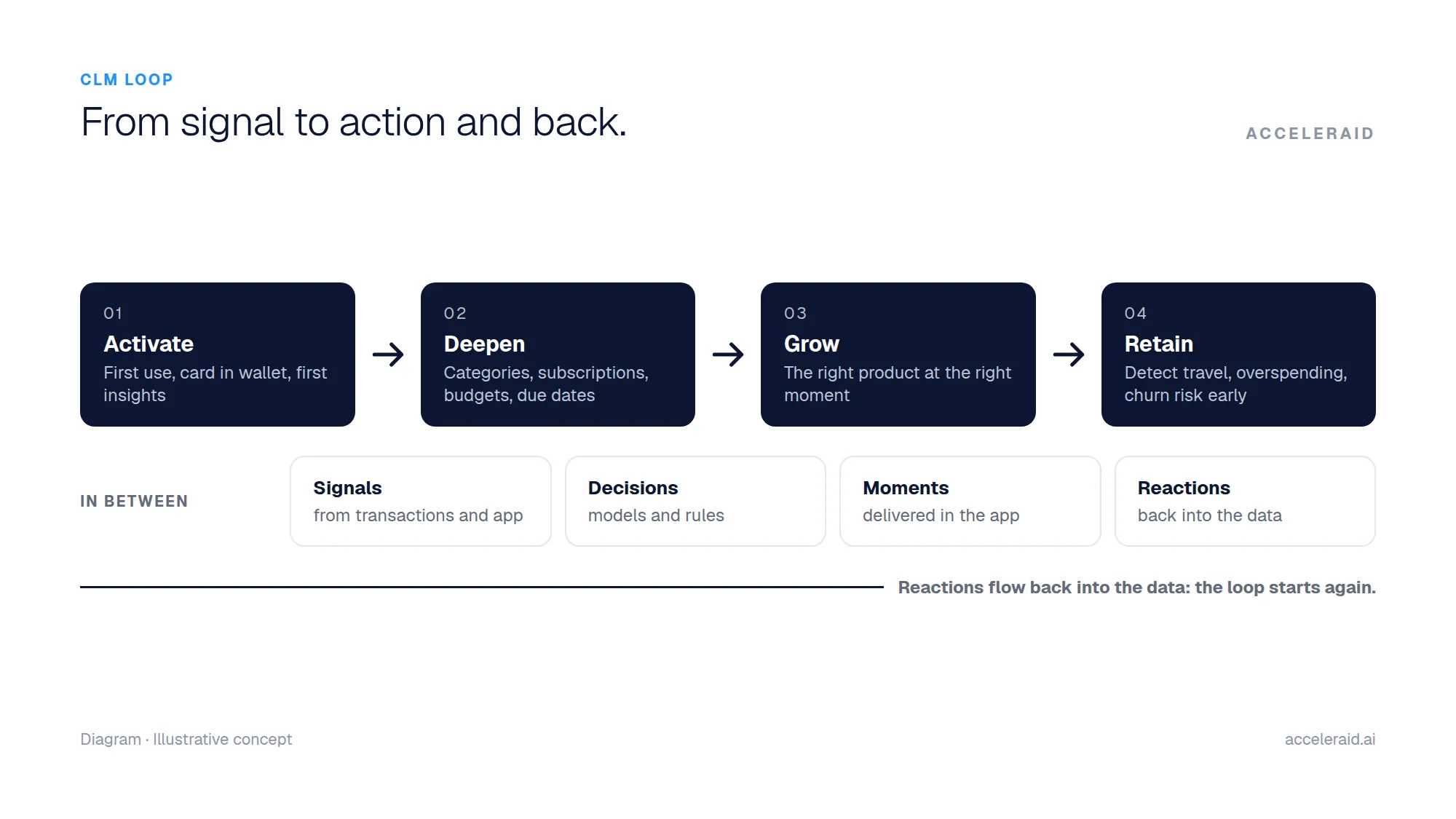
The CLM loop: signals flow back into models and rules.

A moment from the card
Example
Flight to Lisbon paid with the card.
One message, one tap: Portugal eSIM, reminder of travel cover, hotel offer with travel credit.
Trigger, mix and timing are unique to this customer. Partners and offers are defined with you.
✓
Illustrative example
Beyond banking
With the customer's consent, verified attributes from the wallet join card data in the Customer Data Platform. Next Best Product moves from segment to individual.
Wallet → verified profile
More data. Already verified.
Identity and address
state-signed, no document upload
Age, residence, household
eligibility and relevance in one step
Income and account ownership
attested proofs instead of paperwork
Next Best Product
One person. One fitting offer.
Signal
a booking, a border crossing, a payday
Profile
card data, wallet attributes, consent
Decision and moment
value, eligibility, timing, your rules
Around the card
Products customers thank you for.
eSIM for the trip
triggered by the flight on the card
Loyalty and miles
partner programs, status tiers
Insurance and own products
device, travel upgrade, installments, deposits
EUDI Wallet
Banks must accept it from December 2027.
Under Regulation (EU) 2024/1183 (eIDAS 2.0), every member state must offer an EUDI Wallet by December 24, 2026; by December 24, 2027 banks and payment institutions must accept it at the customer's request. According to eudi-wallet.gov.de, the German wallet launches in early 2027. Orientation only, not legal advice.
What is Personal Finance Management for banks?
Do we need a new app for this?
Which data does PFM require?
How is the virtual advisor different from a chatbot?
Where does the data run, and what about GDPR?
How quickly are first results visible?
What does PFM with ACCELERAID cost?
Read on