CLM & CVM
The Banking App as a Financial Hub: Personal Finance Management, CLM, Service and a Virtual Advisor from One Data Loop
How CRM and transaction data, CLM, customer service and a virtual advisor come together in the banking app – with 16 use cases by category.
•
acceleraid Editorial Team
•
10 min read

On a Sunday evening a customer opens her banking app to check whether the card statement due on the 20th still fits her budget. The app shows her balance, recent transactions and a due-date note. What she does not see: that three subscriptions renew the same week, that the merchant with the cryptic descriptor is her dentist, that the bank could long since have offered instalments on the furniture purchase, and that the chatbot cannot answer "Will the money last until the statement?" because it does not know her account. The scene is invented; the condition is routine. The app is the bank's most used channel, yet it knows less about this customer than CRM, transaction system, service centre and marketing do between them.
The app is where the bank happens
The channel data leave little room for debate. In the American Bankers Association survey with Morning Consult, 54% of US bank customers name the mobile app as their primary account channel, twice the share of 2017, and for the first time it leads among Baby Boomers too, at 38% (ABA/Morning Consult via Axis Intelligence). According to MX Technologies data, 53% of customers log into their primary financial app every day and 22% several times a day (MX via Neontri). And the apps work: J.D. Power scores national bank apps at 723 and credit card apps at 713 out of 1,000 points in 2026, crediting the core experience of login, design and navigation (J.D. Power).
That is where the problem sits. The app is an excellent window onto the account but rarely a place where the bank knows the customer. According to MX, 61% of consumers expect their provider to know them and understand their needs; yet 34% often receive irrelevant messages, and 31% see outdated or irrelevant information in their provider's insights (MX Research). In the global Celent study for Temenos, 58% want more financial guidance and 51% say their bank should anticipate their needs when they open the app; only 4% of banks make personalisation their top investment priority (Temenos/Celent).
Four silos describing the same customer
The gap has a structural cause. Four systems know the same customer, each from one angle:
The CRM and customer master know who she is: products, limits, consents, segment.
The transaction data know what she does: merchants, categories, foreign currency, rhythm, subscriptions, salary credits.
Customer service knows where things go wrong: tickets, blocks, complaints, disputes.
Marketing knows what the bank last told her, usually the same thing too often.
While these four sources stay apart, the app can display but not advise. Personal finance management remains a pie chart of spending, the chatbot a search box for the FAQ, the campaign a calendar. In a survey of more than 900 banking executives, only 48% of customers receive timely guidance tied to their transactions, and only 42% of digital communications are triggered by a real event (Personetics 2026 Global Banker Survey).
One data loop instead of four systems
The answer is not another front end but a shared data loop behind the app. It has three stages.
First, unification. A customer data platform joins customer master, card transactions, limits and statements, and app and service events into one profile updated in real time. The decisive element is a context layer that answers four things at once: who the customer is (identity), what she wants right now (intent), what the bank may do with her data (permission) and what happened last (memory).
Second, the decision. Customer lifecycle journeys and a next-best-action logic decide whether and what the bank says in this moment. The rules belong to the bank: eligibility, contact budget, suppression after complaints or payment stress.
Third, delivery. The same decision appears as an insight or tracker in the app, a push nudge, an offer at the right moment or an answer from the virtual advisor. The channel changes; the logic does not.
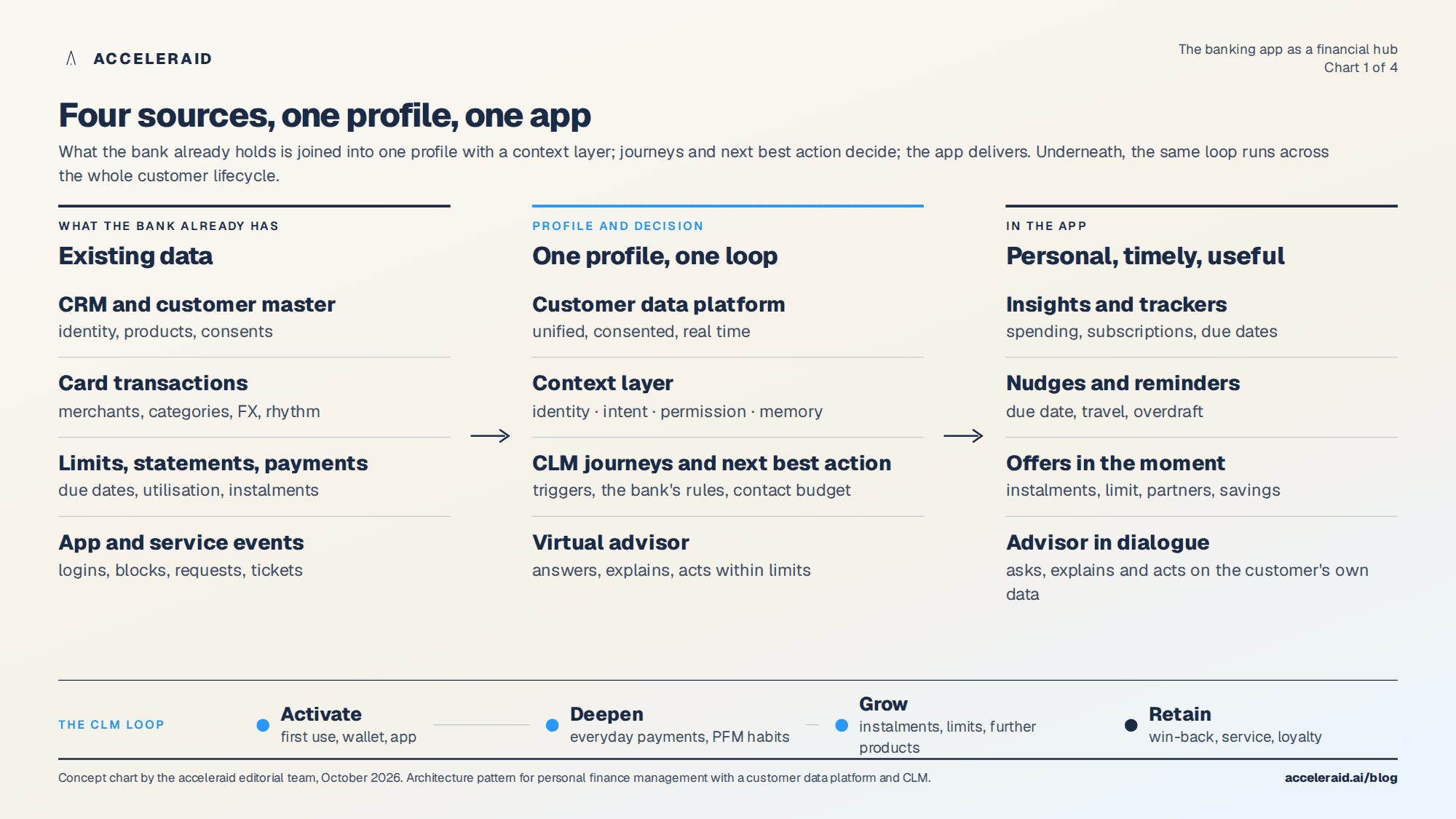
This loop carries the entire lifecycle: activate (first use, wallet), deepen (everyday payments, PFM habits), grow (instalments, limits, further products) and retain (win-back, service, loyalty). Each phase needs different content on the same data foundation.
The top use cases by category
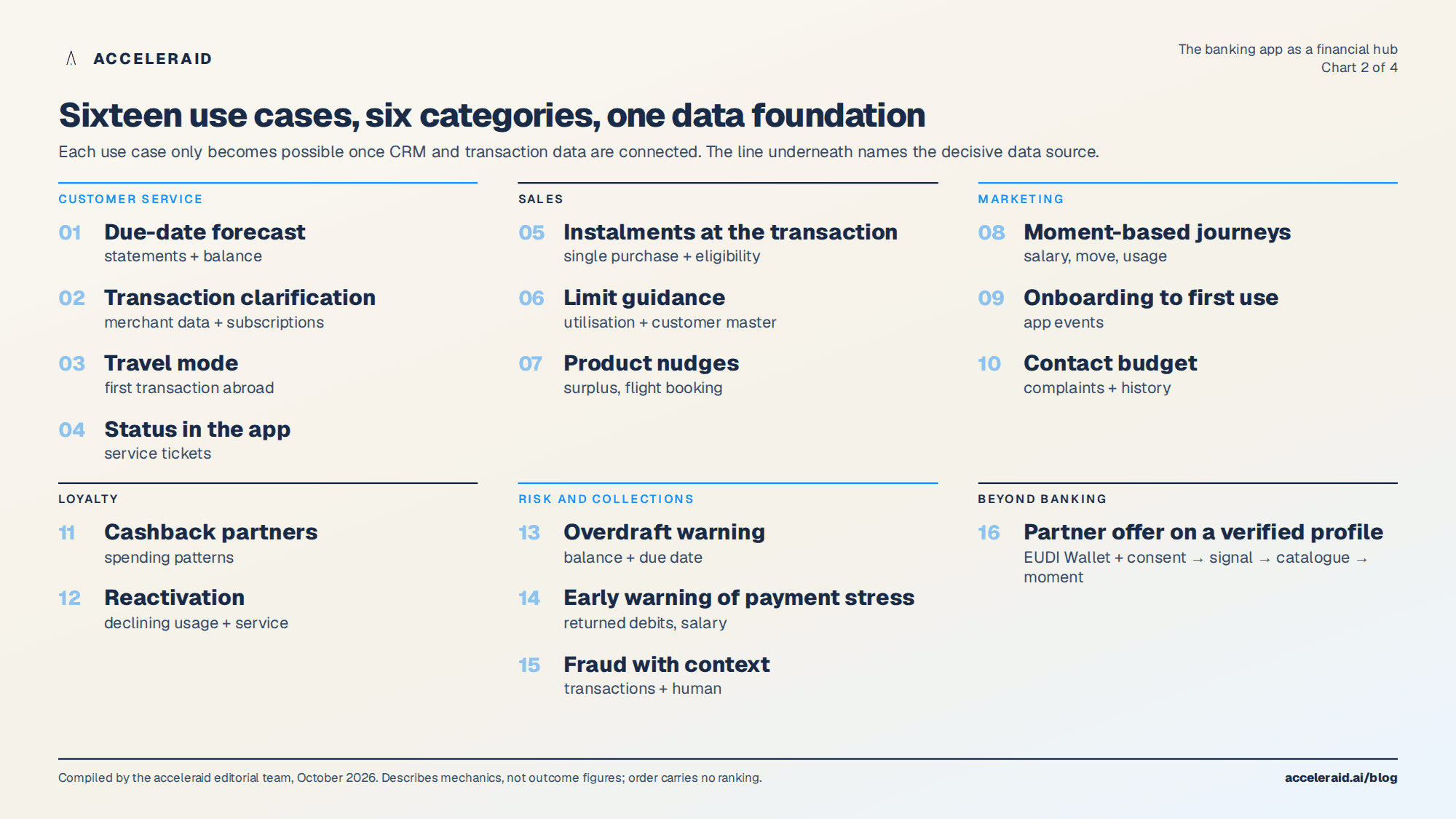
Connecting CRM and transaction data lets every discipline in the bank do something new. The list below groups the use cases we consider most effective by category; it describes mechanics, not outcome figures, which depend on portfolio, consents and execution.
Customer service
Due-date forecast: "What will be debited on the 20th, and does the balance cover it?" answered before it is asked.
Transaction clarification: unfamiliar descriptors mapped to merchants, places and subscriptions, so many queries and chargebacks never arise.
Travel mode: first use abroad detected, card stays active, foreign currency fees and partners explained.
Status in the app: dispute, limit change or replacement card with live progress, no call needed.
Sales
Instalments at the transaction: large purchases converted into instalments in the app where eligibility and permission exist.
Limit guidance at high utilisation instead of a silent decline at checkout.
Product nudges from behaviour: a savings plan on a recurring surplus, travel insurance after a flight booking, a second card on household patterns.
Marketing
Moment-based journeys instead of calendar campaigns: salary credit, a move, a first foreign transaction or declining usage trigger the message, not the monthly plan.
Onboarding through to first active use: wallet set up, first payment, first insight seen.
Contact budget and suppression: one message a week, no offers after a complaint.
Loyalty
Suggest cashback partners from spending patterns and show progress towards bonus thresholds.
Reactivation when usage declines, with service rather than discounts; anniversaries and status changes as occasions.
Risk and collections
Overdraft and due-date warnings with an option to act instead of a fee.
Early warning of payment stress: returned debits and a missing salary credit lead to an instalment plan offer, not a dunning letter.
Explain suspected fraud with context and keep the route to a human open.
Beyond banking
A verified profile via the EU Digital Identity Wallet as the basis for partner offers such as eSIM, hotel, flight or insurance at the moment of need.
Demand for this list is documented. In the US edition of the Celent study, 86% of consumers use or would welcome proactive messaging about products that match their needs, 69% personalised financial management advice and 67% conversational interfaces (Celent, US Consumer Edition 2026). In a global survey of 2,000 consumers, alerts for unusual expenses such as double billing, spending insights, overdraft warnings and help with savings goals top the wish list (Personetics consumer survey).
Not a helpdesk bot, a virtual advisor
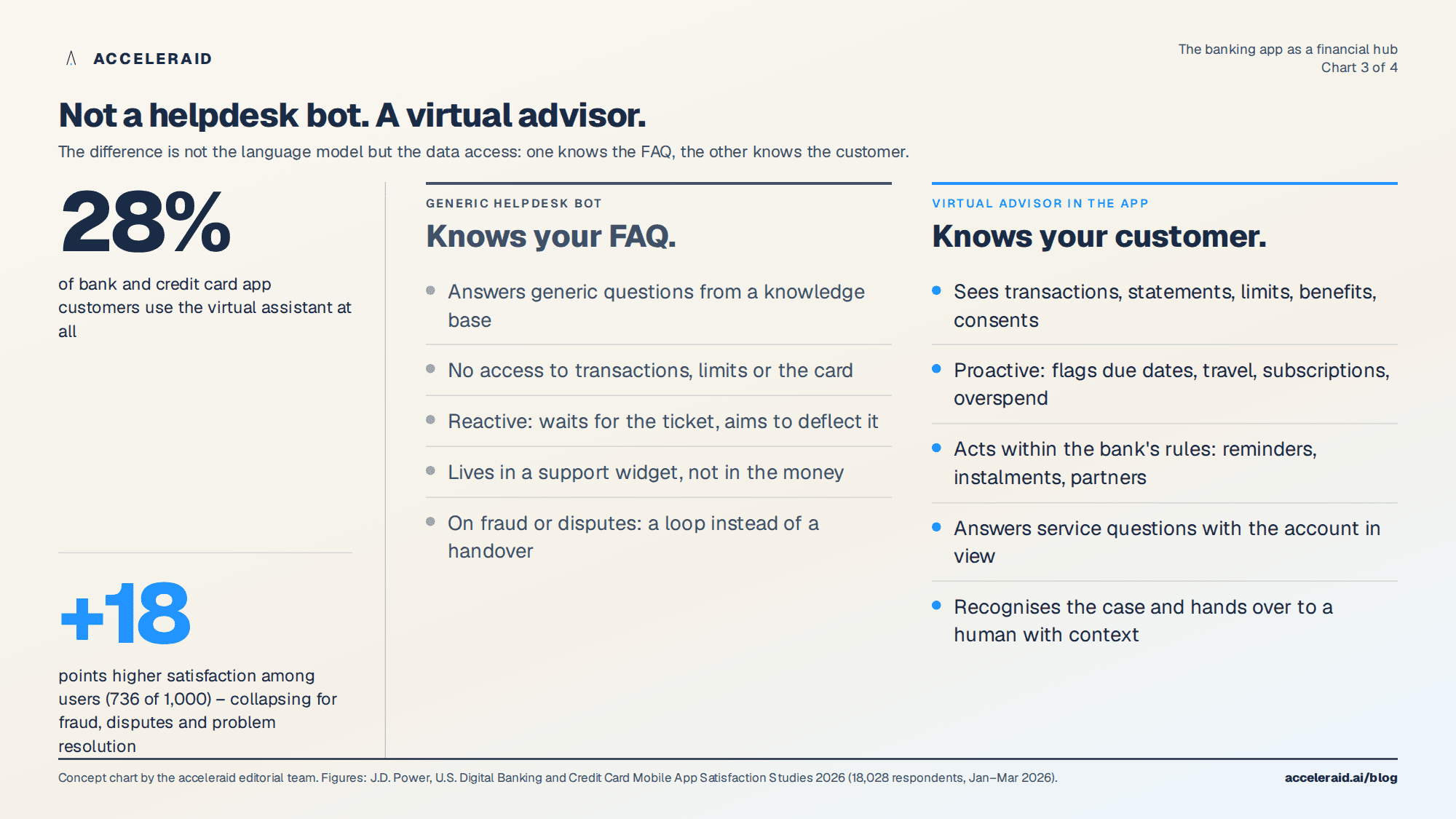
The most visible component is the in-app assistant, and here the industry is furthest from its ambition. J.D. Power finds in 2026 that only 28% of bank and credit card app customers use the virtual assistant at all. Those who do are 18 points more satisfied than non-users, at 736, but satisfaction drops sharply for problem resolution, disputes or fraud; limited escalation options leave customers in "frustrating self-service loops" (J.D. Power).
The reason is not the models' language ability but their access to data. A helpdesk bot answers questions about the bank: opening hours, fees, forms. It knows the FAQ, not the account. A virtual advisor answers questions about the customer, because it runs on the same profile that feeds insights and journeys. It sees transactions, limits, statements, benefits and consents; it speaks up about due dates, travel, subscriptions or overspend; it acts within the bank's rules, for instance by setting a reminder or initiating an instalment plan; and it answers service questions with the account in view.
An illustrative example: asked "Can I afford the trip to Lisbon before the next statement?", a helpdesk bot replies with a link to the instalments page. A virtual advisor replies: after the statement on the 20th, around 2,100 euros of headroom remain this cycle; the flights can be split into instalments; shall it set a travel budget and a reminder before the due date? The second answer is no language model trick but the result of a connected profile. Just as important: on suspected fraud or a dispute, the same advisor must recognise the case and hand the context to a human instead of sending the customer round in circles.
Beyond banking starts with verified identity
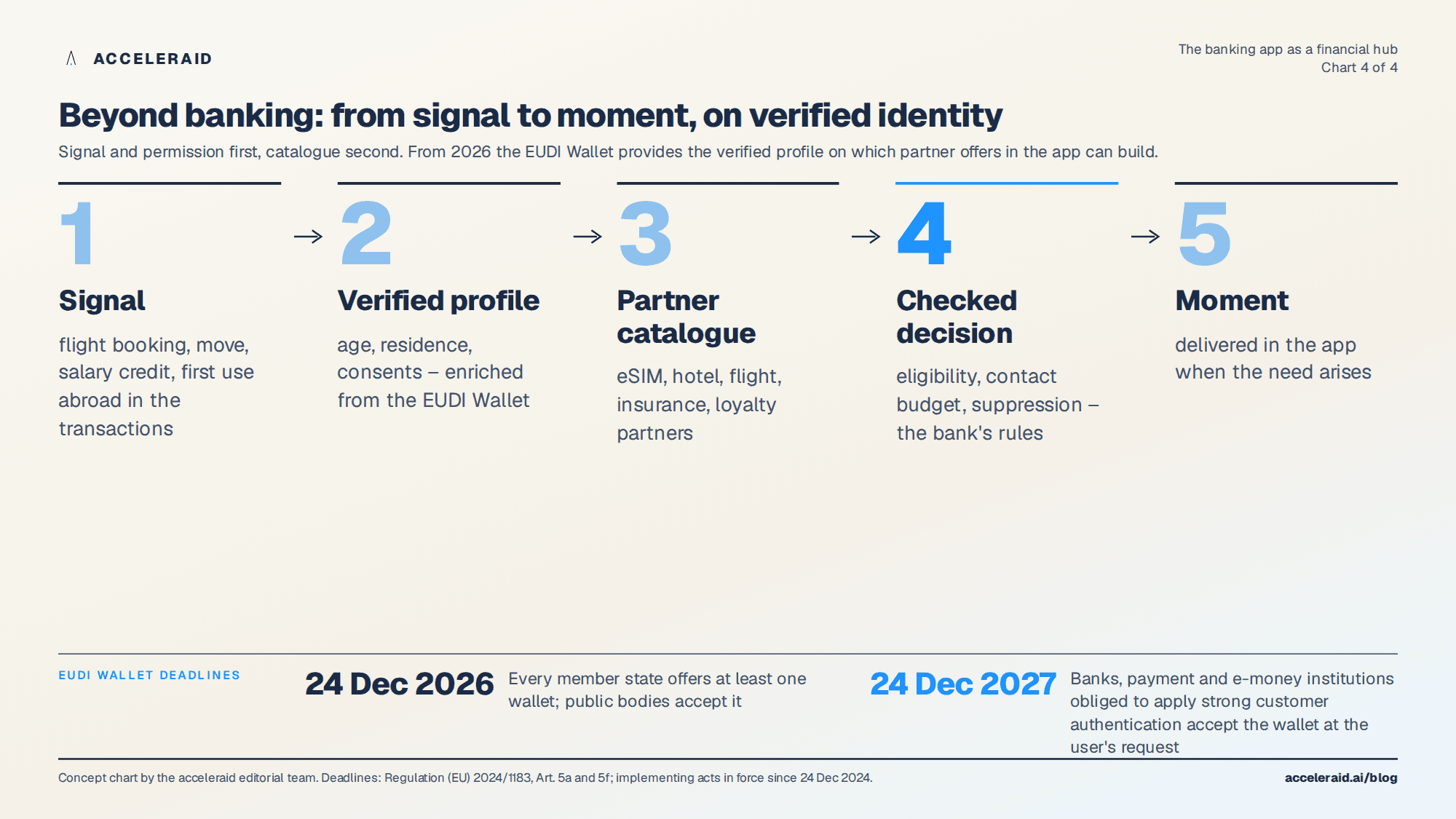
If the app is where customers manage their money, adjacent needs arise there too: an eSIM before a trip, insurance after a purchase, a hotel after the flight. The regulatory foundation exists. Under Article 5a of Regulation (EU) 2024/1183, every member state must offer at least one European Digital Identity Wallet by 24 December 2026; by 24 December 2027, banks, payment and e-money institutions obliged to apply strong customer authentication must accept the wallet at the user's request (Garrigues; EADTrust).
For the app this means a verified profile enriched, with consent, by wallet attributes. On it sits a next-best-product mechanism in five steps: a signal in the data (a flight booking), a match against the verified profile (age, residence, consents), a selection from the partner catalogue, a checked decision under the bank's rules and delivery at the moment of need. Capgemini reports that 73% of card customers are motivated by personalised offers and rewards (Capgemini Top Trends 2026 Banking). The difference from classic partner marketing is the order: signal and permission first, catalogue second.
What governance requires
An advisor that reads transactions and delivers offers is an AI system in customer contact. Article 26 of the EU AI Act obliges deployers of high-risk systems, among other things, to ensure human oversight by trained staff, to follow the instructions for use and to keep logs for at least six months (Article 26 AI Act). However individual functions are classified, the architectural consequence is the same: consents managed per data source and purpose, every decision logged with rule version and data basis, suppression rules that campaigns cannot override, and a route to a human in every dialogue. Consent-first is not a brake but the precondition for the customer entrusting her transactions to the app at all.
Where success shows
A PFM loop is measured not by features but by four quantities: active use and return after an insight, service cases resolved in the app before the call, conversion per contact alongside fewer contacts, and payment stress detected earlier. Each needs a control group; otherwise you measure the calendar, not the effect.
Five takeaways
The app is the primary channel for most customers and works well technically; what is missing is knowledge about the customer, not design.
CRM, transactions, service and marketing describe the same person from four angles; only a shared profile with a context layer turns that into advice.
The strongest use cases span every discipline, from due-date forecasts in service and instalments at the transaction to early warnings in collections.
A virtual advisor differs from a helpdesk bot in data access, proactivity, the ability to act within the bank's rules and a real route to a human.
Beyond banking starts with verified identity; the EUDI Wallet deadlines in 2026 and 2027 set the pace, consent and logging set the frame.
Anyone wanting to know where their institution stands can start with one question for their app: can it answer "Will the money last until the statement?" If not, it shows an account, but it does not yet advise.
Illustration: AI-generated. AI-assisted content: We use AI technologies and automated agents in the creation of our articles, including from Microsoft, Google, OpenAI, Anthropic and other providers. Topics, editorial direction and final approval remain with our team.
Keep reading
More articles
CLM & CVM
The Banking App as a Financial Hub: Personal Finance Management, CLM, Service and a Virtual Advisor from One Data Loop
How CRM and transaction data, CLM, customer service and a virtual advisor come together in the banking app – with 16 use cases by category.

CLM & CVM
Next Best Action in Banking 2026: From the Propensity List to a Checked Decision
Next best action in banking 2026: why the propensity list is not enough, the three questions a decision keeps apart, and how it is measured.

Automation
AI Marketing Automation in Banking: What Changes Compared with Campaign Automation
AI marketing automation in banking: tools have tripled, impact has slipped. Five shifts compared with campaign automation, and what to build first.