For banks, card issuers and insurers in Germany, Austria and Switzerland
EUDI Wallet: mandatory by December 2027.
An advantage today.
The EUDI Wallet is the EU's state-issued digital identity under eIDAS 2.0. The German wallet launches in early 2027; from December 24, 2027 banks must accept it as proof of identity. ACCELERAID helps banks bring verified attributes such as identity, residence or income into the Customer Data Platform with consent and turn them into Next Best Product and beyond-banking offers.
✓
Timeline and relying-party tasks, factual and dated
✓
Verified attributes as consent-based signals in the CDP
✓
Swiss e-ID in the same model


Wallet attributes
Example
Wallet
Identity, residence Mannheim, over 18: confirmed. Frequent flyer status: shared with consent.
PID + attestation
Moment
“Your flight to Lisbon: activate a Portugal eSIM? One tap, no documents needed.”
Eligibility checked ✓ · logged
○
Illustrative concept
Your rules
Personal Finance Management
Next Best Action
Top of Wallet
Transaction data
EUDI Wallet
Virtual advisor
Customer Data Platform
Hosted in Frankfurt
Consent first
Timeline 2025–2027
EUDI Wallet timeline for banks: what applies when.
As of October 20, 2026. Dates come from the linked sources; we review the timeline quarterly. The legal assessment for your institution is made by your compliance team.
Since December 2025
EUDI Wallet sandbox in Germany
The official sandbox is open to organizations for tests with test data. According to eudi-wallet.gov.de, participation is a prerequisite for later productive use.
September 2025 / June 2026
Switzerland: yes to the e-ID Act, new timetable
Voters approved the e-ID Act. According to eid.admin.ch (June 2026), the e-ID and trust infrastructure will be introduced in 2027, with the federal swiyu wallet.
December 24, 2026
EU member states provide wallets
Under Article 5a of Regulation (EU) 2024/1183, every member state must offer at least one EUDI Wallet by this date. Germany opts for a state wallet, which follows in early 2027.
Early 2027
German EUDI Wallet, version 1
Smartphone app with identity function (PID from ID card or eAT) and digital credentials. Namirial names January 2, 2027 as the launch date. Further functions such as QES and payment confirmation follow in stages.
December 24, 2027
Acceptance obligation for banks
Under Article 5a of Regulation (EU) 2024/1183, banks as well as payment and e-money institutions subject to strong customer authentication must accept the wallet at the user's request from this date; Namirial and Fincite (2026) also name insurers. Example: account opening under anti-money-laundering rules.
Sources: eudi-wallet.gov.de, Namirial, Fincite and eid.admin.ch (as of October 20, 2026).
Relying party
What banks prepare as a relying party.
Summarized factually from public sources, without legal advice. The five points are also the prerequisite for using wallet data for personalization later.
Registration as a relying party
Anyone requesting wallet credentials registers in the respective member state and discloses which attributes are requested for which purpose. Requests are limited to what is necessary.
Acceptance of all certified wallets
A non-discrimination requirement applies: credentials from every recognized EUDI Wallet must be accepted, not only from the German state app.
Adapting processes with identification duties
Account opening under anti-money-laundering rules, re-identification, proof of authority: wherever video identification or document upload stands today, the wallet becomes an accepted option.
Consent and purpose limitation per attribute
Identity for onboarding is a different purpose than residence for a travel offer. Each request needs its own basis and its own entry in the log.
Testing in the sandbox
Use cases are tested with test data in the official sandbox before going live. ACCELERAID supports the integration into CDP and processes.
From identity to personalization
Signal, profile, catalog, decision, moment.
The obligation ends at identification. The opportunity begins afterwards: with the customer's consent, verified attributes become signals in the Customer Data Platform, and Next Best Product moves from segment to individual.
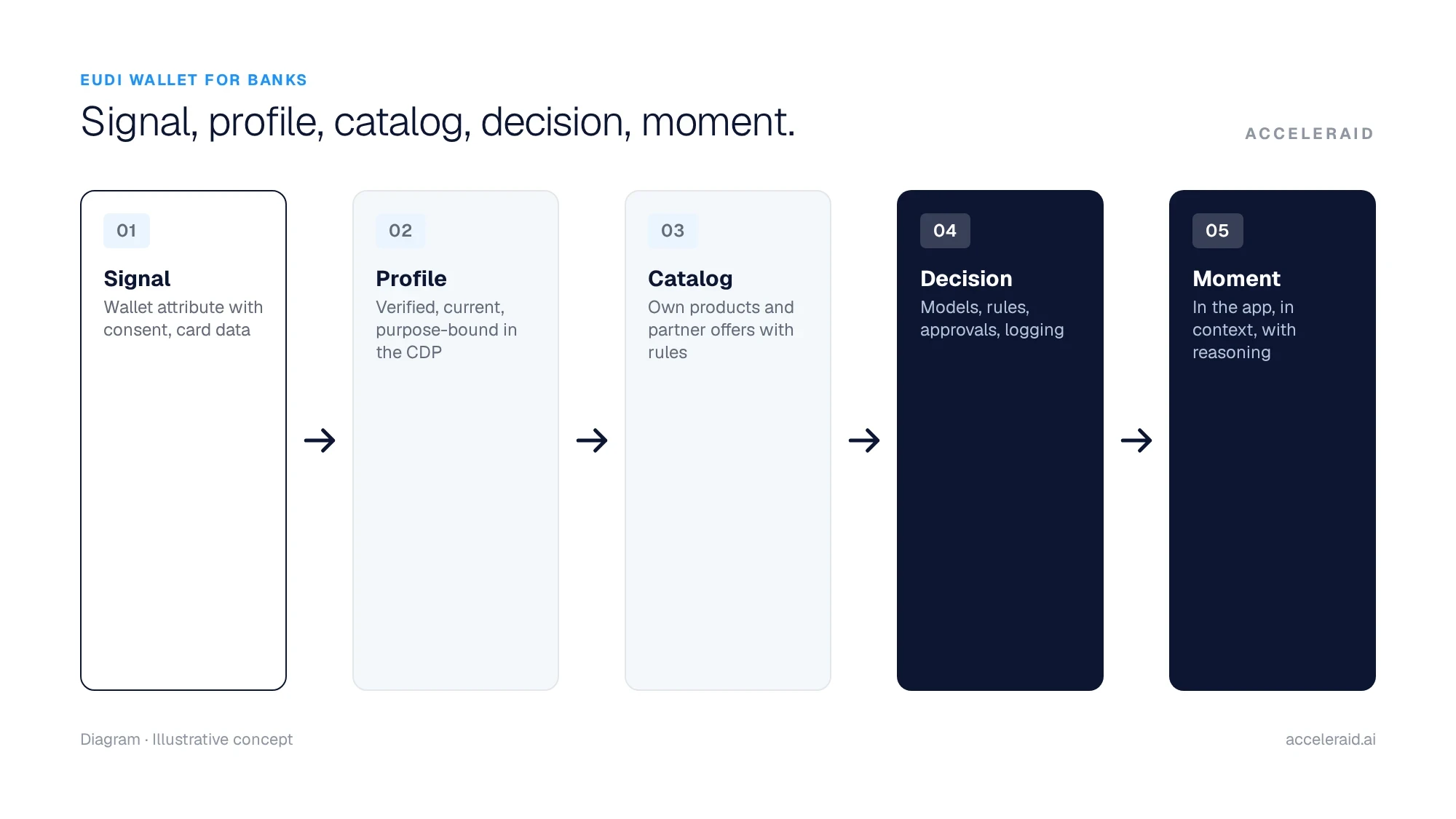
Five steps from verified identity to the fitting offer, each with consent and a log.
Signal
a booking, a move, a border crossing, a new credential in the wallet
Profile
card data plus verified attributes: age, residence, income, household, memberships
Decision and moment
eligibility, value, timing and your rules decide; delivered in app, push or advisor
Use cases
Six applications with wallet attributes.
From the mandatory task to the beyond-banking offer. Each uses the same CDP and the same consent model.
Onboarding without document upload
Identity and address come state-signed from the wallet. No video identification, no scan. The application ends where it starts: in your app.
KPI: completion rate
Re-identification and step-up
For new products, proof of authority or sensitive changes, identity is confirmed again in seconds, with a log.
KPI: turnaround time
Eligibility and age
“Over 18”, residence in the sales territory or student status are shown selectively, without disclosing further data.
KPI: failed applications
Keeping master data current
Instead of letters, uploads and follow-ups, the customer confirms their data in the app. Master data stays current, and the obligation becomes a contact moment.
KPI: refresh rate
Address change as a life event
A new address in the wallet is a moving signal: home insurance, electricity, standing orders, branch. With consent, it becomes a moment.
KPI: products per customer
Beyond banking around the card
Trip detected, residence known, status in the wallet: eSIM, travel cover, loyalty or hotel offer, timed to the booking.
KPI: partner revenue

A moment from the card
Example
Flight to Lisbon paid with the card.
One message, one tap: Portugal eSIM, reminder of travel cover, hotel offer with travel credit.
Trigger, mix and timing are unique to this customer. Partners and offers are defined with you.
✓
Illustrative example
Beyond-banking example
This is what hyper-personalization with wallet attributes looks like in everyday life. Illustrative; partners and offers are defined with you.
Signal
Flight to Lisbon paid with the card.
Transaction
airline, travel date, destination country
Wallet
residence Germany, over 18, frequent-flyer status attested
Consent
travel offers: granted. Insurance: granted. Partner advertising: not granted.
Decision
Three offers pass the check.
Portugal eSIM
eligible, partner offer from the travel catalog
Travel cover reminder
own product, already included, information only
Hotel with travel credit
loyalty partner, status from the wallet taken into account
Moment
One message, two days before departure.
Channel
app card plus push, no email newsletter
Tone
short, useful, no advertising for anything not permitted
Log
signal, attributes, rules and reaction in the decision record
Comparison
Today vs. with the EUDI Wallet: four processes.
What changes in the processes banks run anyway, and which data arises with consent for personalization.
Account opening (identification duty)
Video or postal identification, minutes to days
PID from the wallet, seconds
Verified identity, address, age
Master data refresh
Letter, upload, follow-up
Re-confirmation in the app
Up-to-date master data
Address change
Form, proof, manual check
New credential from the wallet
Moving signal, life event
Age verification
Copy of ID
“Over 18” disclosed selectively
Eligibility without date of birth
The Swiss e-ID follows the same pattern with the swiyu wallet; ACCELERAID handles both wallets in one attribute and consent model.
Consent-first governance
What the customer does not allow does not happen.
Wallet attributes are the most trustworthy data a bank will ever receive. They stay that way only if the handling is visibly clean.
Per attribute · Purpose, basis, status
Every attribute in the CDP carries its purpose, its legal basis and the consent status. Identity for onboarding and residence for offers are separate entries.
Selective · Request only what is needed
The wallet allows selective disclosure. Whoever only needs “over 18” does not request a date of birth. The request profile is defined with data protection and compliance.
Revocable · Withdrawal takes effect immediately
If the customer withdraws consent, the attribute disappears from decisions and offers. The withdrawal is logged like the grant.
Traceable · Log per decision
Which attributes fed into which decision is in the decision record. That answers questions from customers, data protection and supervisors.
How is data protection preserved when wallet attributes flow into the CDP?
What is the EUDI Wallet?
From when must banks accept the EUDI Wallet?
What does relying party mean?
Which attributes can a bank use from the wallet?
May the bank use wallet data for personalization?
How does the Swiss e-ID fit in?
What is beyond banking, and what does it have to do with the wallet?
How do we start, and what does ACCELERAID do?
Read on