CLM & CVM
The AI Decision Engine Business Case: What Banks Can Calculate Before Go-Live
The AI decision engine business case in banking: three value levers, four cost blocks and cautious scenarios banks can calculate before go-live.
•
acceleraid Editorial Team
•
6 min

Anyone who wants to introduce an AI decision engine needs a number the board can decide on before go-live. Studies offer impressive ranges for this, but not a figure for your own bank. This article shows how a bank builds the business case use case by use case: with three value levers, four cost blocks and cautious assumptions set out in scenarios. How to measure value after launch with a control group is covered in our article AI bubble or real value?. This one is about the calculation that comes first.
What an AI decision engine decides in banking
An AI decision engine decides, for every customer and every moment, which action the bank takes: a notification, a service step, an offer or, deliberately, no contact at all. It combines probability models with rules, consents and a contact budget. We have described how such an engine is built in the five building blocks of an AI decision engine, and typical triggers in ten use cases for next best action.
One property is decisive for the business case: the engine only creates value where its decision differs from what the bank already does today. A bank that already runs a good campaign for maturing fixed-term deposits gains only the difference to that campaign, not the total reinvested volume.
What studies show and what they don't
Published figures are ranges from consulting projects and benchmarks; they show the direction, not your own bank's number. McKinsey puts the typical revenue lift from personalisation at 10 to 15 percent, with a range of 5 to 25 percent depending on sector and ability to execute (McKinsey, Next in Personalization 2021). For European banks, McKinsey reports from its own project work 20 to 30 percent higher customer engagement, 10 to 25 percent higher customer value and 15 to 25 percent better customer experience when AI-powered customer value management is executed well (McKinsey, September 2026).
Individual banks cite their own figures. Discovery Bank reports that its next-best-action model delivered a 40 percent uplift in the impact of client engagement initiatives; the article does not say how this was measured (Databricks, September 2026). BCG explicitly calls causal measurement and incrementality testing for next best action "essential, not optional" (BCG, May 2026). For an overview of study figures on personalisation platforms, see our article on the business case for a personalisation platform.
A hypothetical cooperative bank works through three cases

Illustration: AI-generated, hypothetical example.
Hypothetical example: The head of sales management at a cooperative bank has to give the board a decision paper on a decision engine by the end of the year. Together with a controller, he selects three use cases: outreach when fixed-term deposits mature, a signal for likely account closures and a service notification after a returned direct debit. For each case they calculate three scenarios. The controller insists that the board sees the cautious scenario first. The result: the service notification carries the business case even in the cautious scenario because it avoids calls, while the deposit case depends heavily on the assumption about the incremental effect. They start with the case that holds up under cautious assumptions. The bank and the people are fictitious.
Three value levers and four cost blocks
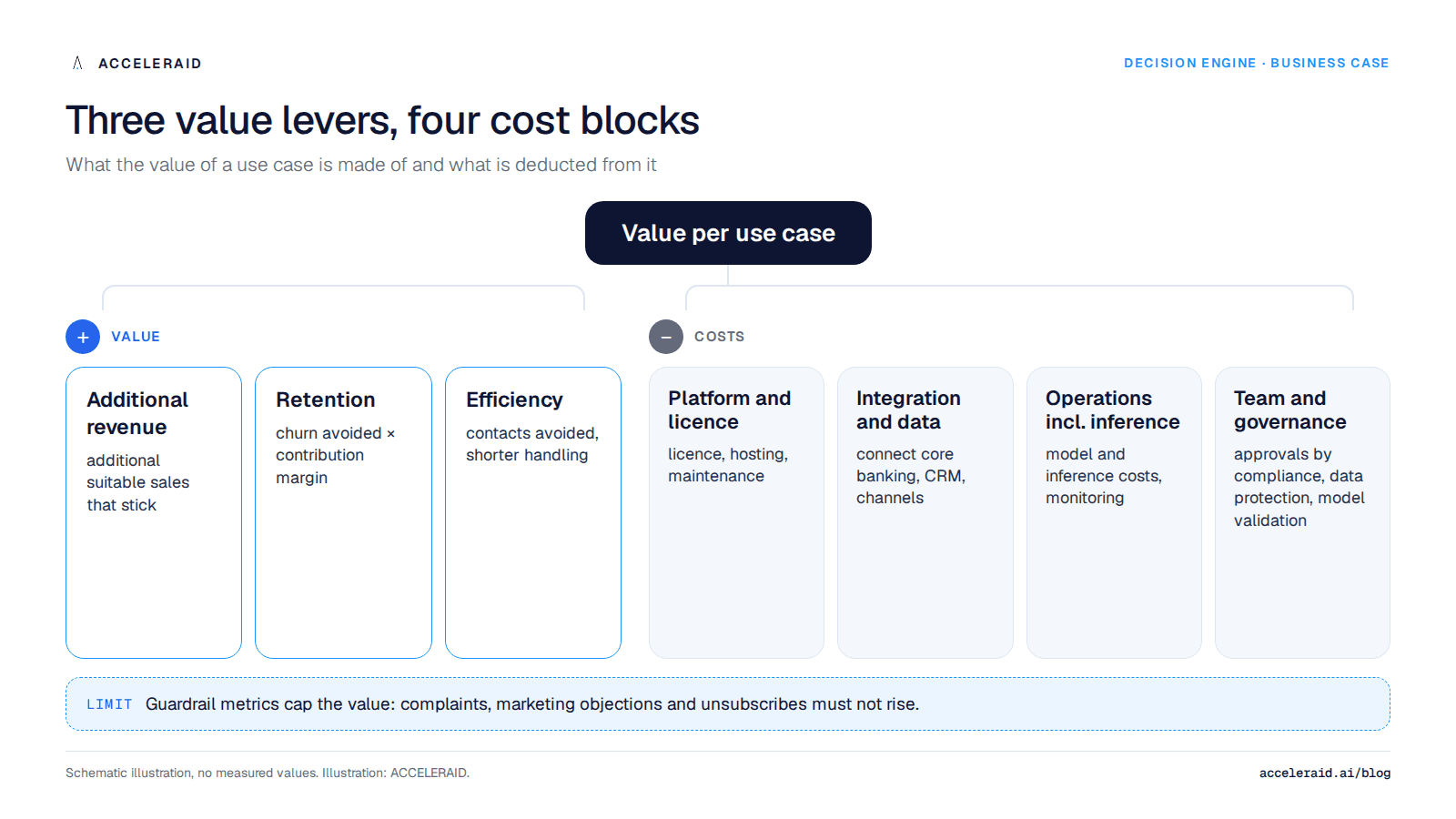
A robust business case splits value and cost into a few blocks that can each be checked. On the value side there are three levers:
Additional revenue: additional suitable sales that stick, net of cancellations and withdrawals.
Retention: churn avoided, valued at the contribution margin per customer over a cautious retention period.
Efficiency: contacts avoided, such as calls after a proactive notification, shorter handling times and less untargeted mailing.
On top of these come guardrail metrics that create no value but cap it: complaints, marketing objections and unsubscribes must not rise. On the cost side there are four blocks: platform and licence, integration and data connection, ongoing operations including model and inference costs, and the specialist team with governance, meaning approvals by compliance, data protection and model validation. Why inference costs in particular are growing with agents is explained in our article on AI inference costs.
The calculation per use case
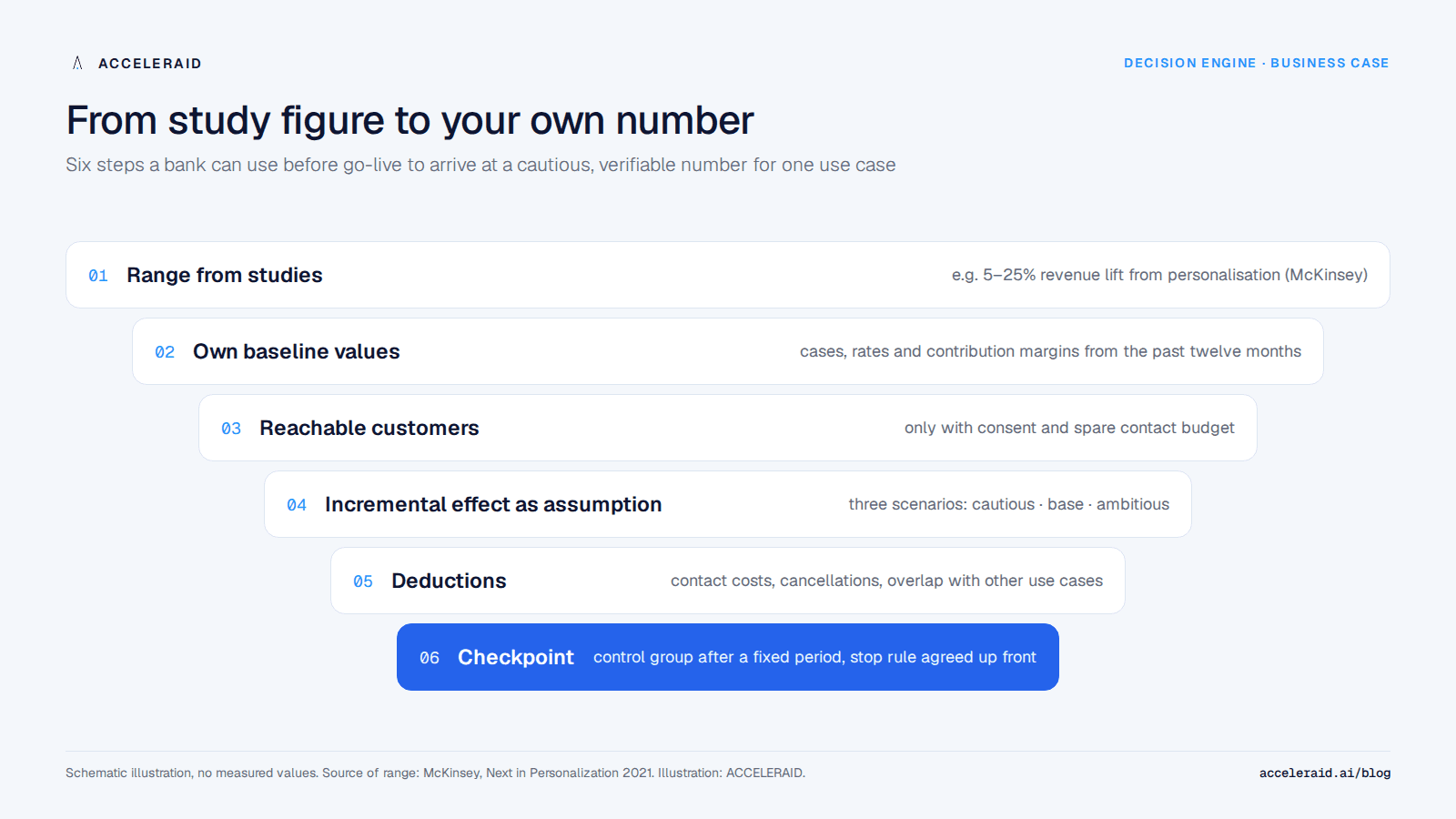
The calculation is done per use case, and only with the incremental effect compared with today. The basic formula is simple: reachable customers times frequency of the trigger times incremental effect times value per outcome, minus contact and handling costs. Each of these inputs needs a documented origin.
Only customers with the appropriate consent and spare contact budget are reachable. The frequency of the trigger and the value per outcome come from the bank's own data, for example maturities, closures or returned debits over the past twelve months. The incremental effect is the only real assumption. There are three sources for it: an earlier test by the bank, a small pilot or, if neither exists, the lower half of published ranges.
This produces three scenarios. The cautious scenario uses the lower effect and a lower reach, the base scenario the expected value, the ambitious scenario the upper end. Gartner recommends steering AI investment by value per outcome rather than by usage (VentureBeat on Gartner, October 2026). For the business case, this means every scenario ends in a value per resolved trigger that can be checked against a control group after launch.
Five mistakes that undermine a business case
Most inflated business cases fail not because of the formula but because of five recurring mistakes.
Total rate instead of incremental effect: the calculation counts every sale after an outreach, including those that would have happened anyway.
Double counting: the same customer appears in several use cases. Because the engine chooses only one action per moment, the values cannot simply be added up.
Customers without consent: reach is calculated on the entire customer base instead of the customers who may be contacted.
Missing costs: governance, approvals and ongoing model costs are left out because they appear in no licence quote.
No stop rule: there is no agreement on the result after the pilot at which a use case will be discontinued.
Avoiding these mistakes gives the board a smaller but defensible number.
Data protection belongs in the calculation
Consent and auditability are not side conditions of the business case; they determine its size. The number of customers with valid consent limits the reach of every use case. Under Article 22 GDPR, decisions with legal effect, such as on a loan, must not be based solely on automated processing; here the engine prepares and a person decides. ACCELERAID checks consent before every delivery, provides explainable outputs without automated individual decisions and logs every AI output in an audit-proof way (ACCELERAID). Data is processed in an ISO 27001-certified data centre in Frankfurt, or on-premise at the bank on request.
Five takeaways
The business case for an AI decision engine in banking is calculated per use case and only with the incremental effect over current practice.
Study figures such as McKinsey's 10 to 15 percent revenue lift show the direction; your own number comes from your own baseline values and a cautious assumption about the incremental effect.
Three value levers (additional revenue, retention, efficiency) are set against four cost blocks: platform, integration, operations including inference costs, and governance.
Three scenarios, with the cautious one first, show which use cases hold up even under low assumptions.
Consent limits reach; a stop rule and a control group make the business case verifiable after launch.
Illustration: AI-generated. AI-assisted content: We use AI technologies and automated agents in the creation of our articles, including from Microsoft, Google, OpenAI, Anthropic and other providers. Topics, editorial direction and final approval remain with our team.
Read on
Where to go next.
From the blog

CLM & CVM
Next Best Action in Banking: Ten Use Cases with Trigger, Check Rule and Success Measure

CLM & CVM
Customer Value Management for Banks in 2026: Objective Function, Constraints and the Right Organisational Model

CLM & CVM