CLM & CVM
Next Best Action in Banking: Ten Use Cases with Trigger, Check Rule and Success Measure
Ten next best action use cases in retail banking with trigger, check rule and success measure, as a table with chart and a customer story.
•
acceleraid Editorial Team
•
5 min

Next best action in banking rarely fails on the model and often on the question of what should be triggered. Write down ten use cases with trigger, check rule and success measure, and half the architecture is decided. How a propensity list becomes a checked decision is covered in Next Best Action in Banking 2026, the engine behind it in AI Decision Engine in Banking.
Why trigger, check rule and success measure belong together
A use case exists once three things are fixed. The trigger is the event, threshold or date that opens the case. The check rule says when the bank, despite the trigger, does nothing or something else: no consent, open complaint, contact budget exhausted, unsuitable product. The success measure says how, after 90 days, you tell whether the case served its purpose, against a control group, not last year. McKinsey describes leading banks running hundreds of such transaction-based triggers and testing them continuously, which in its experience lifts click-through rates two- to threefold (McKinsey, AI-powered personalisation in banking). Hundreds begin with ten.
Ten next best action use cases in retail banking
# | Use case | Trigger | Check rule | Success measure (90 days, vs. control group) |
|---|---|---|---|---|
1 | Salary not received | Regular credit missing 10 days after usual date | Service notice only, no product; adviser task in month two | Cases resolved, salary accounts retained |
2 | Card declined | Decline for limit or funds in past 24 hours | No credit approach with arrears or open complaint | Repeat declines, overdraft use |
3 | Term deposit maturity | Maturity in 21 days | Risk profile must be current, else renewal offer only | Renewal rate, volume lost |
4 | Moving home | Address change or moving pattern | Service first; products after 14 days at the earliest | Primary relationship retained, switching service used |
5 | 90 days inactive | Standing orders only for 90 days | Check if second account intended; no discount | Reactivation, attrition after 180 days |
6 | Balance build-up | Balance above three months' income for 60 days | Only with investment consent; else advice offer | Appointments, invested volume, no complaints |
7 | New recurring payee | First payment to nursery, landlord or insurer | Confirm the life event before any offer | Confirmations, product use afterwards |
8 | Card spend drops | Minus 40 percent over 30 days year on year | No approach if reason known (travel, illness) | Spend recovery, cancellations |
9 | Mortgage fixed rate ends | Fixed-rate period ends in 12 months | Adviser only; no automatic rate commitment | Prolongation rate, lead time to conversation |
10 | Complaint closed | Closed 7 days ago, customer satisfied | Only then lift suppression of all offers | Satisfaction after contact, repeat complaints |

Three patterns stand out. Most triggers are service occasions; the check rule stops a missing salary from becoming a credit pitch. Four cases include a waiting period before any product is allowed. The success measure is never messages sent.
One customer, one case, one decision
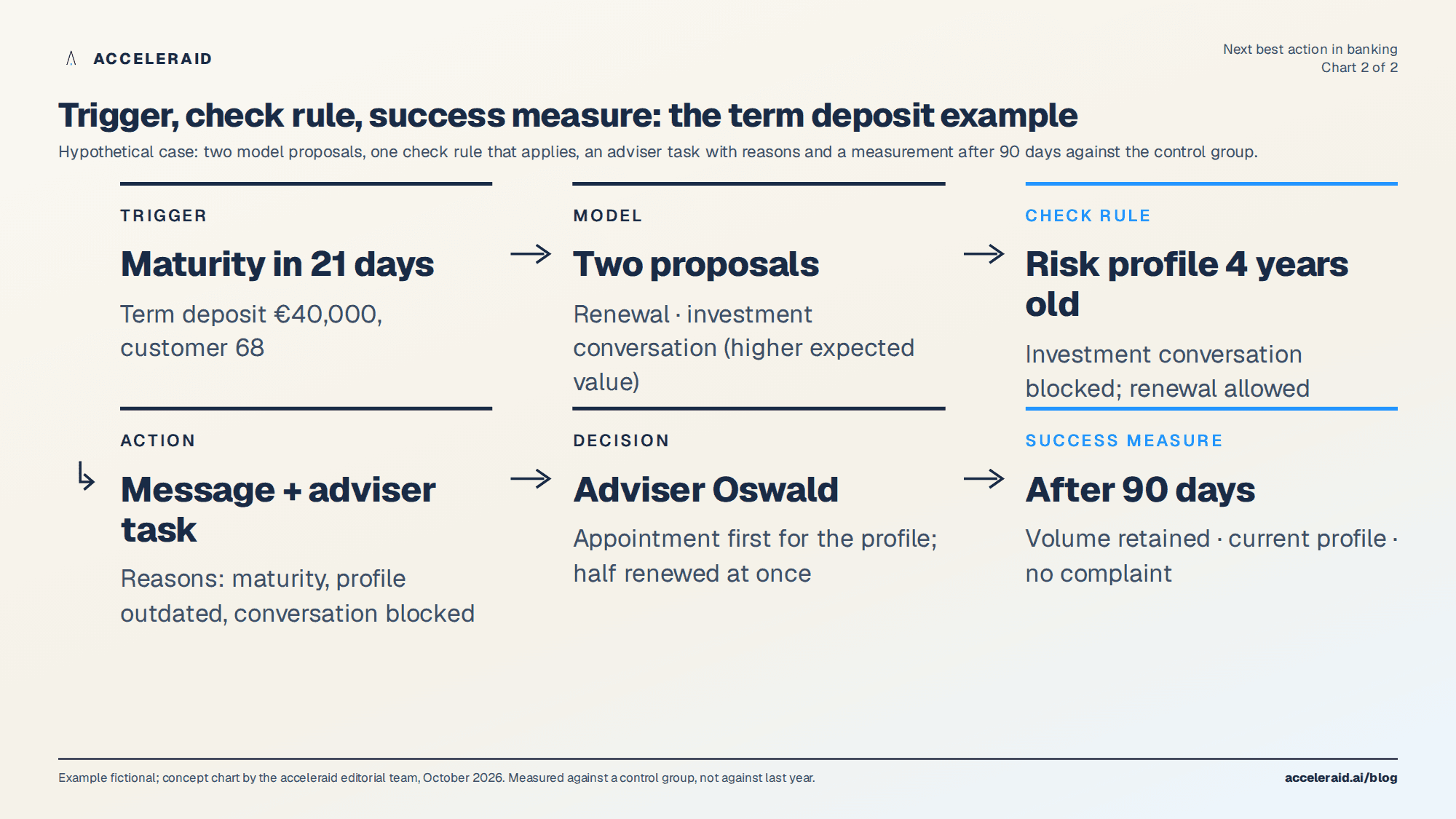
The story is hypothetical. Ruth Albers, 68, holds a 40,000-euro term deposit maturing in three weeks. Case 3 opens. The model proposes renewal at a slightly better rate and, with higher expected value, an investment conversation. The check rule applies: her risk profile is four years old. Only the renewal goes out; her adviser Tim Oswald receives a task with reasons: maturity, profile outdated, investment conversation blocked until updated.
Mr Oswald calls. Ms Albers laughs: the maturity letter arrived the same day. He decides not to discuss investments on the phone but to offer an appointment where the profile is renewed first. She renews half immediately and accepts. After 90 days the success measure counts both: volume retained and a current profile, the basis for every further case.
Why the list is more urgent in 2026
Cases 1, 3, 5 and 6 target deposits, and that market is moving. In J.D. Power's study of 107,059 US bank customers, 20 percent had moved money away from their primary bank in the past three months, up from 17 percent, most often under-40s and affluent customers (J.D. Power, 2026 U.S. Retail Banking Satisfaction Study). An analysis of over 25 million accounts at 164 institutions shows that term deposit holders, forced to decide at maturity, switch more often than current and savings account holders (Harvard Business School Working Knowledge). Maturity is the moment the bank reliably reaches the customer, and the moment the customer is likeliest to leave.
Five takeaways
A next best action use case is trigger, check rule and success measure; without all three it is a campaign idea.
Most strong triggers are service occasions; the check rule decides whether they may ever become an offer.
Waiting periods belong in the rule: after a move, complaint or life event, service first and products only after confirmation or a set period.
Measure after 90 days against a control group, in volume retained, reactivation and complaints, never in messages sent.
Deposit cases are the most urgent in 2026: 20 percent of customers move money away from their primary bank, and term deposit maturity is when they decide.
To start, take three cases from the table, write each check rule in one sentence, and decide who gets the adviser task.
Illustration: AI-generated. AI-assisted content: We use AI technologies and automated agents in the creation of our articles, including from Microsoft, Google, OpenAI, Anthropic and other providers. Topics, editorial direction and final approval remain with our team.
Read on
Where to go next.
From the blog

CLM & CVM
Customer Value Management for Banks in 2026: Objective Function, Constraints and the Right Organisational Model

CLM & CVM
The Banking App as a Financial Hub: Personal Finance Management, CLM, Service and a Virtual Advisor from One Data Loop

CLM & CVM
Next Best Action in Banking 2026: From the Propensity List to a Checked Decision
Let's talk about your use case.
In 30 minutes we show how ACCELERAID can look in your bank – with your data, your products and your rules.