CLM & CVM
Next Best Action in Banking 2026: From the Propensity List to a Checked Decision
Next best action in banking 2026: why the propensity list is not enough, the three questions a decision keeps apart, and how it is measured.
•
acceleraid Editorial Team
•
9 min read

On Monday morning an adviser opens her work list. Forty names, next to them a column headed "credit propensity" with values between 0.61 and 0.89. No indication of why these forty, nothing about what last happened with each customer, nothing about what she should not do. In many banks this is still what passes for next best action: a sorted propensity list. This article sets out what next best action in banking has to deliver in 2026 so that the list becomes a decision that is checked, explained and measurable. It is meant to stand on its own; how an engine decides in detail is covered in an earlier piece, and the strategic framing is in our foundational article.
Why the propensity list is no longer enough in 2026
The industry's own numbers are unambiguous, and they do not come from vendors alone. In Personetics' survey of more than 900 senior bank decision-makers across North America, EMEA and APAC, institutions convert on average only 53 percent of their digital engagement into measurable outcomes; nearly 60 percent of failed conversions trace back to offers that do not match customer needs or are simply too generic, and a new personalised offer takes twelve to thirteen weeks on average from concept to launch (Personetics, 2026 Global Banker Survey). Celent and Temenos found in September that only 4 percent of banks name personalisation of the customer experience as their top investment priority, while three in four customers are at best moderately satisfied (Temenos/Celent). And in the Digital Banking Report on 2026 trends, just 6 percent of institutions have adopted AI-powered personalisation (Digital Banking Report).
These figures do not describe a model problem. Propensity models have been good enough for twenty years. They describe a decision problem: between the score and the contact there is no instance that asks whether the action is permitted, appropriate and sensible right now. As long as that instance is missing, models improve and outcomes do not.
Next best action in banking means three questions, three mechanisms
The most common design flaw is asking a single number to answer three different questions. A next-best-action decision in a bank consists of three separate questions, and each needs a different mechanism.
First: may this customer have this product at all? That is a deterministic question. Age, residence, existing holdings, credit grade, the product's target market, suitability for investment products: the answer is yes or no, it is expressed in rules, versioned and auditable. No model belongs here.
Second: how likely is the customer to respond? This is the question propensity and uplift models are built for. The answer is a probability, it may be imprecise, and it has to be monitored because it drifts.
Third: should the bank make this offer now? That is a question of judgement and care. An open complaint, a recently declined credit application, signs of financial difficulty, a marketing objection, an exhausted contact budget: any of these can turn a high-probability offer into the wrong action. This question belongs in suppression rules and governance, not in the model.
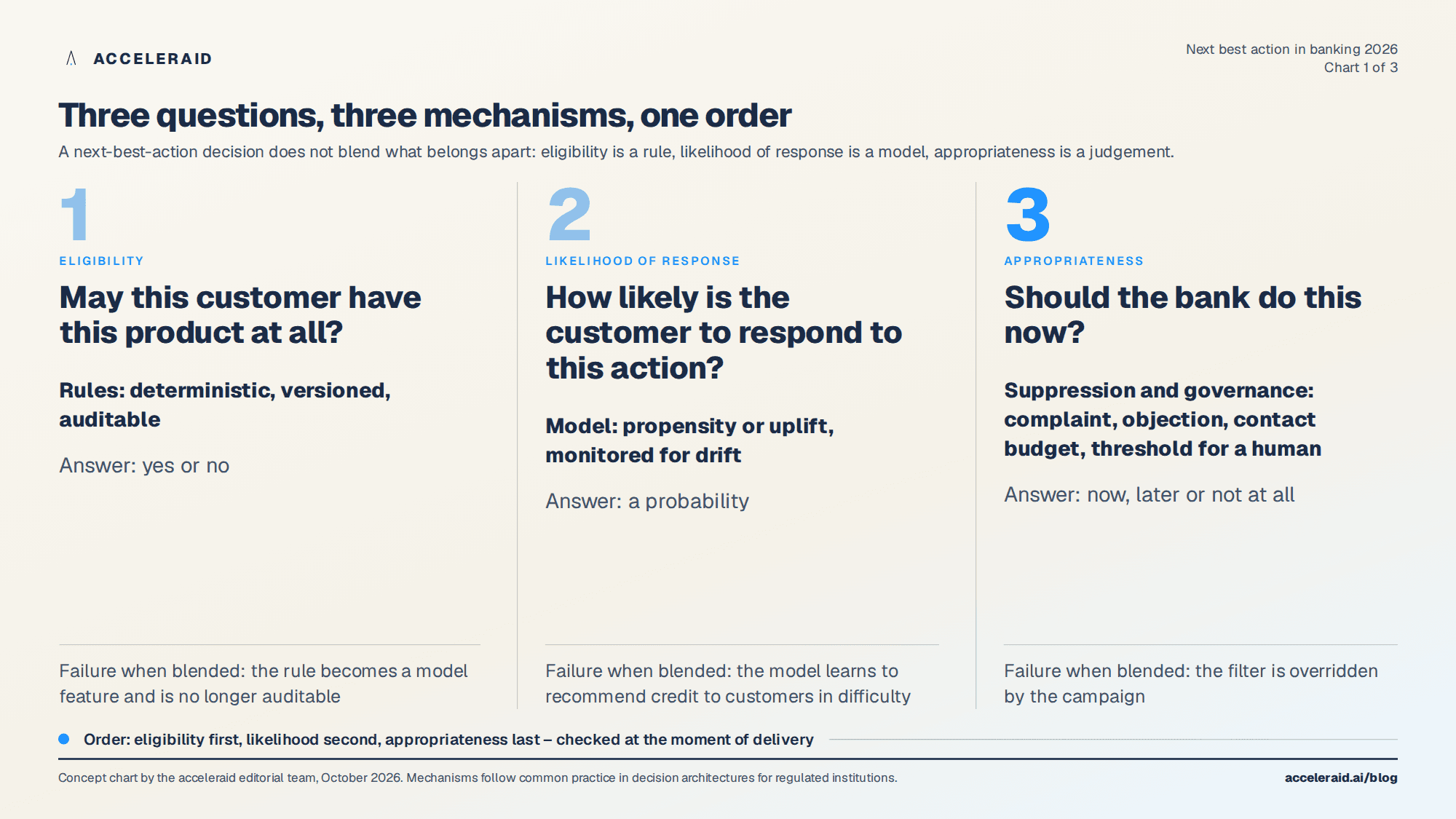
When the three are blended, what happens is what happens in practice all the time: the model learns from historical conversions that customers in difficulty often accept credit, and recommends credit to precisely them. The eligibility rule is pulled into the model as a feature and is no longer auditable. And suppression is built as a downstream filter that a campaign configuration can override when needed. The separation is not an academic exercise. It is what makes the decision explainable and the audit trail complete.
Action, not offer
The second difference between a list and a decision is in the word "action". A list knows one type of action: the offer. A decision knows at least four: the offer, the notice, the service intervention and the deliberate decision to do nothing. Which of these is best depends on the trigger, not on the score.
Independent research shows customers see it the same way. Datos Insights finds that the most valuable forms of personalisation, from the customer's point of view, are not product offers at all: fraud and security alerts, account notifications, cash-flow guidance and timely financial insights generate more engagement than offers (Datos Insights). J.D. Power's 2026 Financial Health Support and Advice Study finds that only 20 percent of bank customers say their provider always personalises the information they receive; where it does succeed, satisfaction rises by 238 points on a 1,000-point scale (J.D. Power). So the adviser from the opening does not need forty credit propensities. She needs one action per customer, with a reason: "Term deposit matures in 14 days, customer visited the rates page twice, offer a conversation" is an action. "0.83" is not.
A hypothetical example in three steps
A constructed case shows how the three questions work together. A customer, 58, holds a term deposit of 40,000 euros that matures in two weeks. In the past ten days she has opened the interest-rate page in online banking three times and the calculator for securities savings plans once. A propensity model gives her a response likelihood of 0.71 for a brokerage account.
Step one, eligibility: she does not yet hold a brokerage account, the product's target market fits, but for an investment recommendation the suitability assessment is missing. A specific product offer is therefore ruled out; an offer of a conversation about the maturity is not. Step two, likelihood of response: high, and higher for a conversation than for a product, because the behaviour signals a need for orientation. Step three, appropriateness: no marketing objection, no open complaint, last contact six weeks ago, contact budget free. The check does establish, however, that under an internal rule a maturity above 25,000 euros goes to the adviser, not to an automated channel.
So the decision is not "offer brokerage account" but "adviser: maturity in 14 days, customer researching rates and savings plans, offer a conversation, clarify suitability before any product recommendation". Same data, same score, different action. The difference lies entirely in the three questions and their order.
Check last, not first
The third difference is when the check happens. In campaign architectures the audience is selected overnight, filtered and handed to the channel. Between selection and the moment the customer opens the app, hours or days can pass. In that time she may have filed a complaint, declared an objection or had a direct debit returned. A check that runs only at selection is stale by then.
For a bank this implies a clear order: candidates may be precomputed, because models do not need millisecond decisions. Suppression, however, has to run at the moment of delivery, against the current state, and no campaign setting may override it. That includes a contact budget that counts across all channels: a customer who received a letter on Tuesday does not get a call on Wednesday, even if a second model recommends him for a different product.
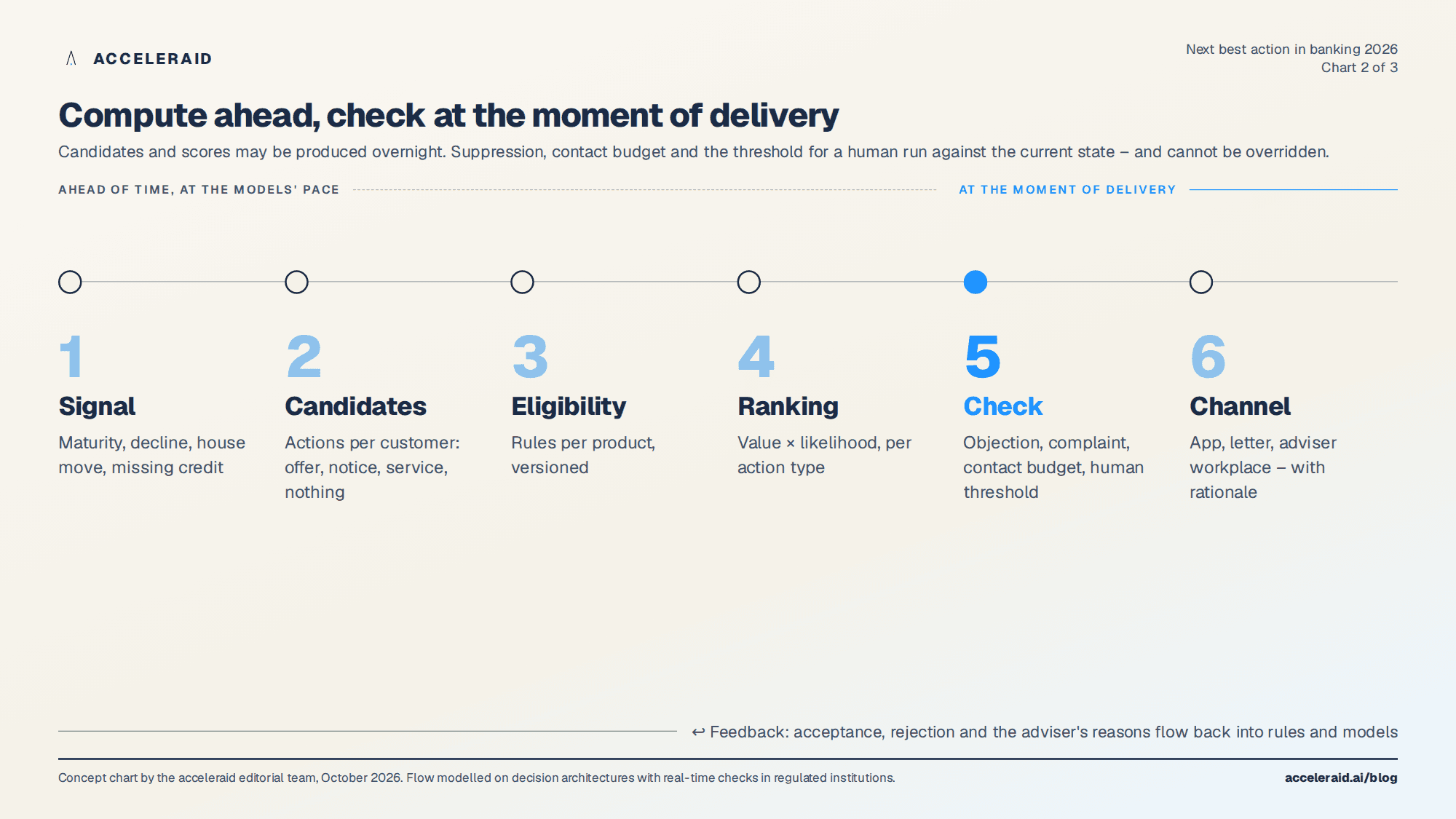
This step is also where the threshold for a human is drawn. Not every decision needs a release, but every decision needs a defined rule for when it does: wealth advice, credit offers after a change in income, anything subject to a suitability assessment. In part 3 of our series on the agentic experience platform we described this threshold as part of the decision record; here it is enough to note that without the check step it has nowhere to act.
What makes a next-best-action decision measurable
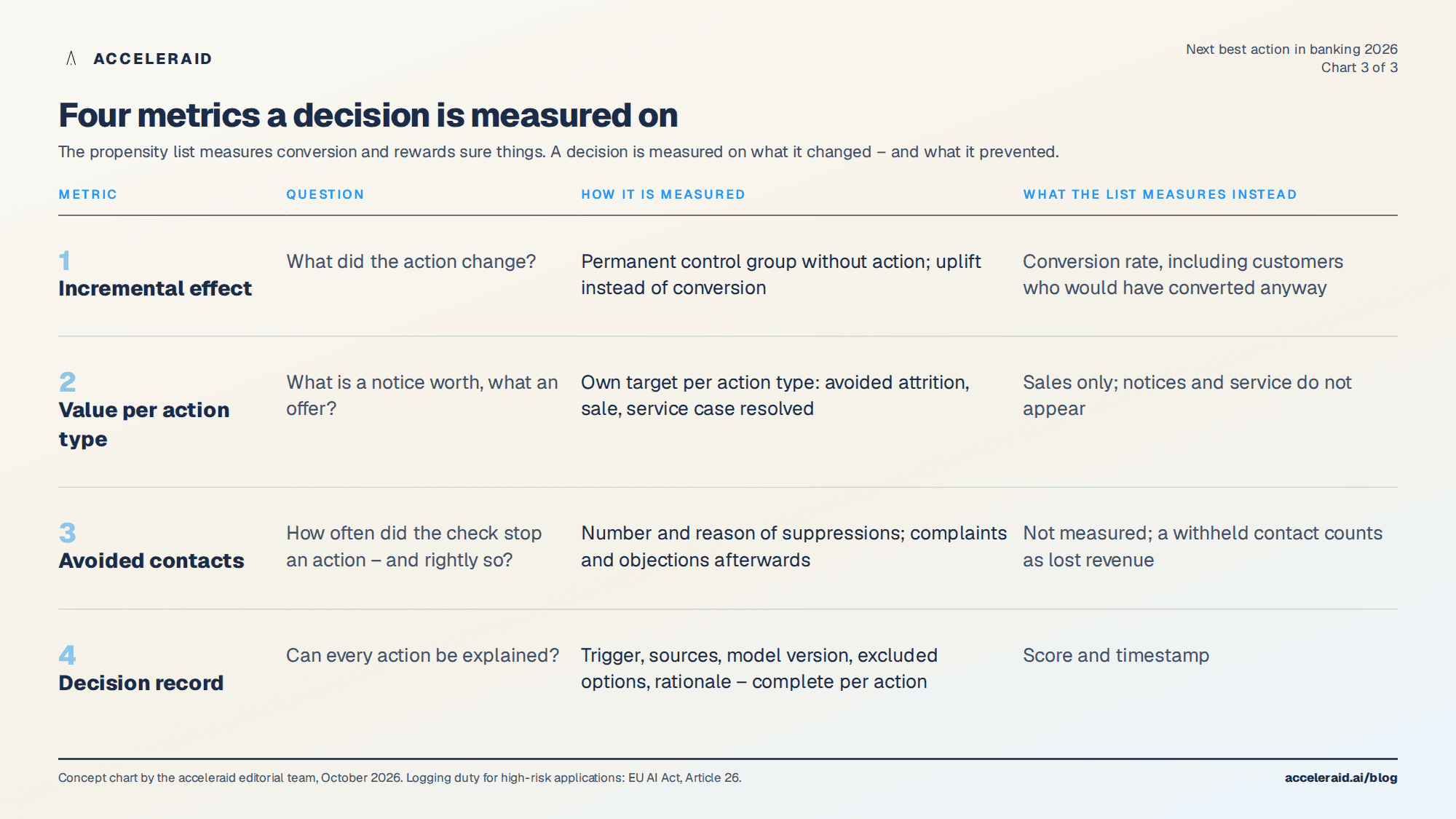
The propensity list is usually measured on conversion, and that is exactly what misleads. A model that predicts sure things produces high conversion rates among customers who would have converted anyway. The question a bank has to answer is: what did the action change? That takes four things.
A permanent control group that receives no action, so that the incremental effect becomes visible. Measurement per action type, because the value of a notice lies in avoided attrition, not in a sale. A metric for avoided contacts: how often did the check stop an action, and what would have happened otherwise? And a decision record that captures, for every action, the trigger, the sources used, the model version, the excluded options and the rationale. The last of these is not just a basis for measurement; under the AI Act it is already mandatory for high-risk applications such as creditworthiness assessment (EU AI Act, Article 26).
McKinsey has put the return, where this works, in a similar range for years: 5 to 15 percent higher campaign revenue and 10 to 30 percent more efficient marketing spend for banks that apply personalisation and analytics consistently (McKinsey). The range is wide because it depends less on the model than on whether the three mechanisms and the check step exist.
The adviser's role
Back to Monday's list. In a bank that treats next best action as a decision, the adviser sees not forty scores but perhaps twelve actions, each with a trigger, with what the system ruled out, and with the rationale. She can reject an action and say why. That feedback is not a convenience feature: it is the signal from which rules and models learn. An engine whose suggestions are quietly ignored in advice conversations learns nothing, and its hit rate stays where it was on day one.
That is the real yardstick for next best action in banking in 2026: not how well the model predicts, but how many of its suggestions pass the check, are accepted by people and demonstrably change something.
Five takeaways
A propensity list is not yet a next-best-action decision: it only answers who is likely to respond, not whether the bank may and should act.
Three questions, three mechanisms: eligibility deterministically in rules, likelihood of response in a monitored model, appropriateness in suppression rules that cannot be overridden.
The best action is often not an offer. Notices, service interventions and deliberate inaction belong in the action space, and customers reward exactly that.
The check and the contact budget run at the moment of delivery against the current state, not overnight at selection.
What gets measured is the incremental effect against a control group, per action type, including avoided contacts, on the basis of a complete decision record.
Anyone wanting to find out where their own institution stands can start with a single question: can an adviser see, for every recommendation, what the system ruled out and why? If not, it is still a list.
Illustration: AI-generated. AI-assisted content: We use AI technologies and automated agents in the creation of our articles, including from Microsoft, Google, OpenAI, Anthropic and other providers. Topics, editorial direction and final approval remain with our team.
Keep reading
More articles

Automation
AI Marketing Automation in Banking: What Changes Compared with Campaign Automation
AI marketing automation in banking: tools have tripled, impact has slipped. Five shifts compared with campaign automation, and what to build first.

CLM & CVM
Next Best Action in Banking 2026: From the Propensity List to a Checked Decision
Next best action in banking 2026: why the propensity list is not enough, the three questions a decision keeps apart, and how it is measured.

CLM & CVM
The First Job for the Bank's Assistant: Tell Me When There's Something Better
TD survey: 69% would hand the bank's assistant a task, 38% want alerts to better products. What that means for customer dialogue and lifecycle decisions.