CLM & CVM
The First Job for the Bank's Assistant: Tell Me When There's Something Better
TD survey: 69% would hand the bank's assistant a task, 38% want alerts to better products. What that means for customer dialogue and lifecycle decisions.
•
acceleraid Editorial Team
•
5 min read

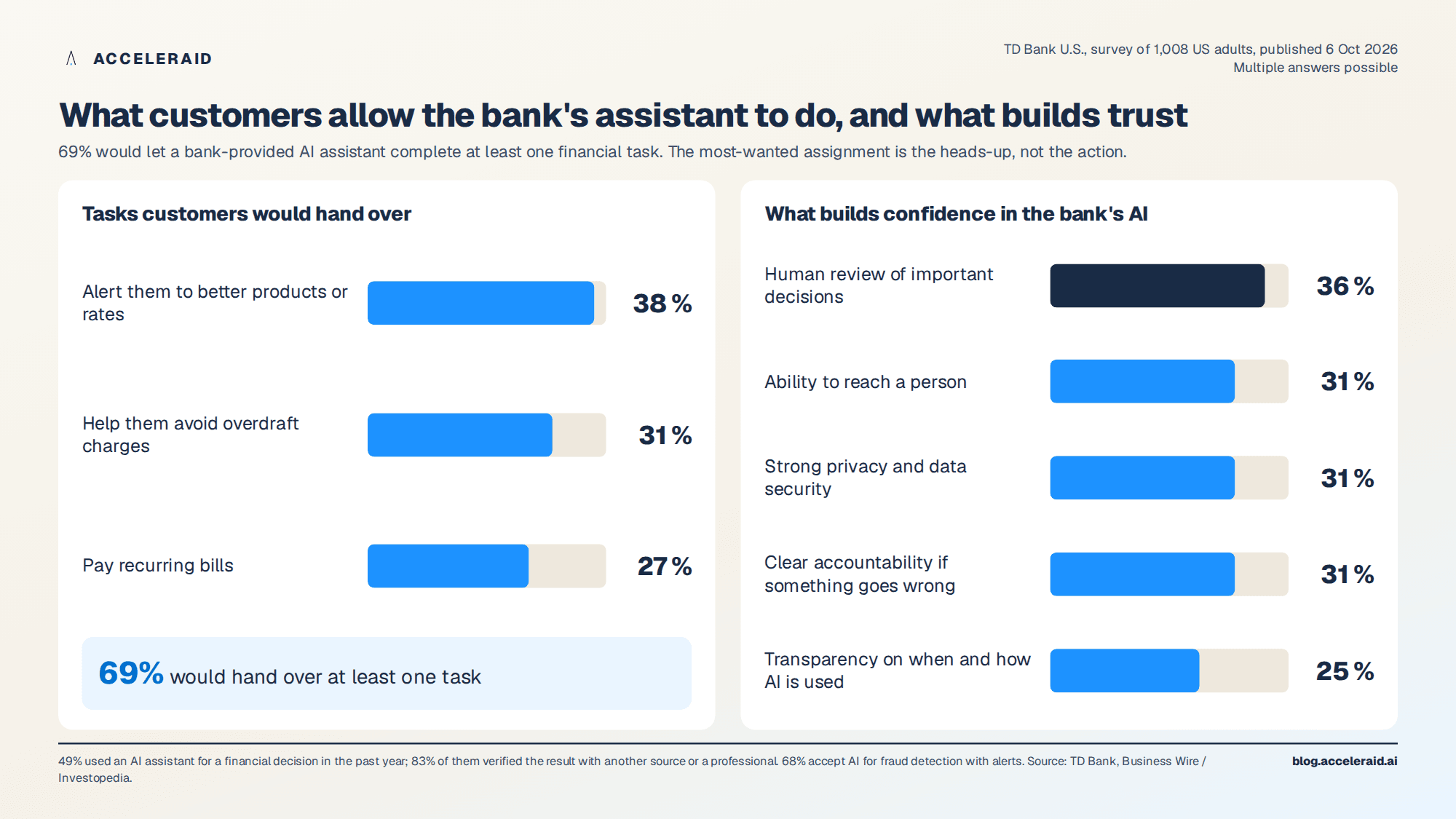
If bank customers could hand one task to an AI assistant from their bank, which would it be? The answer from a TD Bank survey of 1,008 US adults, published on 6 October 2026, should interest every marketing department: not the transfer, not the bill, but the heads-up. 38 percent of respondents would let a bank assistant alert them to potentially better products or rates. 31 percent would let it help them avoid overdraft charges, 27 percent would let it pay recurring bills. In total, 69 percent would allow a bank-provided assistant to complete at least one financial task on their behalf.
The number matters because it places the most-wanted assignment exactly where banks have been weakest: the proactive, individually relevant notice. Customers do not primarily want the bank to act for them. They want the bank to tell them when there is something better, before they go looking themselves.
The assistants are arriving in the app right now
The survey landed in a week in which several providers moved their assistants from pilot to production. Toss Bank in South Korea introduced an AI chat agent for all customers on 7 October, handling card deliveries and lost-card reports in conversation. According to the bank, waiting for a representative used to take more than five minutes; with the agent, handling time fell by around 90 percent to roughly 30 seconds. Identity checks run through the app's security screen, not the chat. Where fraud is suspected or the conversation runs long, a person takes over without the customer starting again.
Backbase moved its "Conversational Banking" solution into general availability on 8 October. Customers state requests in natural language, such as replacing a lost card or checking a payment, and agents carry them out within the bank's existing policies, permissions and approvals. According to the vendor, the technology runs at more than ten institutions; one of the four largest banks in South Africa is said to have supported 22 million customer interactions with it and raised its self-service containment rate from 20 to 70 percent. These are vendor figures, but they indicate the scale. Visa has offered a white-label assistant for banking apps since the summer that links spending insights to actions such as a card lock in the same conversation; a US pilot was announced for August, with no results published yet.
The pattern is the same in all three cases: the assistant no longer just answers questions, it completes tasks within the rules the bank sets. That makes it a daily channel to the customer. The question is what the bank says there.
What customers allow the assistant to do, and what builds trust
Task customers would hand to the bank's assistant | Share |
|---|---|
Alert them to better products or rates | 38% |
Help them avoid overdraft charges | 31% |
Pay recurring bills | 27% |
At least one financial task | 69% |
The TD survey also shows what trust depends on. 36 percent name human review of important financial decisions as the most important confidence factor; 31 percent each cite the ability to reach a person, strong privacy and data security, and clear accountability if something goes wrong. 25 percent want transparent explanations of when and how AI is used. 49 percent used an AI assistant for a financial decision in the past year, and 83 percent of them verified the result with another source or a professional afterwards. Ted Paris, who leads analytics and AI at TD Bank U.S., puts it this way: consumers are drawing clear lines around where AI can help and where human judgment remains essential.
The heads-up is a lifecycle decision
For customer management, this implies a shift. Today, the notice about a better product is usually a campaign: a segment is selected, an offer is worded, a send date is planned. Inside the assistant, the same notice becomes a decision about an individual, made at the moment the customer is already talking to the bank. That requires three things a campaign logic does not provide.
First, a current customer view: which products does the customer use, on what terms, which consents are in place, when was the last contact? Second, a suitability check: a notice about a better term deposit is only a service if it fits the customer's liquidity and does not breach contact rules. Third, a boundary between notice and action: the 38 percent want to be informed, not automatically reallocated. The model may propose, a rules layer checks, the customer or an adviser decides. The survey figures on human review and reaching a person are not an obstacle here; they are the build instructions.
A bank with these three building blocks can fill the assistant with what customers most often want from it. A bank without them will run it as a better FAQ channel and keep sending the notices by campaign, eight weeks after the trigger.
Five takeaways
69 percent of the US customers TD surveyed would hand a bank assistant at least one task; the most-wanted assignment is the alert to better products or rates (38 percent).
Toss Bank, Backbase and Visa showed in the same week that assistants are moving from answering to doing, always within the bank's policies and approvals.
Trust rests on human review (36 percent), reachability, privacy and clear accountability (31 percent each); 83 percent of AI users double-check results.
The product notice inside the assistant is no longer a campaign but an individual decision in the customer's moment, and it needs a current customer view and a suitability check.
Notice and action must stay separate: the model proposes, rules check, the customer or adviser decides. That is exactly the line customers draw themselves.
Illustration: AI-generated. AI-assisted content: We use AI technologies and automated agents in the creation of our articles, including from Microsoft, Google, OpenAI, Anthropic and other providers. Topics, editorial direction and final approval remain with our team.
Keep reading
More articles

AI & Banking
Agentic Experience Platform for Banks: Why the Loop Matters, Not the Tool
Treasure AI, golden context, 15 CDP use cases: why in banks the time from signal to checked action matters, not the tool. Opening article of the series.

CLM & CVM
Customer Lifecycle Management and Customer Value Management: The Operating Model for Agents
Part 1/5: CLM supplies the rows, CVM the objective. Why agents without an operating model optimise for clicks, and what belongs in each cell of the matrix.

Data & Technology
Customer Data Platform with a Context Layer: From Golden Record to Golden Context
Part 2/5: Three contexts, five functions, four kinds of memory. What turns a data field into a context object, and what the agent should not see.
