CLM & CVM
Personalisation as the Activation Layer: One Decision, Four Surfaces, One Way Back
Part 4/5: Personalisation is the execution of a checked decision, the same everywhere. Why contact budget and channel suppression are part of it.
•
acceleraid Editorial Team
•
6 min read

Series Agentic Experience Platform for Banks · Part 4 of 5. The lead article describes the five layers, Part 3 the decision engine. This part covers the layer in which the decision reaches the customer.
In banks, personalisation is usually discussed as a question of channel: what the app shows, what the email says, what the adviser sees. In an agentic experience platform, personalisation is something simpler and at the same time more demanding: the execution of a checked decision, the same everywhere. The activation layer ensures that the decision record from Part 3 arrives in every channel with the same meaning, and that the outcome flows back. Without that way back, the loop learns nothing.
One decision, four surfaces
The activation layer of the Acceleraid platform serves four surfaces: app and web, outbound communication, the adviser workplace and the service assistant. All four receive the same checked decision record. What differs is the form, not the content.
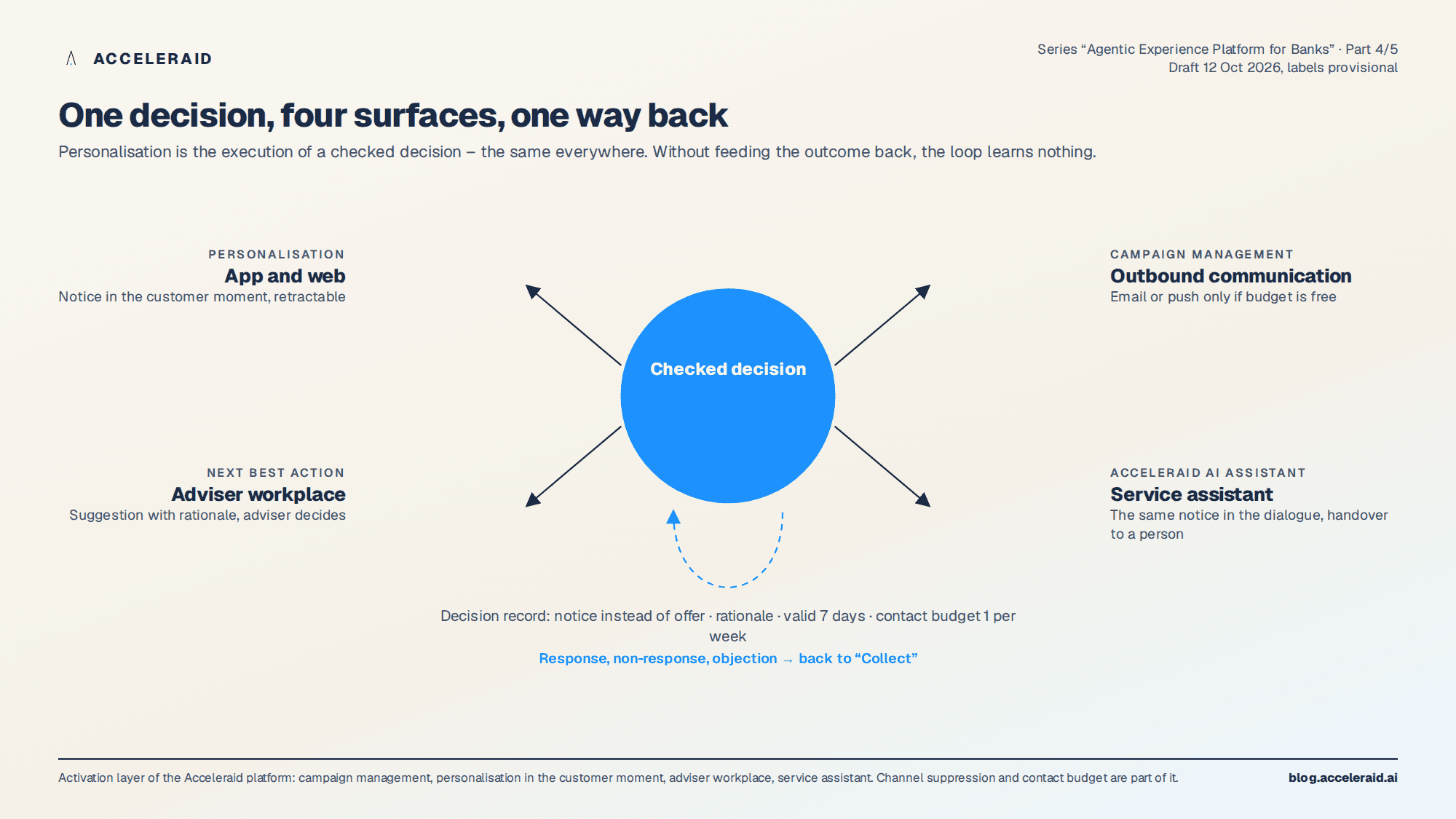
In app and web the notice appears in the customer moment, that is, when the customer is there anyway, and it is retractable: if she does not react, it disappears after its defined validity without triggering a second approach. In outbound communication the same notice only becomes an email or push message if the contact budget is free; otherwise the send is skipped and the omission is logged. On the adviser workplace the notice appears as a suggestion with its rationale; the adviser decides whether and how to take it up. In the service assistant, finally, the same notice is ready in the dialogue in case the customer calls or writes, with a defined handover to a person.
The point is not that every surface personalises. The point is that all four execute the same decision. Whoever sees a notice in the app, receives an offer by email and hears something else again from the adviser is not experiencing personalisation, but three systems that do not know each other. In our piece on AI personalisation in banks we described this as the real problem: not too little personalisation, but too many unconnected places doing it.
The service assistant as the fourth surface
The service assistant is the youngest of the four surfaces and the one where keeping the decision identical is hardest. A dialogue system tends to answer the customer's question and forget what the bank knows about her. In the activation layer the assistant is therefore not an independent decision-maker but a surface that reads the same decision record as the app and the adviser. If the customer calls about her card, the assistant knows about the open notice on the salary credit, but raises it only if the record permits that for this channel, and hands over to a person as soon as a complaint or an emotional situation becomes apparent. That this transparency is no side issue is shown by the same Salesforce survey: for 72 percent of customers it is important to know whether they are communicating with an AI agent (Salesforce). So the assistant says what it is, and it acts within the same frame as every other surface.
Why channel suppression is part of personalisation
The most important function of the activation layer is not delivering but holding back. A contact budget defines how many approaches a customer receives in a week at most, across all channels combined. Channel suppression defines that a notice shown in the app does not additionally arrive by email. A validity defines when a notice expires. All three are data in the decision record, not settings in the campaign tool.
That this restraint is no loss of effect is shown by the customer figures. In the latest Salesforce survey, 73 percent of customers say companies treat them as an individual rather than a number, up from 39 percent in 2023; at the same time 71 percent feel increasingly protective of their personal data, and 64 percent believe companies are reckless with customer data (Salesforce). Both movements at once mean: customers expect to be recognised, and they punish recognition that turns into harassment. Personalisation that does not know the contact budget consumes the trust it rests on.
The customer moment over time
In an agentic experience platform, speed is not measured in campaign days but in the time from signal to checked action. A hypothetical sequence shows where the time actually goes.
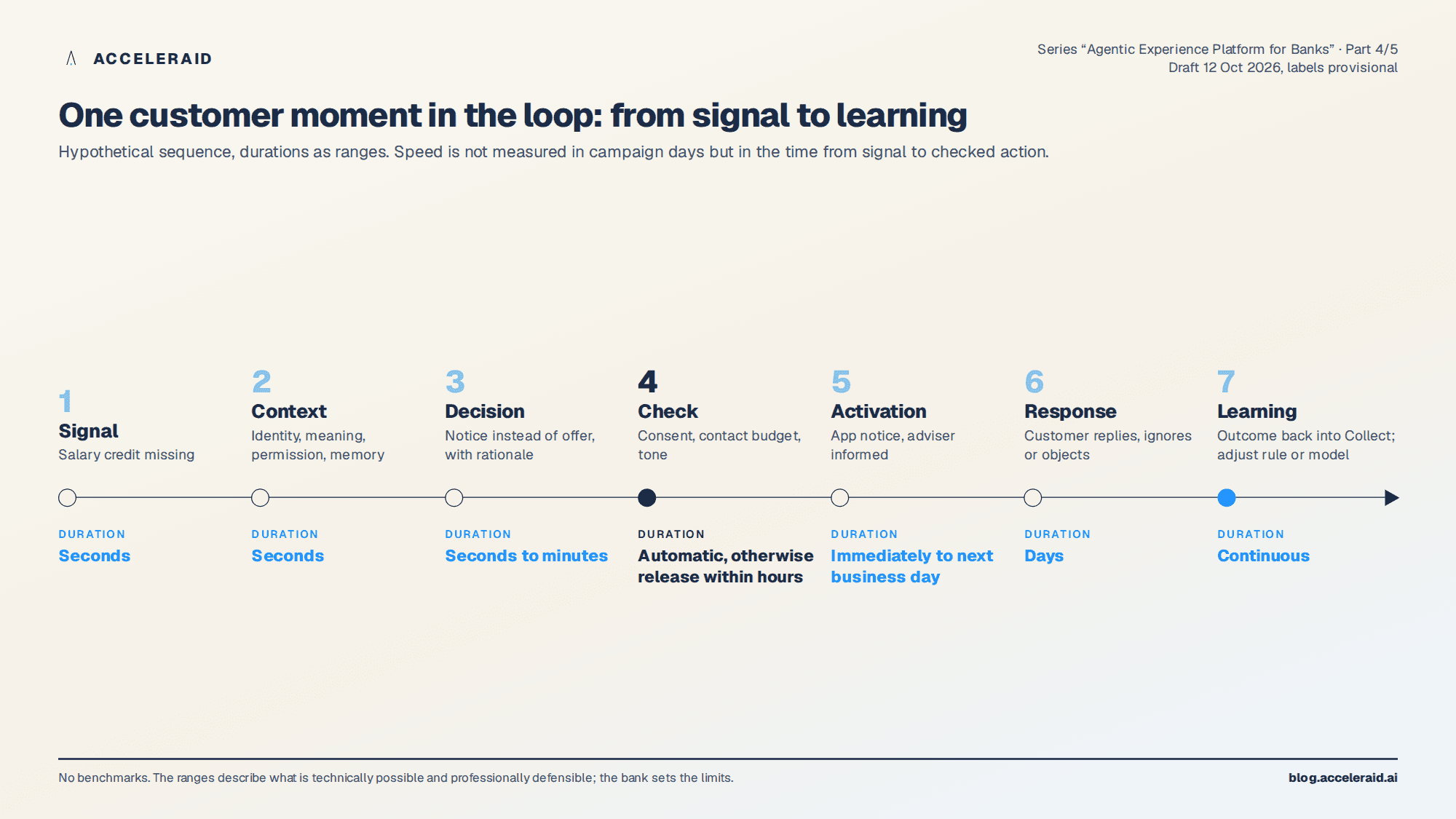
Signal, context and decision sit in the range of seconds; that is the part agents accelerate. The check runs automatically if the rules exist as data, and takes hours if a person has to release. Activation happens immediately in the app or on the next business day via the adviser. The customer's response takes days. Learning runs continuously. The ranges are not benchmarks; they describe what is technically possible and professionally defensible, and the bank sets the limits.
Two things stand out. First, the slowest part is not the technology but the human release, and that is as it should be, as long as it sits where the risk is high and not everywhere. Second, learning is the only step without an end. Response, non-response and objection go back into the context layer as events and change the next decision. An activation layer without this way back is a campaign tool with a shorter cycle.
What the adviser gets out of it
The adviser workplace deserves its own look, because it is the surface on which personalisation fails most often. A suggestion without a rationale is an imposition; the adviser can neither check it nor explain it to the customer. A suggestion with its rationale, the excluded options and the trigger is, by contrast, a relief: she sees why the notice makes sense, what the system deliberately does not suggest and what prompted the suggestion. Whether she calls is her decision, and her decision flows back as an event. Capgemini expects 75 percent of banks to deploy AI agents in customer service within the next two to three years (Capgemini). The adviser workplace is where it becomes clear whether those agents relieve advisers or sideline them.
What follows in the next part
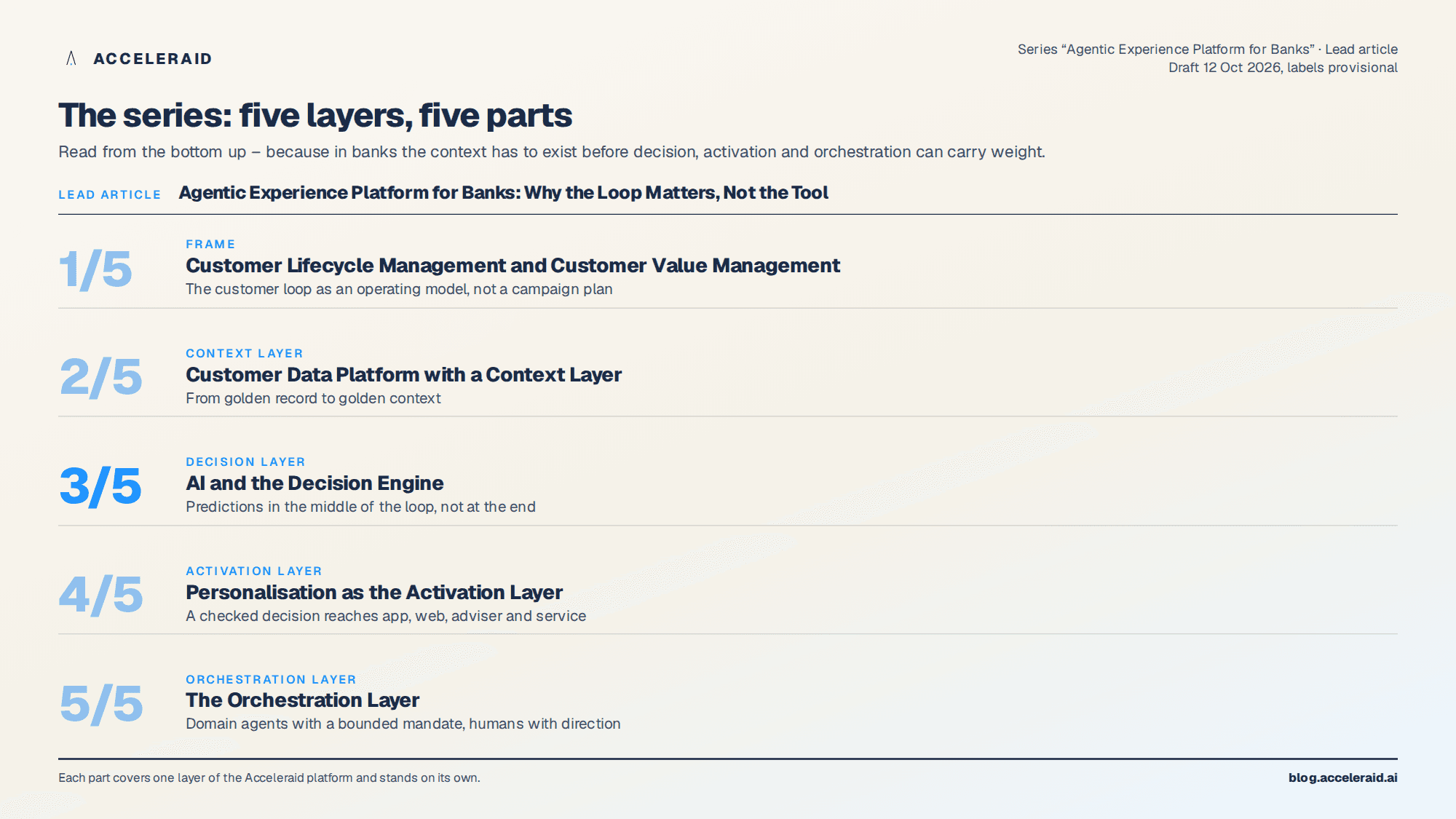
Four surfaces, one decision record, one way back: that presupposes someone coordinating the steps, clarifying responsibilities and stepping in when something goes off track. Part 5 closes the series with the orchestration layer: domain agents with a bounded mandate, humans with direction.
Five takeaways
Personalisation is the execution of a checked decision, the same in every channel; three systems with three messages are not personalisation.
The four surfaces app and web, outbound communication, adviser workplace and service assistant differ in form, not in content.
Contact budget, channel suppression and validity are data in the decision record; holding back is the activation layer's most important function.
Customers expect to be recognised and punish harassment; both at once call for personalisation that knows its budget.
Without responses flowing back into the context layer, the activation layer is merely a faster campaign tool.
Illustration: AI-generated. AI-assisted content: We use AI technologies and automated agents in the creation of our articles, including from Microsoft, Google, OpenAI, Anthropic and other providers. Topics, editorial direction and final approval remain with our team.
Keep reading
More articles

AI & Banking
Agentic Experience Platform for Banks: Why the Loop Matters, Not the Tool
Treasure AI, golden context, 15 CDP use cases: why in banks the time from signal to checked action matters, not the tool. Opening article of the series.

CLM & CVM
Customer Lifecycle Management and Customer Value Management: The Operating Model for Agents
Part 1/5: CLM supplies the rows, CVM the objective. Why agents without an operating model optimise for clicks, and what belongs in each cell of the matrix.

Data & Technology
Customer Data Platform with a Context Layer: From Golden Record to Golden Context
Part 2/5: Three contexts, five functions, four kinds of memory. What turns a data field into a context object, and what the agent should not see.
