AI & Banking
AI Bubble or Credit Cycle? Who Is Financing the AI Build-Out with Debt and How Much of It Reaches Real Growth
AI bubble or credit cycle? How bonds, SPVs and private credit finance the AI build-out, how much reaches real growth and what banks should check.
•
acceleraid Editorial Team
•
8 min
Andreessen Horowitz's "State of Markets II" report of 30 September 2026 is one of the most optimistic readings of the AI boom: valuations are backed by earnings, and technology accounts for around 76 percent of S&P 500 earnings growth in 2026 (a16z, September 2026). Anyone asking whether there is an AI bubble will mostly find counter-arguments there. Two questions, however, get little attention in the report. Who finances the data centre build-out once the free cash flow of the large platforms is no longer enough? And how much of the investment boom actually shows up as real growth once imports and prices are taken into account? This article answers both questions with data from the BIS, the ECB, Goldman Sachs, PIMCO and J.P. Morgan. It also sets out what this means for banks as lenders, as investors and as buyers of AI. It contains no market forecast and no investment advice.

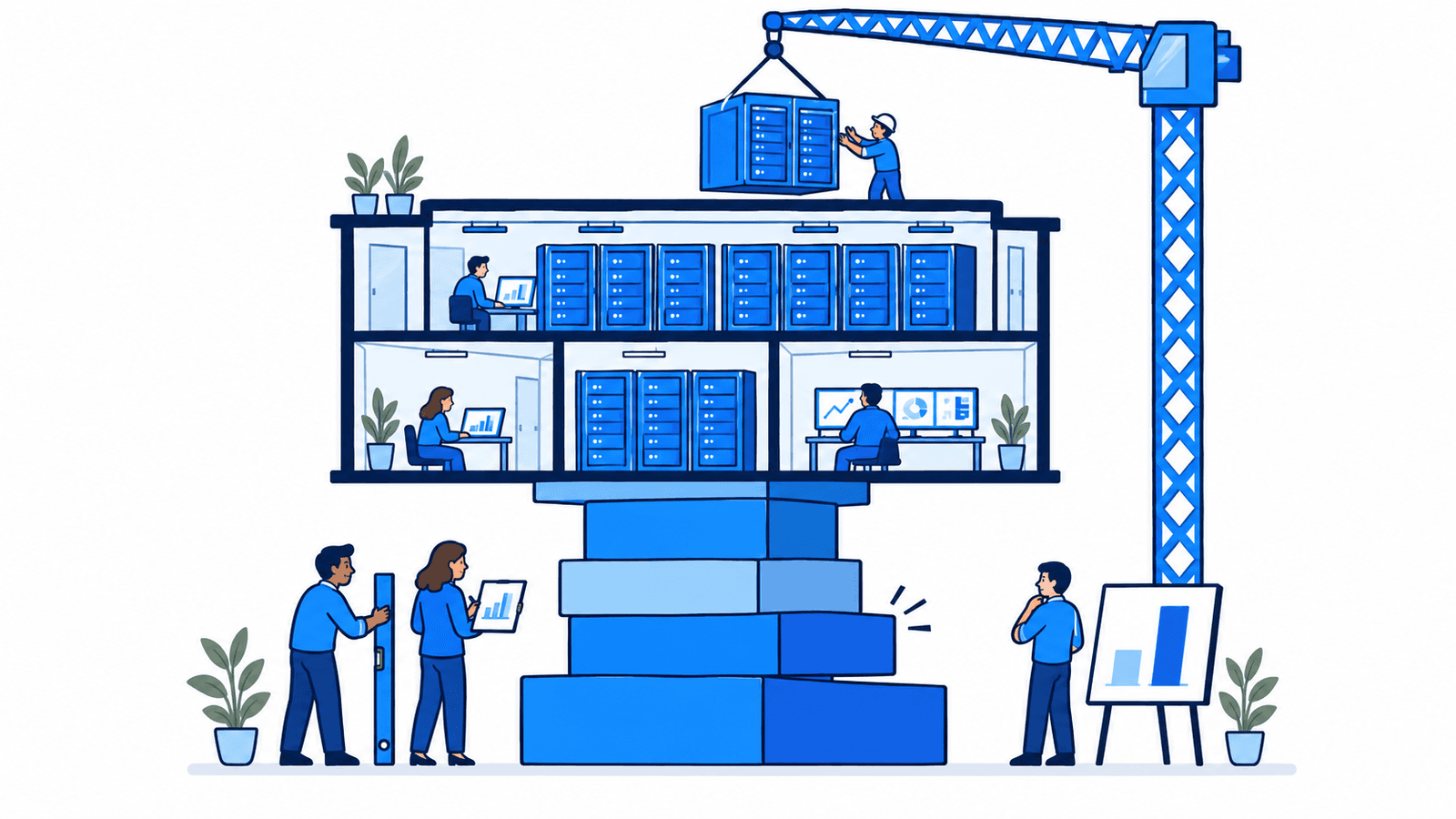
Illustration: AI-generated, hypothetical example.
Hypothetical example: The chief risk officer of a German state bank has to decide whether her institution should take a EUR 150 million ticket in a syndicated loan for a data centre campus. The developer presents a 15-year lease with a large cloud provider. Her credit analyst asks three questions. Is the cloud provider itself liable, or only a project company? What will the hardware be worth in five years? And how many similar positions does the bank already hold through funds, securitisations and credit lines to private credit funds? She postpones the decision until those questions are answered. The bank, the people and the amount are invented; the questions are not.
What the a16z report says about an AI bubble – and what it leaves out
The report argues from earnings, not from financing. Its central thesis is that, unlike in 2000, the share prices of large technology companies are rising mainly because their profits are rising. On the demand for semiconductors, power and networking, it says this has been funded "in large part" by the profits of the largest technology companies, "but increasingly by debt, as well" (a16z). That is all the report page says about debt. Bonds, private credit and real growth are not covered there.
On benefits, too, the report is more cautious than its tone suggests. Nearly 30 percent of S&P 500 companies report some "quantifiable impact" from AI, but only around 2 percent report any tracked metric (a16z). For banks, this is the more important number: for most companies, there is still a wide gap between "we use AI" and "we measure the return".
Who funds the build-out: bonds, special purpose vehicles, private credit
A growing share of the build-out is debt-financed, and part of it sits outside the balance sheets of the large platforms. According to IESE, expected 2026 capital expenditure by the big hyperscalers rose from USD 296 billion at the start of 2025 to more than USD 690 billion by mid-May 2026 (IESE, June 2026). Hyperscalers are the large cloud and platform companies that run their own data centres at global scale. IESE says that, taken together, they are spending almost all of their operating cash flow on capex.
Financing is shifting accordingly. Goldman Sachs estimates that around 27 percent of hyperscaler capex was debt-financed in 2025. It expects about one third in 2026 and around 35 percent in 2027 (Goldman Sachs, August 2026). Hyperscaler bond issuance was USD 108 billion in 2025 and had already reached USD 194 billion by early August 2026. Barclays counts all capital raised through debt and equity by hyperscalers, data centre special purpose vehicles and neoclouds: USD 172 billion in 2025 and USD 346 billion by the end of September 2026 (Yahoo Finance with Barclays data, September 2026).
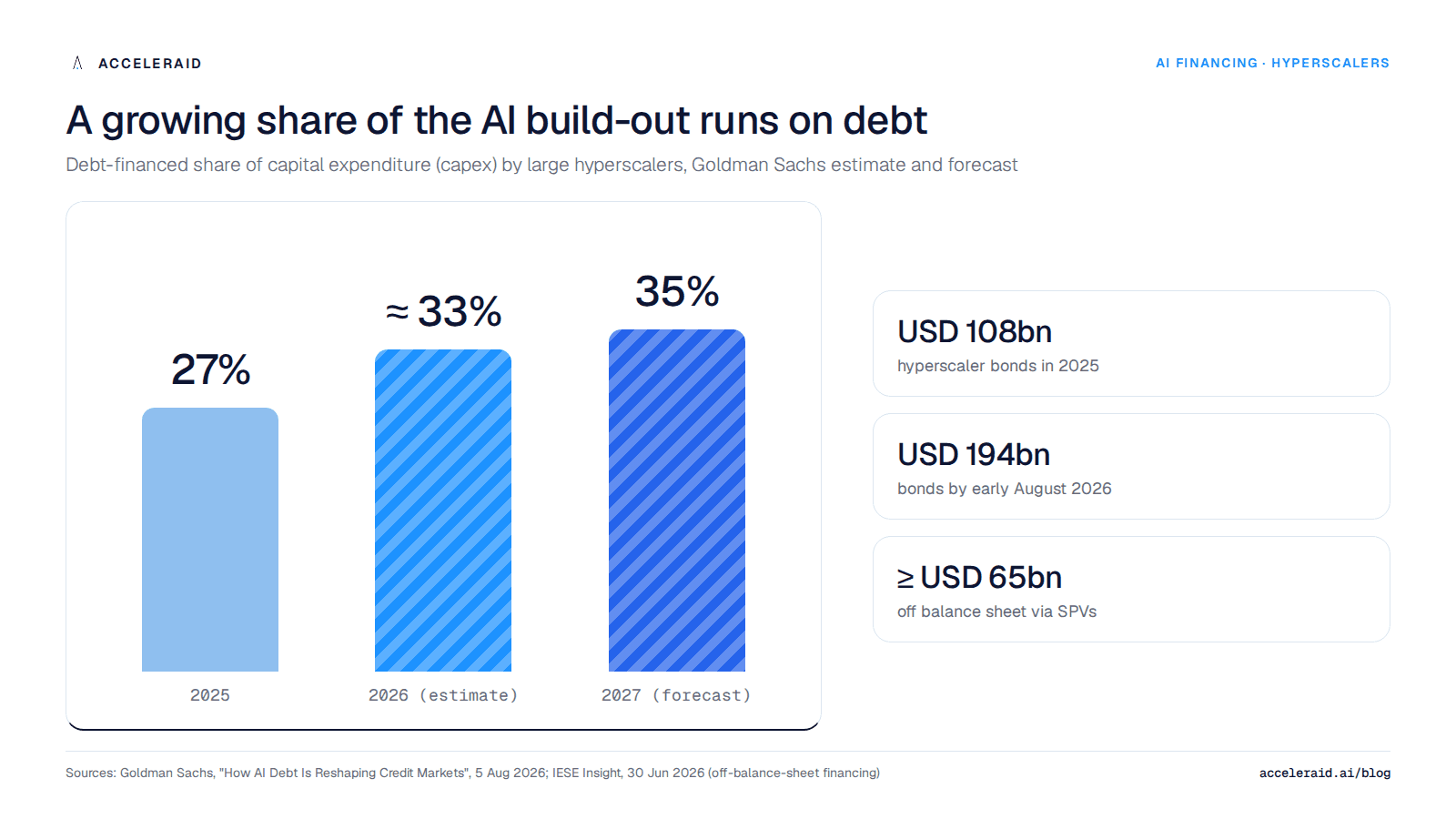
For lenders, the second channel matters more than bonds: special purpose vehicles. A special purpose vehicle (SPV) is a company set up specifically to build or buy a data centre and to raise its own debt for it. The BIS describes the pattern as follows. The hyperscaler typically holds only a minority stake, commits to long-term leases or offtake agreements and may provide guarantees. Economically, this replaces capex with multi-year operating expenses while keeping most of the debt off its balance sheet. The BIS calls this "shadow borrowing" (BIS Quarterly Review, March 2026). IESE puts such off-balance-sheet financing at a minimum of USD 65 billion. The most visible example is Meta's USD 27 billion joint venture with Blue Owl for the Hyperion campus in Louisiana (IESE).
How much of it is real growth
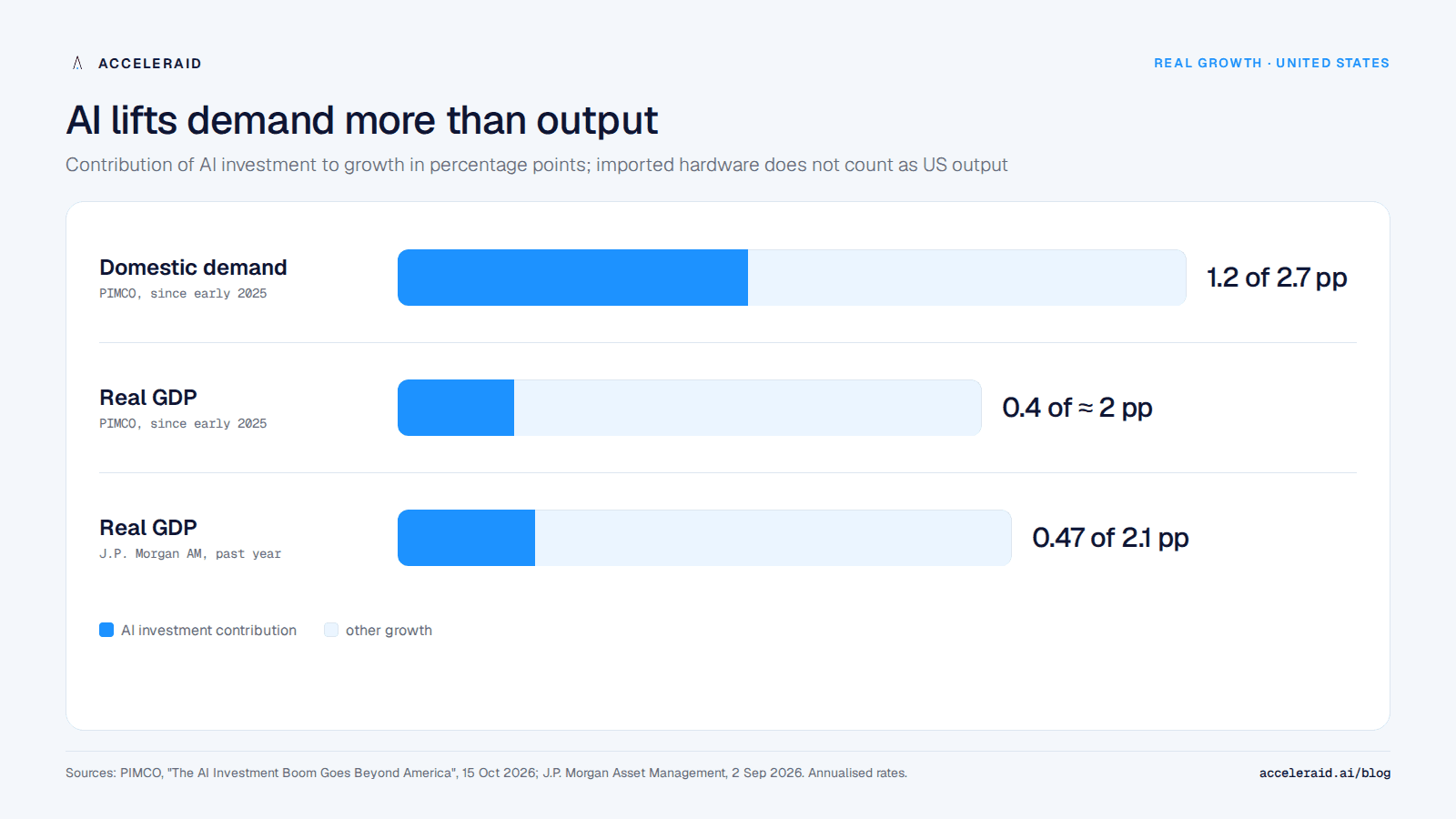
Net of imported hardware, AI investment contributes roughly one fifth of real US growth, far less than its contribution to demand. This is the core of the question whether growth is smaller "after inflation". Strictly speaking, two adjustments are involved. First, investment in real GDP is adjusted for prices. Second, imports are subtracted, because chips and servers made abroad do not count as domestic output. PIMCO estimates that AI investment has contributed around 1.2 percentage points to average US domestic demand growth of 2.7 percent since the start of 2025. Its contribution to real GDP growth of about 2 percent, however, was only around 0.4 percentage points, because a large share of the spending went on imported goods (PIMCO, October 2026).
J.P. Morgan Asset Management arrives at a similar picture: 0.47 percentage points of 2.1 percent real growth over the past year, or roughly one fifth (J.P. Morgan AM, September 2026). The same source notes that the statistics may understate the contribution, for example when US chip design is manufactured abroad or imported chips are booked as intermediate inputs. An imported server is neutral for GDP on the day it is bought, but it still adds to the capital stock. So the claim that the real effect is smaller than the headlines holds. Yet the gap between spending and output is not proof of a bubble; it is first of all a measurement question.
What this means for banks as lenders
For European banks the direct risk is limited for now, but the risk via private credit and special purpose vehicles is growing. In its Financial Stability Review of May 2026, the ECB simulated a shock to the global private credit market. Losses for euro area banks stayed below 1.3 percent of equity at every stage, because their loans to funds are mostly senior and relatively small. The ECB warns, however, that private credit could become an important source of funding for AI data centres, in which case exposures could grow quickly. Market intelligence suggests that up to 30 percent of the roughly USD 3 trillion the build-out needs over the next few years could come from private credit (ECB, Financial Stability Review May 2026).
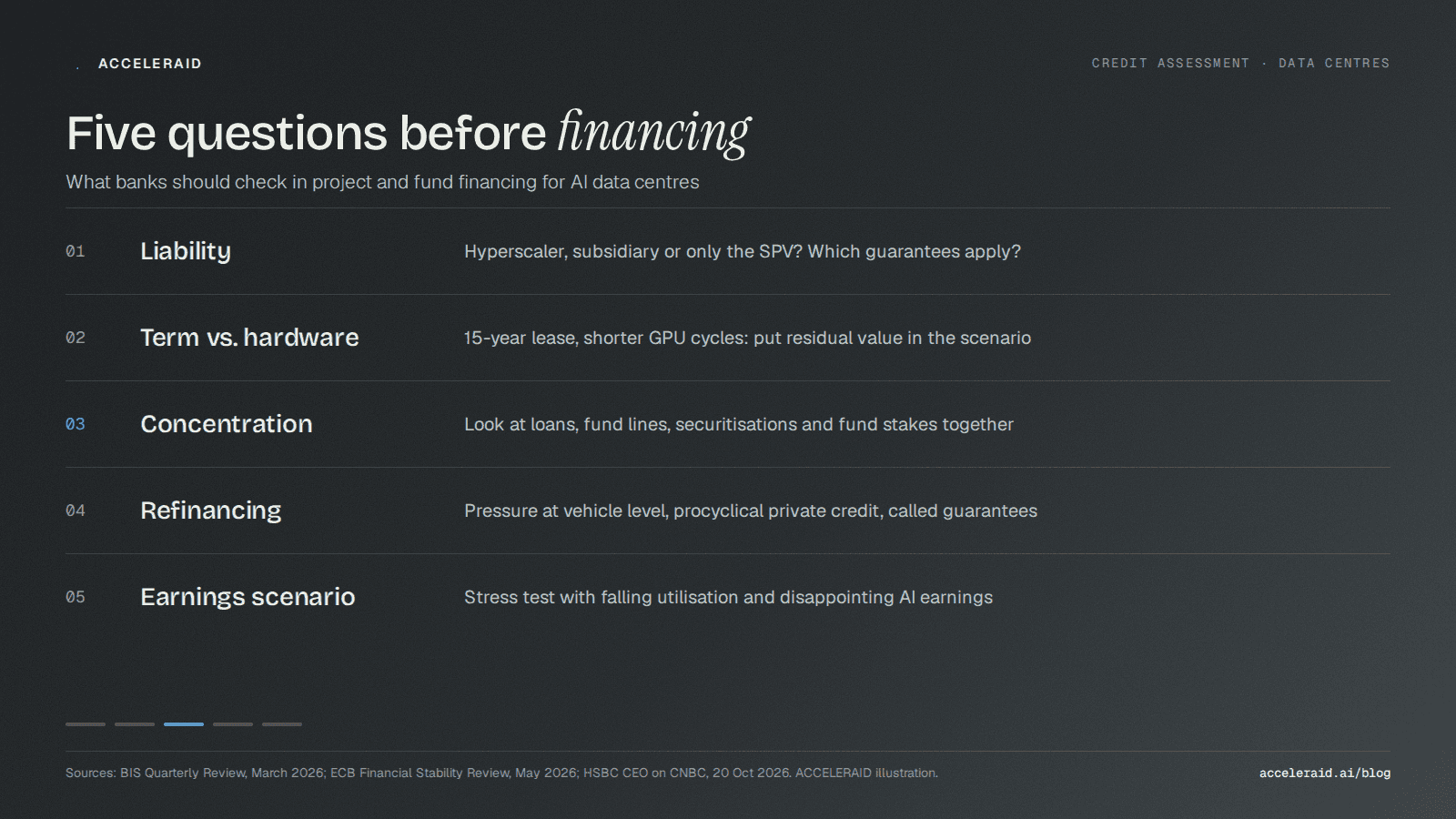
HSBC chief executive Georges Elhedery put the consequence plainly in October: one has to be selective and look at the quality of the tenancy agreements and the pricing of those contracts. Not every project is solid enough to be supported strongly (CNBC, 20 October 2026). This translates into five questions for credit assessment:
Who is liable? Is the lease backed by the hyperscaler itself, a subsidiary or only the SPV – and which guarantees apply on early termination?
How long does the contract run compared with the hardware? Leases often run for 15 years, while GPU generations change much faster. The residual value of the technology belongs in every scenario.
How large is the total concentration? Direct loans, credit lines to private credit funds, securitisations and fund holdings have to be looked at together, not department by department.
What happens at refinancing? The BIS names refinancing pressure at vehicle level, procyclical shifts in private credit appetite and the activation of guarantees as transmission channels to banks.
What if AI earnings disappoint? The ECB explicitly calls future productivity and earnings gains uncertain. A stress scenario with falling utilisation should therefore be standard.
What this means for banks as buyers of AI
Banks that use AI themselves should not tie their strategy to one provider or one price path. When a third of the build-out is debt-financed and spreads are rising, provider prices, capacity and terms can change faster than in a market financed purely from equity. According to Barclays data, credit spreads for bonds of hyperscalers, data centres and neoclouds have widened materially over the past two quarters (Yahoo Finance). For a bank's IT strategy, that means: keep models interchangeable, build exit clauses into contracts and make dependencies visible in the DORA third-party analysis. Measure the benefit with a metric from day one, which is exactly where only 2 percent of large companies are today, according to a16z.
ACCELERAID follows this approach in its own platform: language models from several providers run in European data centres (Azure region Germany, Google Cloud Frankfurt), hosting takes place in an ISO 27001-certified data centre in Frankfurt, and on-premise deployment is available on request. How a bank can assess concentration risk among AI providers is covered in our article on AI provider concentration risk. The supervisors' view is summarised in our piece on the ESAs' autumn 2026 risk update.
Is it an AI bubble?
The data point to a debt-intensive investment cycle with clear weak spots rather than a pure valuation bubble. The earnings of the large platforms are real, as a16z rightly stresses. But it is equally real that a growing share of the build-out runs on debt, often off balance sheet and through markets the ECB describes as opaque. And once imports are netted out, the contribution to real growth is much smaller than the investment totals suggest. Whether this turns into a problem depends less on share prices than on two factors: data centre utilisation, and whether AI customers honour their contracts over the full term. For banks, this is a classic credit question, not a matter of belief.
Five takeaways
The a16z report of September 2026 explains valuations through earnings; it mentions debt in half a sentence and does not cover private credit or real growth at all.
Goldman Sachs estimates the debt-financed share of hyperscaler capex at 27 percent in 2025, about one third in 2026 and 35 percent in 2027, plus at least USD 65 billion of off-balance-sheet financing through special purpose vehicles.
Net of imports, AI investment contributes roughly one fifth of real US growth (PIMCO 0.4 of about 2 percentage points, J.P. Morgan 0.47 of 2.1), far less than its contribution to demand – with possible measurement gaps in both directions.
For euro area banks the ECB sees the direct risk as limited for now (losses below 1.3 percent of equity in its stress scenario), but warns of exposures that could grow quickly through private credit.
Credit assessment here means: liability, contract term versus hardware life, total concentration, refinancing and a scenario with disappointing AI earnings – and for a bank's own AI: interchangeable models and measurable benefit.
Illustrations: AI-generated. AI-assisted content: We use AI technologies and automated agents in the creation of our articles, including from Microsoft, Google, OpenAI, Anthropic and other providers. Topics, editorial direction and final approval remain with our team.
Read on
Where to go next.
From the blog