Regulation & Compliance
ESAs Warn of External Dependencies: What It Means for Banks' AI Providers
EBA, EIOPA and ESMA name dependence on ICT providers outside the EEA as a key vulnerability. Four consequences for AI operations in banks.
•
acceleraid Editorial Team
•
5 min read

On 23 September 2026, the three European supervisory authorities EBA, EIOPA and ESMA published their autumn update on risks and vulnerabilities in the EU financial system. Three items top the list: external dependencies, emerging technologies and private credit (EBA press release, 23 Sep 2026). The first item concerns every bank running generative AI in production, because the models and data centres behind it mostly come from providers outside the European Economic Area.
What the ESAs found
The findings were presented to the Financial Stability Table of the EU's Economic and Financial Committee on 10 September 2026. The authorities describe the starting point as robust: European banks operate from a position of strength, with strong profitability, high capital ratios and low levels of non-performing loans. Deterioration is expected mainly in commercial real estate and among SMEs. Operational risks are increasing; cyber and fraud risk remain the main sources of concern.
On external dependencies, the ESAs get specific. The banking sector shows an ongoing strong reliance on ICT service providers and payment systems outside the EU. The dependence is also visible in financial infrastructures: clearing, repo and credit rating markets are largely intermediated by non-EU entities. Banks also face funding gaps in non-EU currencies, mainly US dollars, sterling and Swiss francs.
In the authorities' assessment, this reliance has three consequences. It ties the sector to other regulatory regimes. It increases vulnerability to geopolitical events outside the EU. And it heightens cyber risk, particularly given the concentration of dependence on a few non-EEA ICT providers. The rapid development of advanced AI systems, the ESAs write, could make cyberattacks more powerful and harder to contain, allowing attackers to identify and exploit vulnerabilities at unprecedented speed. Quantum computing is named as a second dual-natured technology that can optimise processes but also undermine widely used cryptography.
Why this concerns banks' AI architecture
"ICT service providers outside the EEA" sounds abstract. In practice it means the cloud platforms on which core systems run and the model providers whose language models have moved into customer service, case handling and analytics. Most banks source both from a few large US companies. What has long been true for computing power now applies to models: a bank drawing its AI capability from a single provider has a dependency that supervisors and rating agencies read as a risk.
The ESAs explicitly call on supervisors and market participants to monitor dependencies on non-EU and non-EEA service providers and to strengthen preparedness for risks arising from the rapid development of AI and quantum computing. This is a sharpened expectation rather than a new obligation. The Digital Operational Resilience Act has required a register of information covering all contractual arrangements with ICT third-party providers since January 2025. A bank that takes this register seriously can already see the concentration in black and white; the question is what follows.
Four consequences for AI operations
Inventory dependencies, including models. The DORA register captures contracts. An AI inventory must go further and record which model runs in which process, with which provider, in which region, on which data. Only this linkage shows which customer processes stop if a provider fails or a regime changes.
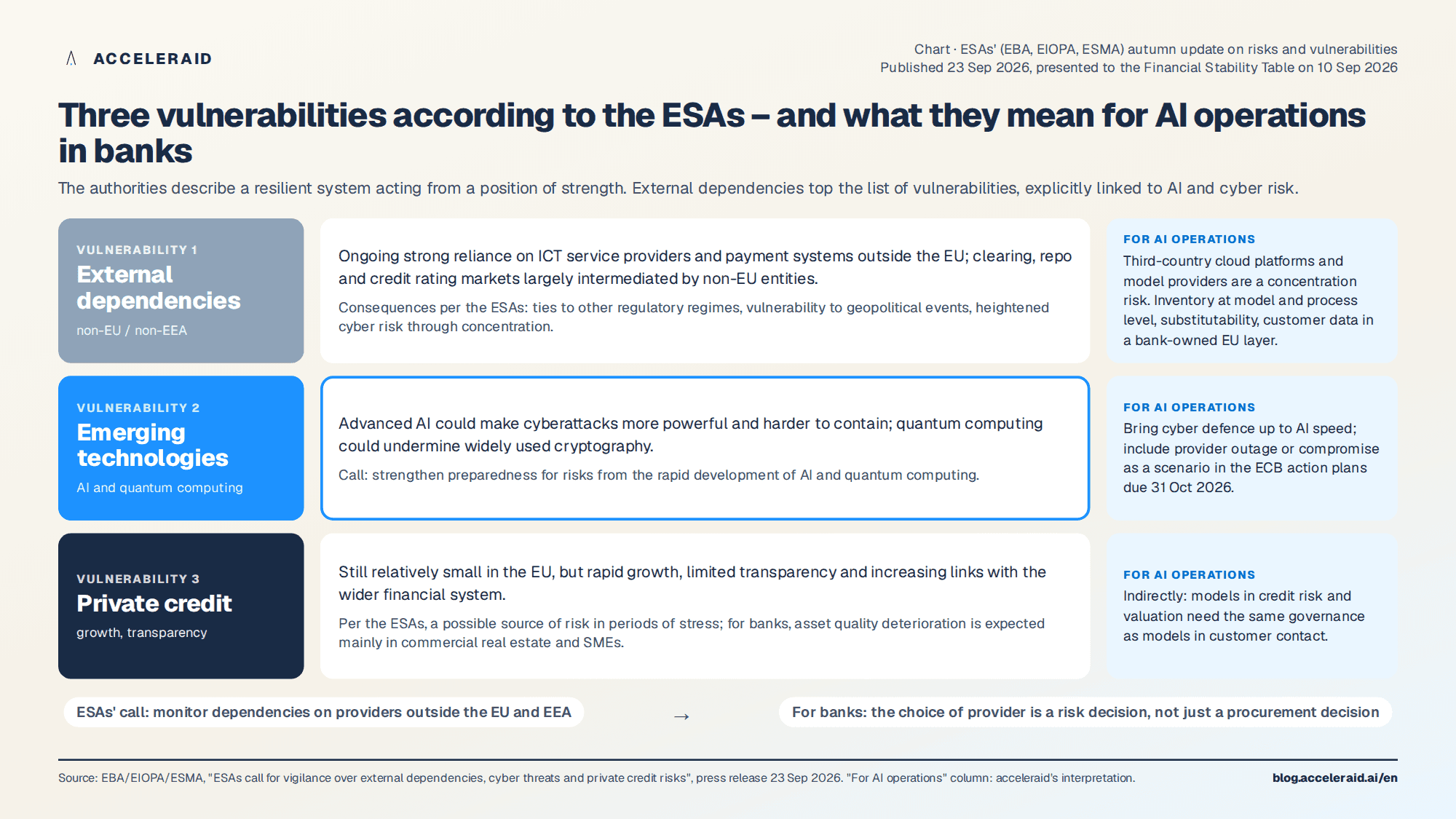
Build substitutability. An architecture in which models sit behind the bank's own layer for orchestration, rules and customer data can switch providers without rebuilding the application. We have described this principle as model independence (why the AI stack must not belong to any single model). Hyperscaler model catalogues and European providers widen the choice (from cloud lock-in to freedom of choice). Substitutability is the operational answer to what the ESAs describe as concentration risk.
Separate customer data. Knowledge about customers, their history, their consents and the rules of engagement belongs in a layer the bank controls and that resides in the EU. The model receives what it needs for the task, and no more. This makes a provider switch possible and limits the scope of what would be affected in an incident.
Bring cyber defence up to AI speed. The ESAs explicitly link external dependency and AI-enabled attacks. The ECB requires supervised institutions to submit action plans on exactly this by 31 October 2026 (what the supervisory letter requires). Banks writing those plans should include concentration on a few providers as a scenario in its own right: what happens if the provider itself becomes the target of an attack?
Assessment
The autumn update is not an alarm call; the ESAs stress the system's resilience and banks' position of strength. But the order of the vulnerabilities named is a signal. External dependencies come first, ahead of private credit, and they are explicitly linked to AI and cyber. For institutions planning to bring AI into customer processes over the coming years, the choice of provider is a risk decision, not just a procurement decision. Banks that treat it that way will have the better answer for supervisors and rating agencies.
Five takeaways
The ESAs name external dependencies, emerging technologies and private credit as key vulnerabilities of the EU financial system; dependence on ICT service providers outside the EEA is singled out as a particular concern.
For banks this means, concretely, that third-country cloud platforms and AI model providers are a concentration risk that supervisors and rating agencies are increasingly examining.
The authorities see a direct link between this concentration and cyber risk, which continues to rise as AI models become more capable.
The DORA register of information reveals the dependency; an AI inventory at model and process level and a substitutable architecture make it manageable.
Customer data and engagement rules belong in a bank-owned layer in the EU; this limits provider dependency and the reach of incidents.
Illustration: AI-generated. AI-assisted content: We use AI technologies and automated agents in the creation of our articles, including from Microsoft, Google, OpenAI, Anthropic and other providers. Topics, editorial direction and final approval remain with our team.
Keep reading
More articles

AI & Banking
Agentic Experience Platform for Banks: Why the Loop Matters, Not the Tool
Treasure AI, golden context, 15 CDP use cases: why in banks the time from signal to checked action matters, not the tool. Opening article of the series.

CLM & CVM
Customer Lifecycle Management and Customer Value Management: The Operating Model for Agents
Part 1/5: CLM supplies the rows, CVM the objective. Why agents without an operating model optimise for clicks, and what belongs in each cell of the matrix.

Data & Technology
Customer Data Platform with a Context Layer: From Golden Record to Golden Context
Part 2/5: Three contexts, five functions, four kinds of memory. What turns a data field into a context object, and what the agent should not see.
