Data & Technology
Your AI Stack for Banking: Nine Building Blocks from Customer Data to AI Assistant and Personalization Engine
A modular AI stack for banks: nine building blocks from deployment and security to CX, with AI Assistant and Personalization Engine on one governed base.
•
acceleraid Editorial Team
•
7 min
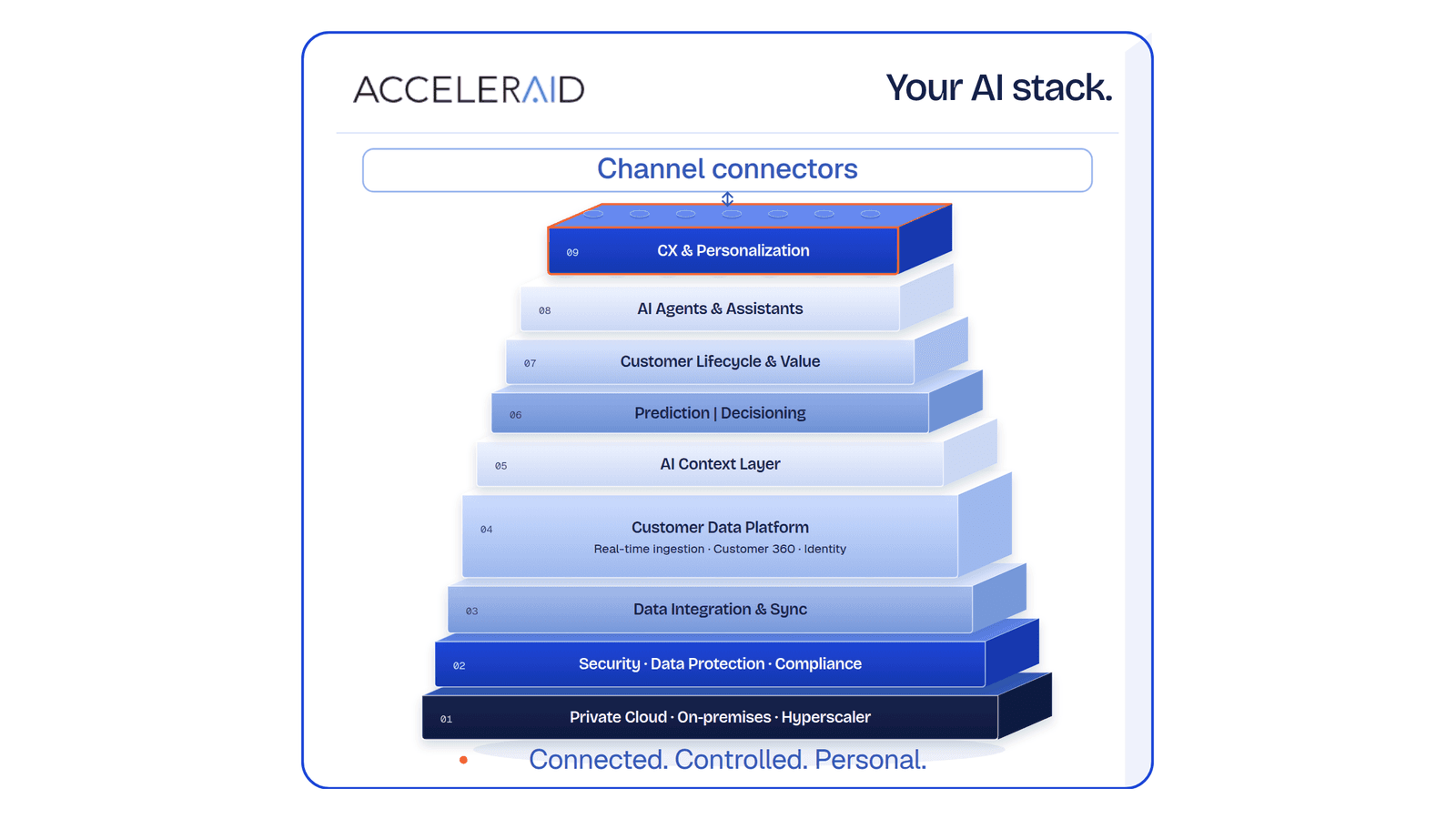
Banks and card issuers do not lack AI ideas. What they lack is a stack that brings customer data, context, decisions and control together, so an AI Assistant can answer correctly and a Personalization Engine can choose the right next action. This article walks through the nine building blocks of a modular, governed AI stack for banking, from deployment at the bottom to the customer experience at the top, and shows where the AI Assistant and the Personalization Engine sit.
Why banks need a stack, not another AI tool
Most banks have AI pilots; few have the architecture to run them at scale under supervision. In a 2026 Camunda survey of banking and financial services leaders, 75 percent plan to deploy or expand agentic orchestration within twelve months, while only 12 percent say their operations are ready for agents at scale (Camunda, State of Agentic Orchestration and Automation 2026). Among the 50 largest banks, the Evident AI Index finds that only about 1 percent of published AI use cases disclose a concrete financial return (Evident AI Index for Banks 2026).
The gap is rarely the model. It is everything around it: which data the AI may see, how it gets the customer's situation, who decides the next action, and how every step is logged. A modular stack answers these questions once, so every new use case does not have to solve them again.
Hypothetical example: A cardholder opens her banking app and asks the assistant about a card payment she does not recognise. The assistant sees the enriched transaction with the merchant's trading name and location, explains it in two sentences and offers to block the card only if she still does not recognise it. A few days later, the same context tells the Personalization Engine not to send her a card upgrade offer this week, because an open service case takes priority. The bank and the customer are fictitious.
The nine building blocks, from the ground up
Each layer has one job, and each layer builds on the one below. The order matters: security is not added at the end, it is the second layer from the bottom.
No. | Building block | What it does |
|---|---|---|
01 | Deployment and infrastructure | Private cloud, on-premises or hyperscaler, depending on the bank's environment |
02 | Security, privacy and compliance | Data protection, permissions and audit trails, with controls designed to support applicable requirements |
03 | Data integration and sync | Connects core banking, CRM, card and transaction data |
04 | Customer Data Platform | Real-time ingestion, Customer 360 and identity resolution |
05 | AI context layer | Turns connected data into the context a task needs and may use |
06 | Prediction and decisioning | Prediction anticipates what may happen next; decisioning chooses the appropriate action |
07 | Customer lifecycle and value management | Connects actions from onboarding and engagement to retention and long-term value |
08 | AI agents and assistants | Assistants explain, agents coordinate the next step, with context, permissions and control |
09 | CX and personalization | The customer-facing outcome: content, conversation and next action shaped around the individual |
Above layer 09, channel connectors deliver the experience to the touchpoints: app, online banking, website, contact centre and adviser workplace. The enclosure around all nine layers is the bank's own AI stack, not a tenth layer.
The foundation: deployment, security and data
Layers 01 to 04 decide whether AI may be used in a bank at all. Deployment determines where data is processed. ACCELERAID runs in a private cloud in an ISO 27001-certified data centre in Frankfurt, or on-premises at the bank on request (ACCELERAID). ACCELERAID holds a SOC 2 report for the company and its software, and the data centre is SOC 2 audited as well. Security, privacy and compliance sit directly on top: field-level PII filtering and redaction, role-based access, consent management and audit-proof logging are part of the data model, not a later add-on.
For regulated institutions, these controls support the requirements that already apply. The Digital Operational Resilience Act (DORA) has applied to financial entities since 17 January 2025 and covers ICT risk management, incident reporting and third-party risk (Regulation (EU) 2022/2554). A stack does not make a bank compliant on its own; it gives the bank the controls and the evidence it needs for its own compliance.
Data integration and the Customer Data Platform then bring the customer picture together. For card issuers, transaction data is a central source: Mastercard's rule AN4569 and Visa's rule 4.1.8.9 oblige issuers to make transactions recognisable to cardholders, which we cover in our article on enhanced merchant data.
The intelligence: context, prediction and decisioning
Layers 05 and 06 turn data into the right action at the right moment. The AI context layer gives an assistant or agent only the context a task needs and is permitted to use, with purpose and expiry attached; we describe this in context layer in banking. Prediction estimates, for example, the likelihood of an account closure. Decisioning applies rules, consents and a contact budget to choose the action, or deliberately no contact. How such an engine is built is covered in the five building blocks of an AI decision engine.
The two products customers experience
At the top of the stack, two ACCELERAID products make the layers below visible to customers and employees.
The AI Assistant answers customers in natural language, starting with the chat on the bank's service website, and can be extended to employees through the bank's internal knowledge. It uses retrieval from approved bank content, PII filtering before any model call and model-agnostic support, for example OpenAI via Azure or Google Gemini, without its own foundation model (ACCELERAID). Because it sits on the context layer, it can explain a transaction or a product condition for the specific customer, not just recite an FAQ. Where a step needs an action, an agent coordinates it and the reviewer logic decides when a person takes over; see our article on the AI orchestration layer.
The Personalization Engine decides which content, offer or service hint each customer sees, across acquisition, activation, retention, cross-sell and winback. Instead of one winner for all, as in a classic A/B test, it uses Bayesian bandit optimisation to learn which variant works for which customer, and checks consent before every delivery. Typical triggers are covered in ten next best action use cases.
Both products draw on the same layers: the same customer data, the same context, the same decision rules and the same audit trail. That is the point of a stack. The assistant does not promise something the Personalization Engine would not offer, and neither sees data it is not allowed to use.
How a bank introduces the stack step by step
A modular stack does not have to be introduced all at once. Three steps have proven practical:
Start with one product and one channel, for example the AI Assistant on the service website, with deployment, security and data integration set up properly from day one.
Add the Customer Data Platform and the context layer once the first data sources are connected, so the assistant answers in a customer-specific way and the Personalization Engine can start with a few use cases.
Expand use cases and channels on the same foundation, measuring each against a control group. How to measure what AI delivers is covered in AI bubble or real value?.
Each new building block uses the controls below it. That is what makes the stack scalable without starting compliance work from scratch for every use case.
Five takeaways
Banks need a governed AI stack, not another isolated AI tool; the gap between AI plans and production readiness is architectural.
The ACCELERAID stack has nine building blocks, from deployment and security at the bottom to CX and personalization at the top, with channel connectors above.
Security, data protection and compliance are layer 02, not an add-on: PII filtering, permissions, consent and audit-proof logging support the requirements that apply to the bank; ACCELERAID and its data centre are SOC 2 audited.
The AI Assistant and the Personalization Engine are the two products customers experience; both draw on the same data, context, decisions and audit trail.
Banks can introduce the stack step by step, starting with one product and one channel, and expand on the same foundation.
Graphic: ACCELERAID modular AI stack. AI-assisted content: We use AI technologies and automated agents in the creation of our articles, including from Microsoft, Google, OpenAI, Anthropic and other providers. Topics, editorial direction and final approval remain with our team.
Read on
Where to go next.
From the blog

Data & Technology
AI Inference Costs: Why Banks Pay More Despite Cheaper Models, and What Helps

Data & Technology
Context Layer in Banking: Why Customer Context Needs Pace, Purpose Limitation and an Expiry Date

Data & Technology