Data & Technology
Mastercard AN4569 and Visa's Enhanced Merchant Data: When the Bank Has to Explain Every Transaction
Mastercard AN4569 since 2023, Visa's Enhanced Merchant Data from January 2027: what issuers must show, and what enriched transaction data does beyond that.
•
acceleraid Editorial Team
•
7 min read

"SQ *BLUEBIRD GMBH 4471, EUR 18.40." That is the entire transaction line, and for the customer who sees it in her banking app on Tuesday evening it is enough to suspect fraud. Nobody knows at that moment that it is the cheese stall where she shopped on Saturday: not the customer, not the app, not the agent who takes her call the next morning. Two card scheme requirements target this gap. Since October 2023, Mastercard's announcement AN4569 has required that cardholders in Europe can recognise every transaction. Visa follows with its Enhanced Merchant Data rule from 23 January 2027. Neither obliges the merchant. Both oblige the card-issuing bank.
What Mastercard AN4569 requires
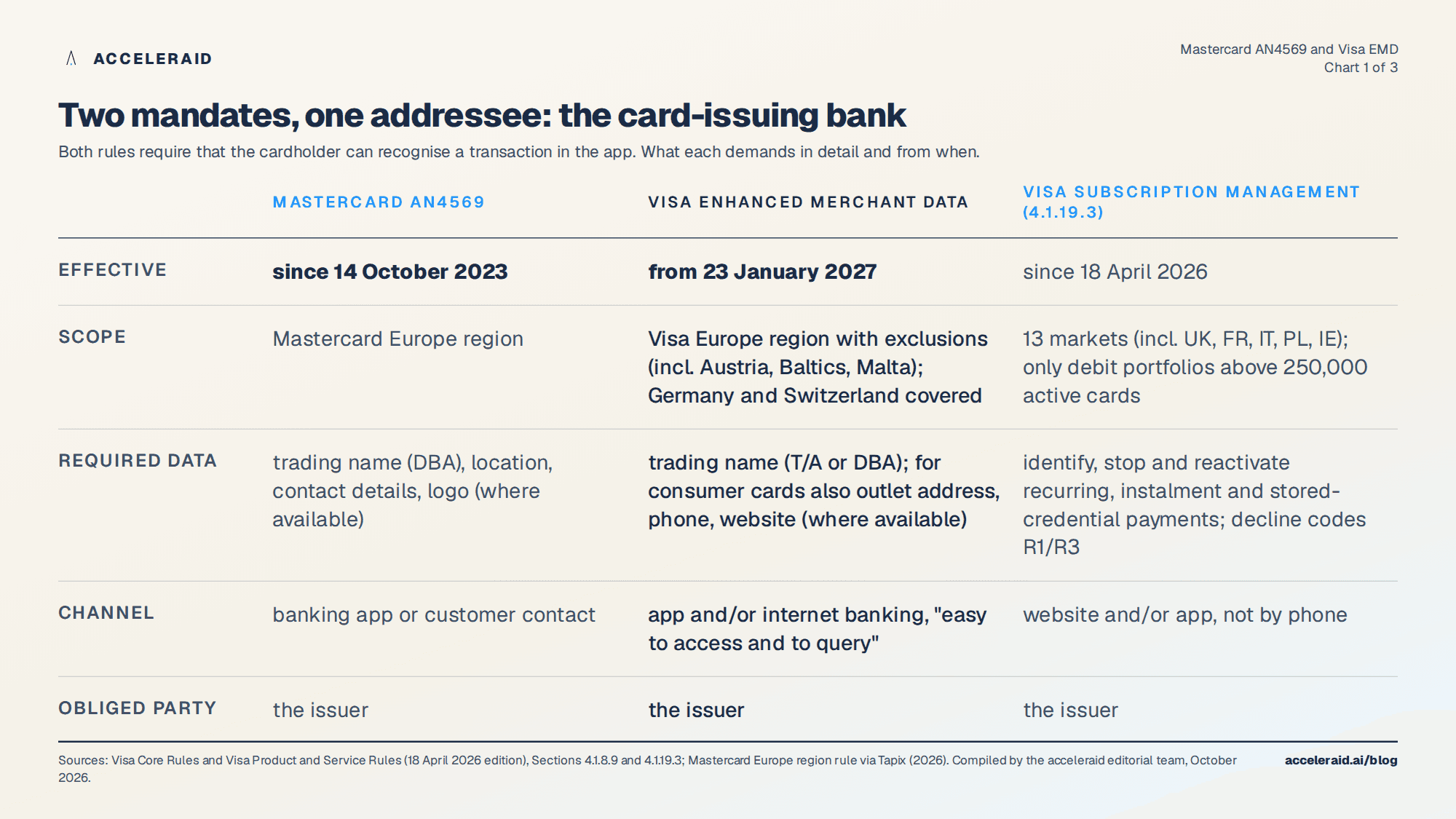
Mastercard anchored the requirement in its Europe region rules, effective 14 October 2023. The core obligation is that the issuer must ensure the cardholder can recognise a transaction, using four pieces of information: the merchant's trading name (the doing-business-as name rather than the legal entity), its location, its contact details and, where available, its logo (Tapix, issuer guide to the transaction data mandates). The rule does not say where the bank should obtain this data, only that it must reach the customer.
That is the decisive point. Responsibility sits neither with the acquirer that writes the merchant name into the authorisation and clearing fields nor with the merchant that displays it at the till. It sits with the bank that shows the transaction in its app.
What Visa's Enhanced Merchant Data prescribes
Visa has written its own requirement into the Core Rules. Section 4.1.8.9, "Enhanced Merchant Data for Cardholders – Europe Region", applies from 23 January 2027: an issuer must make the trading-as or doing-business-as name of a merchant available via its banking application and/or internet banking interface "to help a Cardholder recognize a Transaction". For consumer cards, where available, the merchant outlet address, telephone number and website are added. The data must be "presented in a manner that is easy to access and to query by a Cardholder" (Visa Core Rules and Visa Product and Service Rules, 18 April 2026 edition).
The rule applies in the Europe region with a list of exclusions, among them Austria, Estonia, Latvia, Lithuania, Malta, Cyprus, Iceland and Liechtenstein; Germany and Switzerland are not excluded (Visa Core Rules). A second obligation has applied since 18 April 2026: Section 4.1.19.3 requires issuers of consumer debit portfolios above 250,000 active cards in thirteen European markets to offer a function that lets customers identify and stop recurring payments, instalments and stored credential agreements (Visa Core Rules). Germany is not among them, but the direction is clear: the schemes are moving the intelligibility of a payment from the statement into the app.
Why the descriptor fails so often
The descriptor's shortcomings are a consequence of the message formats, not of individual merchants. Mastercard requires acquirers to transmit in data element 43 the merchant's name as well as location, city and country "substantially the same as it appears on any Transaction receipt"; where a payment facilitator is involved, its name followed by an asterisk must precede the name of the actual merchant (Mastercard Rules, Sections 5.5.1, 5.8.2 and 5.8.3). Visa explicitly allows the merchant name in the clearing record to be abbreviated compared with the receipt (Visa Core Rules, Section 1.5.1.12). This is how "SQ *BLUEBIRD GMBH 4471" comes about: a payment provider's prefix, a legal entity name unrelated to the stall, and a terminal number.
The acquirer rules therefore produce consistent, not intelligible, data. The gap between the two is closed by an enrichment layer on the bank's side: it maps the raw descriptor to a merchant with trading name, address, contact details, logo and category, and stores that mapping on the transaction. Only then can the app show what the rule demands.

One customer, one descriptor, one decision
The following story is hypothetical and stands for an everyday service case. Hanna Weiss, 36, calls her bank on Wednesday morning. She did not recognise the EUR 18.40 transaction and asks for her card to be blocked. Jonas Keller, a customer service agent, sees the same line in his system that she sees. Without further information he is left with the prescribed path: block the card, order a replacement, open a dispute. Cost for the bank, two weeks without a card for the customer, and nothing had happened.
With enriched data the conversation runs differently. Keller sees the trading name of the cheese stall, the market hall as the location and the timestamp, Saturday 11:12. He asks whether she was there at the weekend; she remembers immediately. The agent's decision is not "block the card" but "explain and do nothing". The second decision belongs to the bank: what Keller saw in the call belongs in the app, before anyone calls. Next time, Ms Weiss taps the line, sees logo, address and phone number, and never picks up the phone.
The numbers behind the obligation
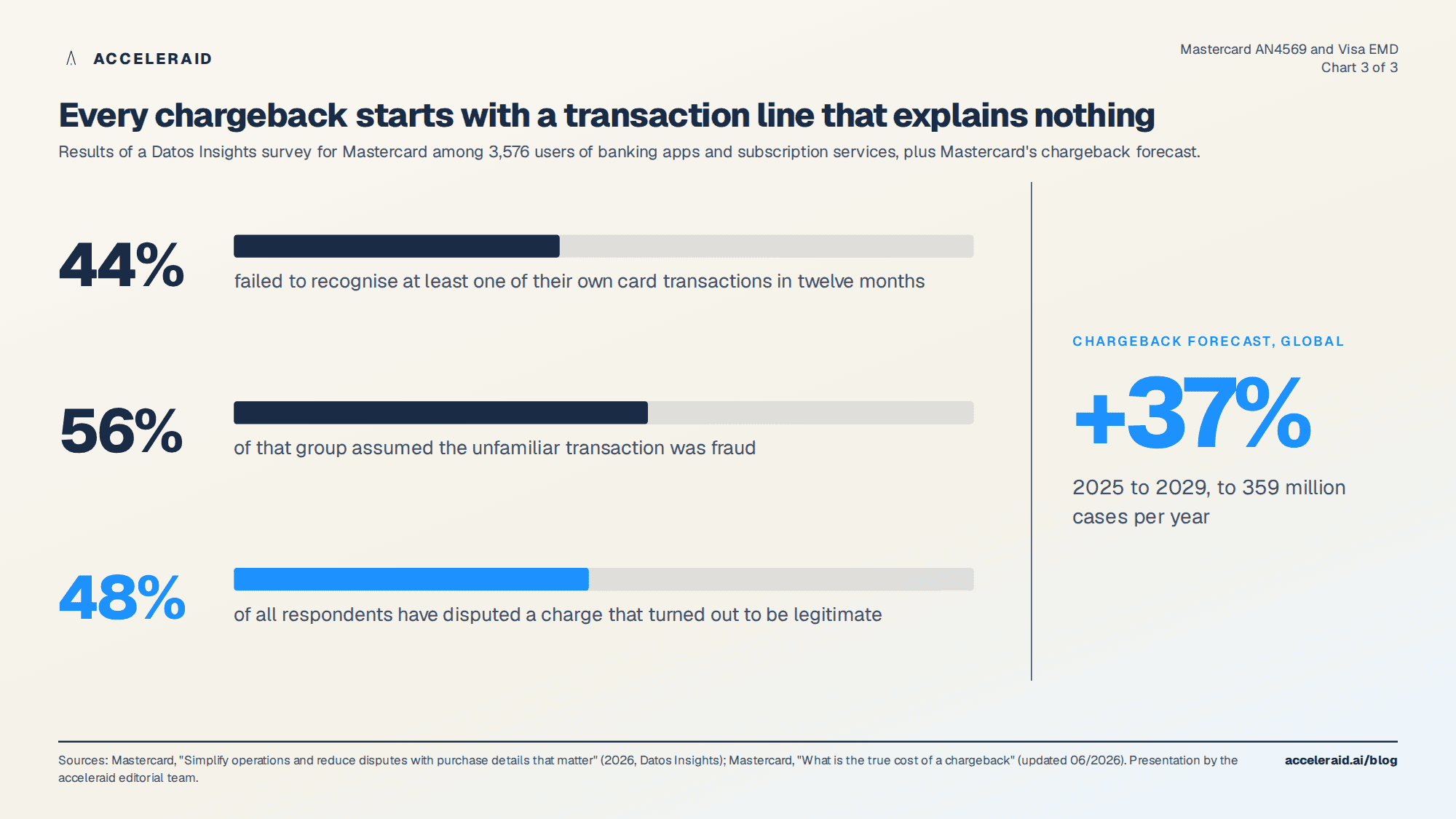
These are not isolated cases. In a Datos Insights survey for Mastercard among 3,576 users of banking apps and subscription services, 44 percent said they had failed to recognise at least one card transaction in the past twelve months; 56 percent of those assumed the transaction was fraudulent, and 48 percent of all respondents have at some point disputed a charge that later turned out to be legitimate (Mastercard, Simplify operations and reduce disputes with purchase details that matter). Mastercard also expects the number of chargebacks globally to grow by 37 percent between 2025 and 2029, to 359 million (Mastercard, What is the true cost of a chargeback). Each of these cases begins with a transaction line that explains nothing.
From obligation to value
Treating enrichment purely as a compliance project for January 2027 leaves most of the value on the table. The same data carries four further applications, described in context in our article on the banking app as a financial hub:
Service deflection. The question "What is this transaction?" is answered in the app before it becomes a call. Every avoided call and every avoided mistaken dispute saves a case.
Subscription overview. Clean merchant identification reveals recurring payments across months and shows them as a list, even where Visa does not yet require it.
Categorisation and budgeting. Trading name and category turn a list of transactions into a spending overview; only on that basis can prompts such as "Will the money last until the statement?" be built.
Signals for the customer lifecycle. A new landlord, a nursery, a car repair shop in the descriptor are life events. How such signals feed into next-best-action decisions without pressuring the customer is covered in our article on CLM, CVM and CLV.
All four share one precondition: the enrichment must be stored as part of the customer profile, not as a display trick in the app. Only then is it equally available to customer service, decision logic and the virtual advisor.
Five takeaways
Mastercard AN4569 has applied in Europe since 14 October 2023, Visa's rule 4.1.8.9 applies from 23 January 2027; both oblige the issuer, not the merchant.
Required are trading name, location or address, contact details and, for Mastercard, the logo, presented so that the customer recognises the transaction and can query it.
The raw descriptor is rule-compliant but not intelligible; the gap is closed by an enrichment layer on the bank's side.
According to Mastercard and Datos, 44 percent of consumers failed to recognise at least one transaction and 48 percent have disputed a legitimate charge; every explanation in the app is an avoided call or dispute.
Stored as part of the customer profile, the same enrichment supports service deflection, a subscription overview, budgeting features and signals for the customer lifecycle.
To check where your own institution stands, take the ten descriptors most often queried in customer service and tap them in your own app. What appears there shows how far the road to January 2027 still is.
Illustration: AI-generated. AI-assisted content: We use AI technologies and automated agents in the creation of our articles, including from Microsoft, Google, OpenAI, Anthropic and other providers. Topics, editorial direction and final approval remain with our team.
Read on
Where to go next.
From the blog


Let's talk about your use case.
In 30 minutes we show how ACCELERAID can look in your bank – with your data, your products and your rules.