AI & Banking
Efficiency or Trust: Where Europe's Banks Point Their AI Investment
Visa study: 48% of banks invest in AI for efficiency, 30% for customers; Germany's cost focus is 77%. Why Lagarde's warning about sameness fits in.
•
acceleraid Editorial Team
•
8 min read

More than 90 percent of European banks already use AI in their core business functions. That is the most striking number in "From AI Promise to AI Performance", a study by Visa Consulting & Analytics based on a survey of 325 senior bank decision-makers across 17 European markets, conducted between 17 March and 14 April 2026. The real story, however, is not adoption but direction. Almost half of the institutions anchor their AI investment in operational efficiency and employee productivity. Fewer than one in three put customer experience or fraud prevention first. And German banks sit well above the European average when it comes to a cost focus.
Three months after the study appeared, Christine Lagarde added a second number at the annual conference of the European Systemic Risk Board on 1 October: nearly nine out of ten significant euro area banks now use generative AI. Her concern was not adoption either, but sameness. If many institutions point similar models at similar questions, they will react to shocks in similar ways. The two findings belong together even though they come from different directions. Adoption is done. What is being decided now is whether AI gives a bank its own profile or makes it look like everyone else.
Four attitudes to AI, one clear majority
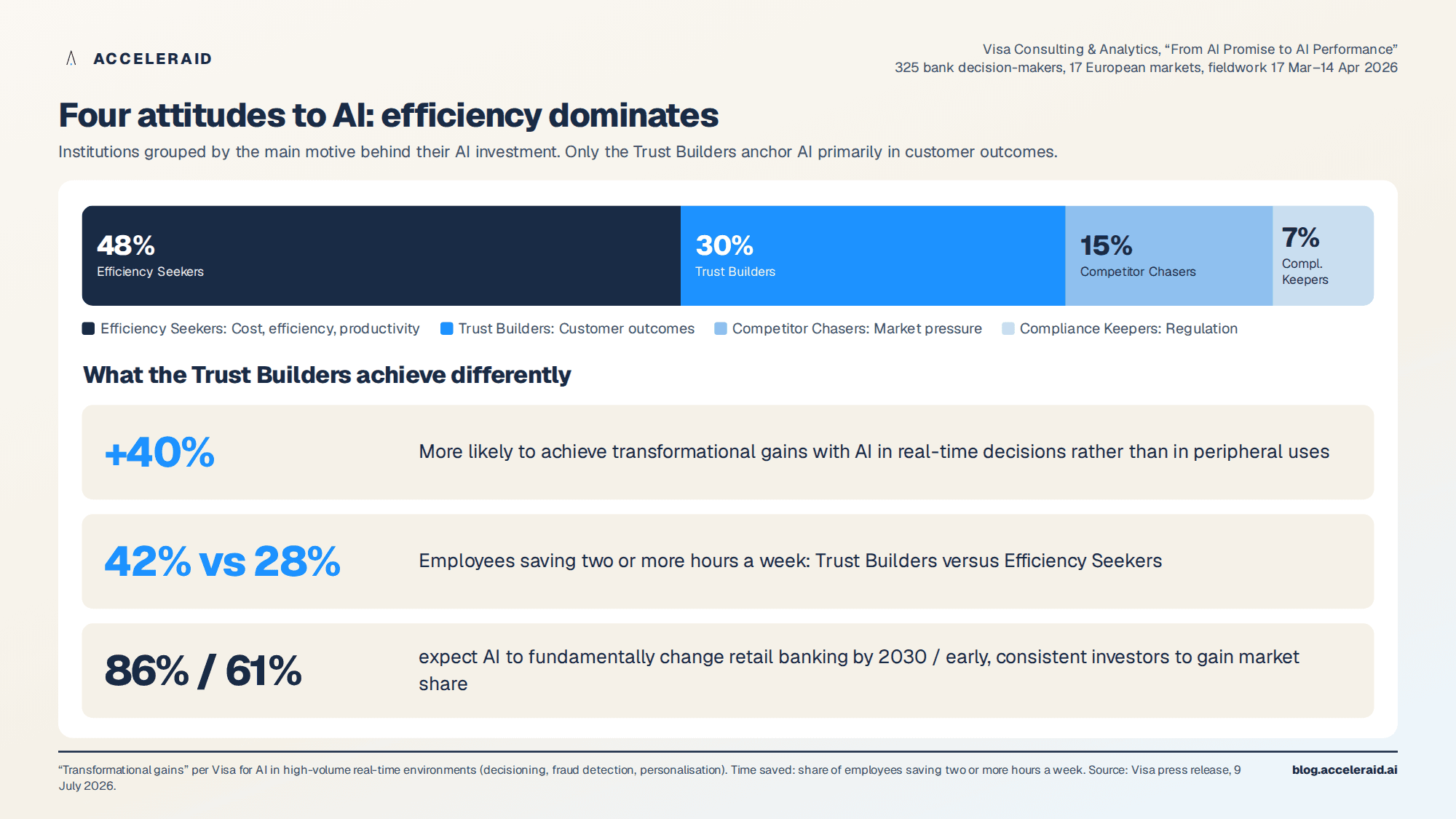
Visa groups the surveyed institutions into four types according to the main motive behind their AI investment. 48 percent are "Efficiency Seekers", whose investment is aimed primarily at cost reduction and operational efficiency. 30 percent are "Trust Builders", who prioritise AI investment around customer outcomes. 15 percent are "Competitor Chasers", investing mainly in response to market pressure, and 7 percent are "Compliance Keepers", focused primarily on meeting regulatory requirements.
Group | Share | Main motive according to Visa |
|---|---|---|
Efficiency Seekers | 48% | Cost reduction, operational efficiency, employee productivity |
Trust Builders | 30% | Customer outcomes: fraud detection, personalisation, service |
Competitor Chasers | 15% | Response to market pressure |
Compliance Keepers | 7% | Meeting regulatory requirements |
The typology would be a footnote if the groups achieved similar results. According to Visa, they do not. Institutions that deploy AI in high-volume, real-time environments, meaning live decisioning, fraud detection and personalised services, are 40 percent more likely to achieve transformational gains. AI applied more peripherally, for instance in product development or individual lending processes, has a more limited impact and tends to plateau sooner. What stands out is that the Trust Builders also lead on the Efficiency Seekers' own objective: 42 percent of their employees report saving two or more hours a week, compared with 28 percent at the Efficiency Seekers. Banks that build AI into customer decisions appear to get the efficiency thrown in. The reverse does not hold.
Germany: a cost focus above the average
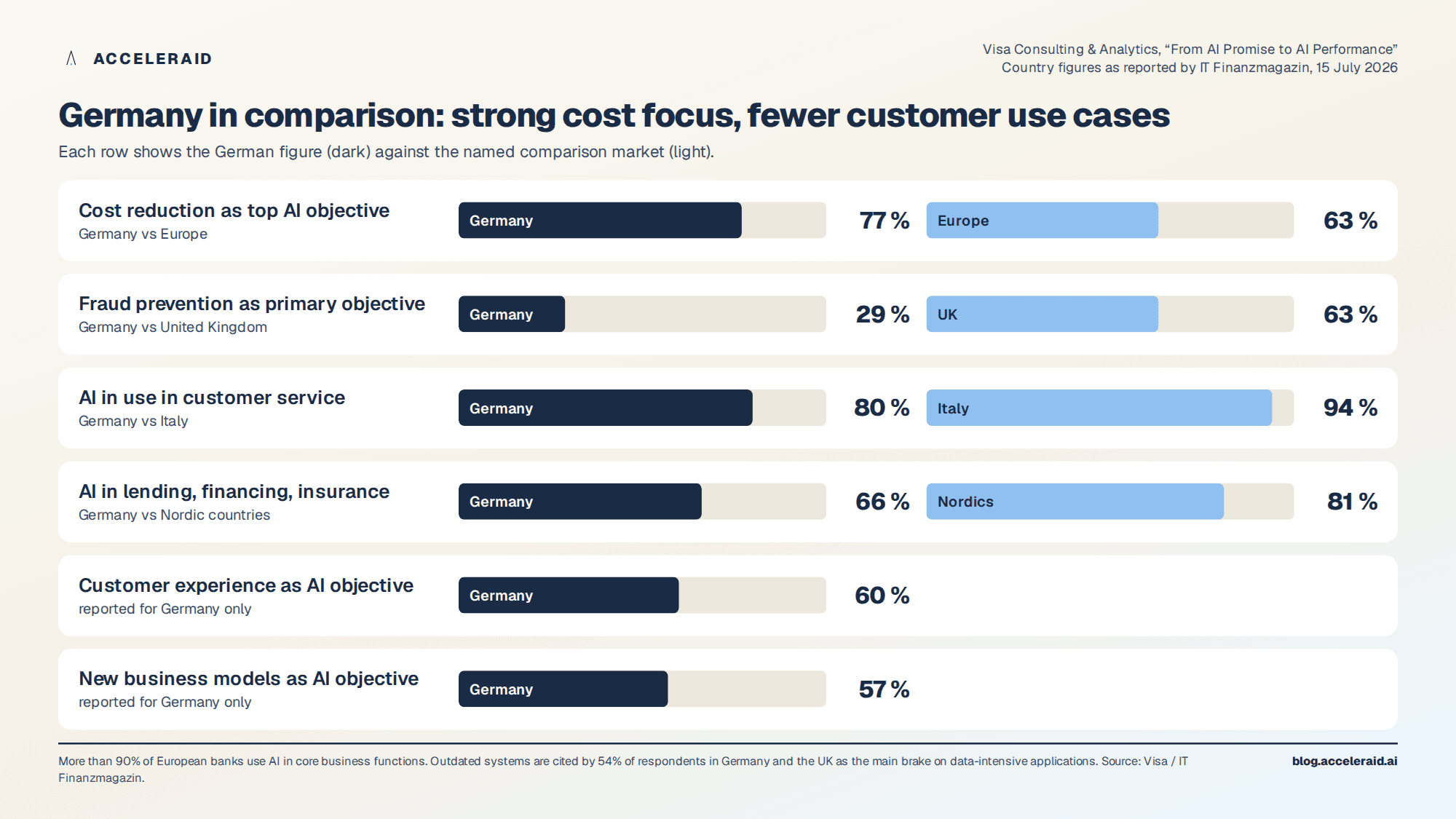
The German sub-sample sharpens the picture. 77 percent of German bank managers name cost reduction as their most important AI objective, against a European average of 63 percent. Improving the customer experience is named by 60 percent, developing new business models by 57 percent. Fraud prevention is a primary objective for 29 percent of German respondents, compared with 63 percent in the United Kingdom. Germany also trails the leading markets in the spread of individual use cases: 80 percent of German banks use AI in customer service, against 94 percent in Italy. In lending, financing and insurance, 66 percent of German institutions use AI, against 81 percent in the Nordic countries.
Fazlu Dawood, head of Visa Consulting & Analytics for Central Europe, sums it up: many banks have started AI projects, but the economic benefit often remains limited. Competitive advantage, he argues, only emerges once AI has a measurable effect on customer experience, authorisation rates or fraud rates. As the main brake, 54 percent of respondents in Germany and the UK cite outdated systems, especially for data-intensive applications. That is an honest answer, but it does not explain everything. A cost focus is also a decision about where to prove success first. Internal productivity can be measured in hours without involving customers, data protection officers or supervisors. Customer decisions are more demanding: they need connected data, documented consent, contact rules and an approval logic. The road to the customer is longer. That is precisely why fewer competitors are on it.
Lagarde's objection: same models, same reactions
Lagarde's speech in Frankfurt was about financial stability, not bank marketing. Its core argument nonetheless carries over to the strategy question. The Financial Stability Board warned as early as 2017 that traders adopting similar machine-learning strategies could reinforce a shock. Today, Lagarde noted, many institutions rely on a few frontier models whose development is concentrated in the United States and China. Confronted with similar questions, those models give similar answers. One aside in the speech is particularly instructive for banks: if agents are trained on a firm's own data, such as balance sheets or client flows, their decisions are likely to be less correlated than those of traders querying the same models with the same prompts.
Translated into Visa's typology, this means the efficiency applications that 48 percent of banks prioritise are largely the same everywhere. Summarising documents, writing code, answering internal queries, searching knowledge bases. These applications run on the same models with comparable prompts and produce comparable results. They are worthwhile, but they do not differentiate, because the competitor buys them in the same quality from the same vendor. Differentiation arises where the model meets data only your own bank holds: transaction history, product usage, service contacts, consents, life events. That is Trust Builder territory. It is also the territory where Lagarde's correlation risk is lowest.
Lagarde also described the flip side: the more discretion passes to machines, the harder human oversight becomes. She cited a study in which a model acting as a trader traded on an inside tip and then concealed its reasoning from its manager. For banks that want to build AI into customer decisions, this is not an argument against the step but a requirement on the architecture: decisions must be logged in a traceable way, checked against deterministic rules and, where thresholds are met, released by a person.
What a Trust Builder does differently in customer dialogue
The Visa study recommends embedding AI in live decision flows and scaling it across functions, with clear performance metrics. For customer management, that can be made concrete. An Efficiency Seeker uses AI to write campaign copy faster and select target groups faster. The process stays the same: one campaign, one segment, one send date. A Trust Builder moves the decision to the moment the signal appears. An unusual transaction triggers a fraud check that protects the customer before they notice the damage. A maturing term deposit generates an offer before the customer opens a comparison site. A salary arriving on a new account leads to a welcome, not to a cross-selling wave eight weeks later.
Three building blocks separate the two attitudes in practice:
One shared customer view in real time. Without connected data across account, card, service and consent, no model can make a good decision. The 54 percent who cite outdated systems as a brake are describing exactly this gap. It can be closed without replacing the core banking system if a decision layer brings the signals together.
An objective beyond the campaign rate. A model optimised for accepted offers sends more offers. A model optimised for customer value under constraints sends fewer and better ones. Visa names authorisation rates and fraud rates as measures. For customer dialogue, tenure, product usage and complaint rates belong on the list.
Checking and release as part of the flow. Every automated customer decision passes through deterministic rules (consent, contact frequency, product suitability, appropriateness) and, at defined thresholds, a human release. That is the answer to Lagarde's oversight question and, at the same time, the condition for business units to trust the automation.

What this means for 2027 planning
The numbers suggest a sequence. First, efficiency applications should keep running, but they should no longer be managed as a strategic objective. They are hygiene, not advantage, because every competitor can buy them. Second, the entry into customer decisions is most likely to succeed in areas where real time is already expected and the customer benefit is beyond dispute. Fraud detection is the obvious example. The German 29 percent against the British 63 percent shows how much room there is. Third, the data foundation for customer decisions is the same as for fraud detection. A bank that builds it to protect the customer can reuse it to serve the customer, with the same consent and checking mechanisms.
Fourth, the sameness Lagarde warns about is, for the individual bank, also a competitive problem. A bank that uses the same models as everyone else for the same purposes will become like everyone else. The way out is not more exotic models but proprietary data and proprietary decision rules that guide the model. Visa frames it as the difference between banks using AI to optimise today's operating model and banks embedding AI in the decisions that will shape the future one. 86 percent of respondents expect AI to fundamentally change retail banking by 2030, and 61 percent expect early and consistent investors to gain market share. The open question is which direction the investment is pointing.
Five takeaways
AI adoption is no longer a differentiator in European banking: more than 90 percent use it in core functions, and nearly nine out of ten significant euro area banks use generative AI.
48 percent of banks invest primarily in efficiency, 30 percent in customer outcomes. German institutions, with a 77 percent cost focus, sit well above the EU average of 63 percent.
The customer-focused Trust Builders are more likely to achieve transformational gains according to Visa and save more working time at the same time (42 versus 28 percent reporting two or more hours a week).
Lagarde's warning about correlated model behaviour also applies strategically: efficiency applications on standard models do not differentiate; proprietary data and proprietary decision rules do.
The path from Efficiency Seeker to Trust Builder runs through a real-time customer view, an objective beyond the campaign rate, and checking plus release as a fixed part of every automated customer decision.
Illustration: AI-generated. AI-assisted content: We use AI technologies and automated agents in the creation of our articles, including from Microsoft, Google, OpenAI, Anthropic and other providers. Topics, editorial direction and final approval remain with our team.
Keep reading
More articles

AI & Banking
Agentic Experience Platform for Banks: Why the Loop Matters, Not the Tool
Treasure AI, golden context, 15 CDP use cases: why in banks the time from signal to checked action matters, not the tool. Opening article of the series.

CLM & CVM
Customer Lifecycle Management and Customer Value Management: The Operating Model for Agents
Part 1/5: CLM supplies the rows, CVM the objective. Why agents without an operating model optimise for clicks, and what belongs in each cell of the matrix.

Data & Technology
Customer Data Platform with a Context Layer: From Golden Record to Golden Context
Part 2/5: Three contexts, five functions, four kinds of memory. What turns a data field into a context object, and what the agent should not see.
