CLM & CVM
Customer Value Management for Banks in 2026: Objective Function, Constraints and the Right Organisational Model
Customer value management in banking 2026: definition, how it differs from CLM and CLV, objective function with constraints, org models and job profiles.
•
acceleraid Editorial Team
•
7 min read

Miriam Lenz, 38, a project lead at a Berlin software company, holds exactly one product with her bank in Prenzlauer Berg: a savings account fed by a fixed monthly amount for three years; salary account, card and investments sit elsewhere. In October she appears on two lists. The consumer lending unit has flagged her, because of that steady saving, as a creditworthy candidate for an instalment loan. The customer value team has flagged her as a customer whose value lies not in the next product but in moving her primary banking relationship. Which of the two lists her advisor Felix Hartmann acts on decides what this relationship is worth in five years. The scene is constructed; the conflict is everyday life.
What customer value management in banking means
Customer value management, or CVM, is, in McKinsey's words, "the process of maximizing value at every stage of the customer life cycle, from acquisition to cross-sell to retention" (McKinsey). The definition comes from telecommunications and transfers to banking unchanged: CVM manages the customer base as a portfolio rather than selling individual products.
That settles the boundary with its two neighbouring terms. Customer lifecycle management describes the processes along the stages, from onboarding to win-back. Customer lifetime value is the measure: a relationship's expected contribution margin over its duration. CVM is the steering in between: it defines the objective that decides when several actions compete for the same customer. We sorted the terms individually in our article on CLM, CVM and CLV and the operating model in part one of the AEP series. What remained open is the organisation.
The objective function and its constraints
Every form of steering needs an objective function. For CVM it reads: maximise the expected customer value of the whole base over time, not this quarter's revenue or one product line's sales. What distinguishes this objective from a sales target is its constraints, and they are the real substance of the discipline:
Contact budget. Every customer receives a limited number of approaches per period; using one has to be justified.
Consent and regulation. What is not permitted is not scored, however valuable it might be.
Risk appetite. A loan that overstretches the customer has negative value, even if it earns income today.
Cost of trust. An ill-fitting approach lowers the chance that the next one is read; that effect belongs in the calculation.
Control groups. Part of the base stays untreated so that impact can be told from chance.
In the Lenz case the picture is clear: the instalment loan brings short-term interest income but uses up a contact, meets no recognisable need and will most likely be ignored or resented. Moving the primary relationship brings almost nothing this quarter but changes everything after it: salary credit, payment data, card, later perhaps investments and financing. Under the constraints, the switch wins.

What telcos did first
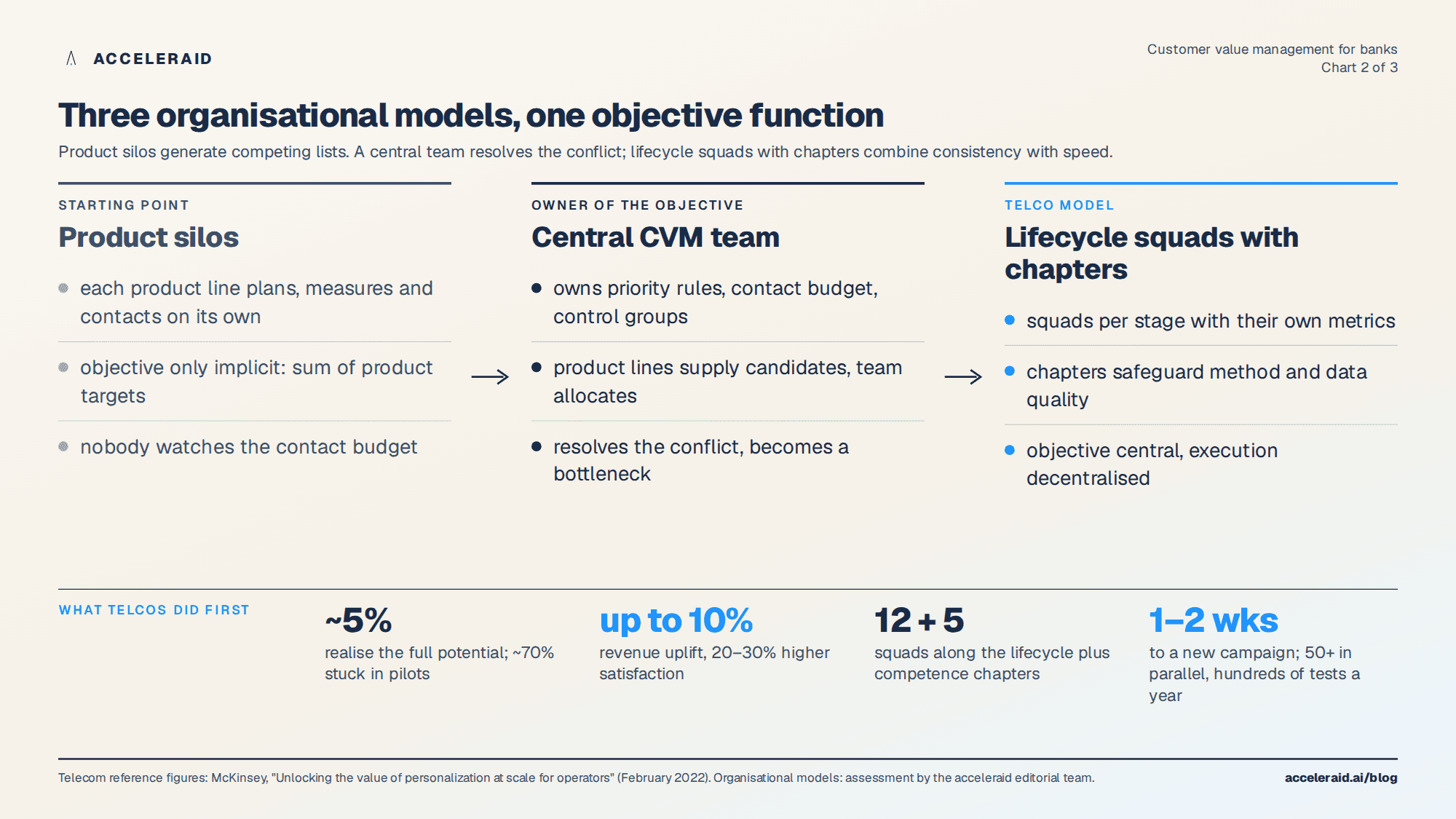
That CVM needs an organisation of its own is something telecommunications learned over two decades of high churn. McKinsey described the state of play in 2022: roughly a quarter of operators were just beginning, around 70 percent had pilots with analytics-driven CVM engines but had not scaled them, and only about five percent were realising the full potential; those who do can expect up to ten percent more revenue and 20 to 30 percent higher customer satisfaction (McKinsey). The decisive factor was not the "brains" of data and analytics but the "legs": talent, an agile operating model, synchronised channels, a steady flow of use cases and CVM as a company priority. One Western European operator organised itself into twelve squads along the lifecycle stages and five competence chapters such as data science and campaign design; leading operators launch campaigns in one to two weeks, optimise more than 50 in parallel and run hundreds of tests a year (McKinsey).
A later McKinsey analysis of the shift from telco to customer-centric techco, built around a next-best-action engine and a single orchestrator for all interactions, cites up to eight percent additional revenue per year, ten to 15 percent lower cost to serve and 20 to 40 points higher satisfaction (McKinsey). Such ranges are consulting figures, not guarantees; the architecture behind them is the one banks are now building.
Organisational models: CVM team or product silos
Product silos. Each product line plans its campaigns, measures its sales and draws on the same customer base. The objective function exists only implicitly, as the sum of product targets, and nobody watches constraints such as the contact budget. This is the model that sends Miriam Lenz the loan offer.
Central CVM team. One team owns the objective function, the priority rules, the contact budget and the control groups; product lines supply offers as candidates, the team allocates. That resolves the conflict but creates a bottleneck when every campaign must pass through one team.
Lifecycle squads with chapters. The telco model: teams each own one stage such as activation, deepening or retention, with their own metrics; chapters safeguard methodology, data quality and campaign craft across all squads. Objective and constraints are defined centrally and embedded in the decision logic; execution is decentralised. For larger banks this is the variant that combines speed with consistency.
What banks are hiring for today
That CVM is arriving in banking is clearest in the job market. Allianz Bank is hiring a Customer Value Management Lead in Sofia to build a CLV framework, prioritise resources with it, design retention programmes for high-value and at-risk customers and own metrics such as revenue per customer, churn rate, product penetration, NPS, cross-sell conversion and share of wallet (Allianz Careers). Sweden's TF Bank is filling a Head of Customer Value Management & Commercial Analytics who owns activation, retention, cross-sell and upsell across the lifecycle and leads LTV modelling (TF Bank via StudySmarter). At Absa the role owns the CVM framework from acquisition through usage growth and retention to value deepening (Absa via MyJobMag); at Vietnam's Techcombank the Senior Expert CVM runs a customer segment's profit and loss and steers its drivers towards customer lifetime value (Techcombank).
What these profiles share is telling: CVM is a role with an objective, metrics and a budget, not an analytics service for product lines, and the lifecycle, not the product, sits at the centre. Customer expectations point the same way, as the global Celent study commissioned by Temenos shows: 58 percent want more financial guidance, 51 percent expect their bank to anticipate their needs, and around 40 percent want benefits based on the overall relationship, while only four percent of banks rank personalisation as their top investment priority (Temenos/Celent).

Back to the decision
Felix Hartmann does not call Miriam Lenz about a loan. He writes to her in the app that the bank will handle the account switch in full, salary, standing orders, direct debits, and that the card on the salary account carries no annual fee. Two days later she replies with a question about transferring her investments. In the product line's lending report she does not appear this quarter. In the CVM team's value report she appears as what she is: a relationship that has just changed direction. The gap between those two reports is why CVM is a question of organisation, not of tooling.
Five takeaways
Customer value management steers the customer base as a portfolio across the whole lifecycle; CLM supplies the processes, CLV the measure.
The objective is expected customer value of the base over time; its constraints of contact budget, consent, risk appetite, cost of trust and control groups separate it from a sales target.
Telcos show that the brains of data and analytics are not enough; those who scaled built organisation, channels and a use-case cadence alongside them.
Product silos generate competing lists; a central CVM team resolves the conflict, lifecycle squads with chapters combine consistency with speed.
The 2026 job profiles define CVM as a role with an objective, metrics and a budget; a bank that does not fill it leaves the decision to its loudest product line.
Illustration: AI-generated. AI-assisted content: We use AI technologies and automated agents in the creation of our articles, including from Microsoft, Google, OpenAI, Anthropic and other providers. Topics, editorial direction and final approval remain with our team.
Read on
Where to go next.
From the blog

CLM & CVM
The Banking App as a Financial Hub: Personal Finance Management, CLM, Service and a Virtual Advisor from One Data Loop

CLM & CVM
Next Best Action in Banking 2026: From the Propensity List to a Checked Decision

CLM & CVM
Customer Lifecycle Management and Customer Value Management: The Operating Model for Agents
Let's talk about your use case.
In 30 minutes we show how ACCELERAID can look in your bank – with your data, your products and your rules.