Automation
AI Marketing Automation in Banking: What Changes Compared with Campaign Automation
AI marketing automation in banking: tools have tripled, impact has slipped. Five shifts compared with campaign automation, and what to build first.
•
acceleraid Editorial Team
•
6 min read

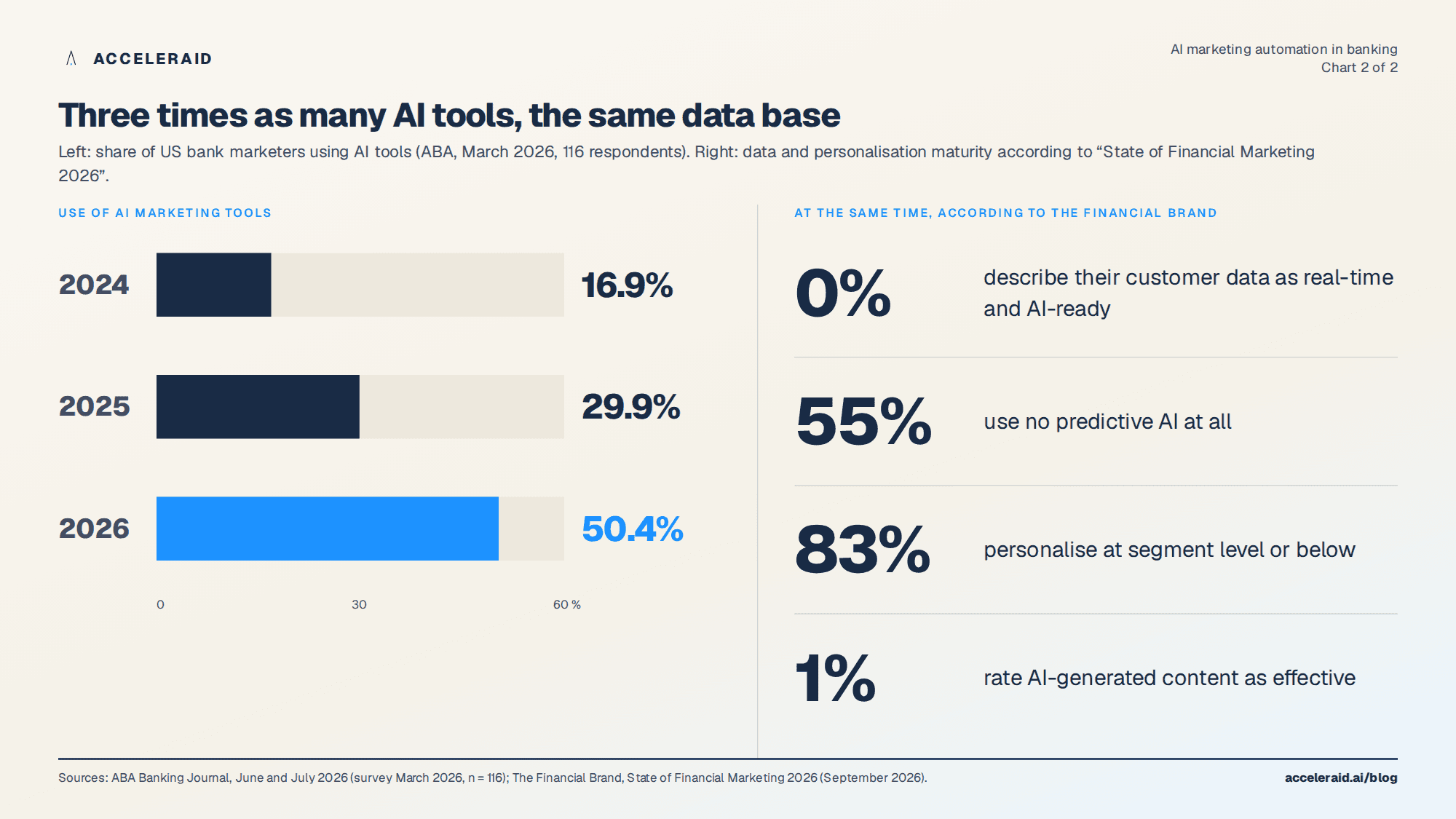
Half of bank marketers in the United States now use AI tools: 50.4 percent in March 2026, up from 29.9 percent a year earlier and 16.9 percent in 2024, according to the American Bankers Association's annual technology survey of 116 marketing leaders (ABA Banking Journal). The same survey shows that marketing automation platforms and CRM systems have remained the most widely used tools for three years running, while the reported impact of automation platforms slipped slightly, from 25.4 percent in 2025 to roughly 22 percent in 2026 (ABA Banking Journal). Taken together, the two findings describe the state of AI marketing automation in banking fairly precisely: the tools are in place, a new AI layer sits on top, and the old layer no longer delivers what it is supposed to.
More production, same relevance
What AI speeds up first is content production. In The Financial Brand's "State of Financial Marketing 2026" research, more than half of banks and credit unions have generative AI operational in marketing. At the same time, not one institution surveyed describes its customer data as real-time and AI-ready, 55 percent use no predictive AI at all, 83 percent personalise at segment level or below, and only 1 percent rate AI-generated content as effective, the lowest score of any tactic asked about, alongside the largest planned budget increase (The Financial Brand).
That is the heart of the problem. The campaign automation of the past decade automated two things: selecting an audience by calendar and sending through a channel. Generative AI now makes the third step cheap, writing the message. Anyone who accelerates only that step sends more variants of the same campaign to the same segments at the same time with the same hit rate. Relevance is not created in the writing. It is created in the decision about whom the bank tells what, when, and when it stays silent.
Five shifts compared with the campaign automation of 2020
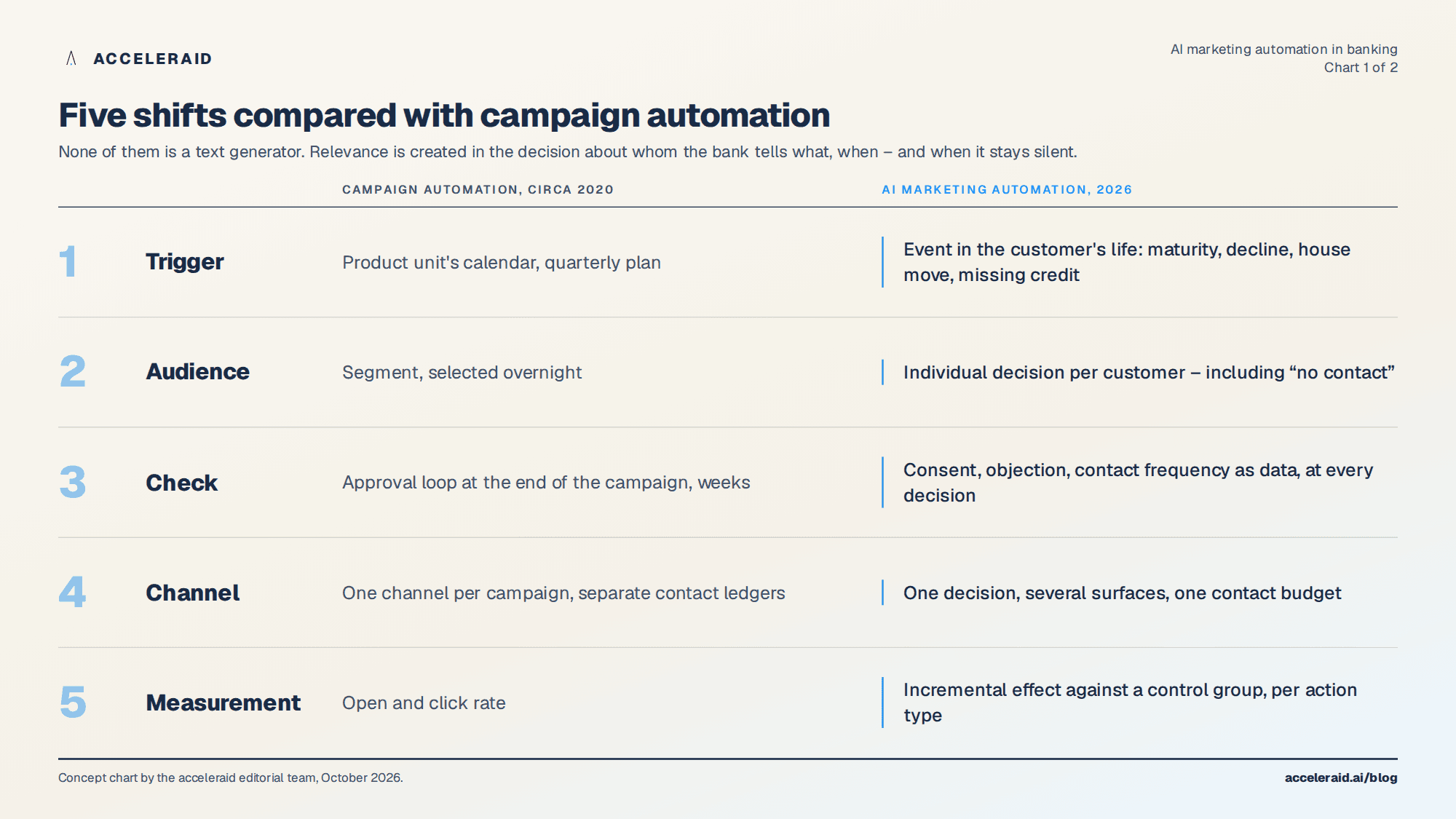
AI marketing automation in banking differs from campaign automation in five respects, and none of them is a text generator.
First: triggers instead of calendars. The occasion for a message is an event in the customer's life, a missing salary credit, a maturing term deposit, a declined card transaction, a house move, not the product unit's quarterly plan. Second: decision instead of selection. The audience is replaced by an individual decision per customer, which can also be "no contact"; how that decision is built is the subject of our deep dive on next best action. Third: checking in the flow. Consent, marketing objections, contact frequency and product rules are checked as data at every decision, not as an approval loop at the end of the campaign. Fourth: channel orchestration. One decision, several surfaces, one shared contact ledger. Fifth: measurement on the incremental effect against a control group rather than on open and click rates.
For banks in Germany the third shift has a legal side that reinforces the argument. Email and telephone marketing require prior express consent under section 7 of the Act against Unfair Competition (UWG), the objection to marketing under Article 21 GDPR can be raised at any time without reasons and must take effect immediately, and purpose limitation restricts which data may be used for which approach. In a campaign logic these conditions are checked once, at selection. Days pass between selection and sending, though, and an objection can arrive in that time. Only when consent, objection and contact frequency exist as data and are checked at every single decision is the send actually permitted at the moment of sending, not merely at the moment of planning.
That the industry knows the direction is shown by the Cornerstone Advisors survey commissioned by Persado: 63 percent of marketing teams at banks and credit unions use generative AI for content, 32 percent for analytics and decision support, but only 9 percent deploy AI agents that execute actions. Asked about the most impactful future application, respondents put campaign and customer journey orchestration (27 percent) ahead of product recommendations (25 percent), and nearly two thirds expect their organisation to let agents act within approved boundaries within two years (Cornerstone Advisors/Persado). Why the approval loop is the real bottleneck in all this is something we set out in a separate piece.
A hypothetical case: the same maturity, two operating models
A constructed example makes the difference visible. A regional bank's marketing team plans its "autumn investment campaign" in October: audience all customers with a term deposit maturing in the fourth quarter, three email variants written by AI and approved by compliance within three weeks, send date 3 November. One customer whose deposit matured on 20 October moved the money to an instant-access account at another bank on the 22nd. On 3 November he receives the investment email. The campaign's open rate is respectable. The customer is gone.
In a signal-driven operation, the maturity would have been recognised as an event on 6 October, fourteen days ahead. The decision would have checked whether marketing consent is in place, whether the customer was contacted in the past 30 days and whether the amount sits above the threshold at which the adviser, not an email, is responsible. The message, pre-drafted by the same AI, would have appeared on her screen before sending, with a rationale and the option to discard it. Compliance would not have approved the campaign; it would have approved, once, the rule under which such notices are permitted. The difference is not in the copy. It lies in the timing, the check and the ownership.
What remains of the marketing automation platform
The platform does not disappear. It becomes the execution layer: it renders, sends, measures delivery and maintains the channel connections. What migrates out of it is the decision about who receives what and when. That decision needs three things a campaign platform does not have: a current customer state drawn from core and card systems, CRM and behaviour; rules that exist as data, versioned and auditable; and a decision record that captures, for every message, why it was sent and what was ruled out. The ABA survey points the same way: among banks' planned technology investments, CRM leads at 34.7 percent and AI marketing tools follow at 33.7 percent, with marketing automation behind at 26.5 percent (SouthState).
For the order of build-out this means: first the customer state and the rules as data, then the decision logic, then the automation of execution, and only at the end the generation of variants. Those who proceed in reverse get exactly the picture the studies paint: high production capacity, no relevance, and 1 percent who consider their AI content effective.
Five takeaways
AI tools in bank marketing have tripled within two years while the measured impact of marketing automation has slipped: more production does not replace a better decision.
The difference from campaign automation lies in five shifts: triggers instead of calendars, decision instead of selection, checking in the flow, channel orchestration, measurement on incremental effect.
Compliance will approve rules in future, not campaigns; that presupposes consent, objections and contact frequency exist as data.
The marketing automation platform remains as the execution layer; the decision moves into a layer with customer state, rules and a decision record.
Build in this order: data and rules, decision logic, execution, generation last. In reverse, you get volume without effect.
Illustration: AI-generated. AI-assisted content: We use AI technologies and automated agents in the creation of our articles, including from Microsoft, Google, OpenAI, Anthropic and other providers. Topics, editorial direction and final approval remain with our team.
Keep reading
More articles

Automation
AI Marketing Automation in Banking: What Changes Compared with Campaign Automation
AI marketing automation in banking: tools have tripled, impact has slipped. Five shifts compared with campaign automation, and what to build first.

CLM & CVM
Next Best Action in Banking 2026: From the Propensity List to a Checked Decision
Next best action in banking 2026: why the propensity list is not enough, the three questions a decision keeps apart, and how it is measured.

CLM & CVM
The First Job for the Bank's Assistant: Tell Me When There's Something Better
TD survey: 69% would hand the bank's assistant a task, 38% want alerts to better products. What that means for customer dialogue and lifecycle decisions.