AI & Banking
AI Is Becoming Rating-Relevant: What S&P's Survey of 179 Financial Institutions Means for Banks
S&P Global Ratings: AI adoption and governance will differentiate banks' credit quality. 84% use AI in the back office, under a third in products.
•
acceleraid Editorial Team
•
7 min read

Rating agencies normally care about capital ratios, loan books and funding. Since 21 September 2026, one more item is officially on the list: how a bank deploys and governs artificial intelligence. That day, S&P Global Ratings published a survey of 179 financial institutions worldwide. The title leaves little room for interpretation: "AI In Financial Institutions Survey: Uneven Adoption And Risk Management Will Drive Credit Quality Differentiation" (S&P Global Ratings, 21 Sep 2026).
The core message: AI deployment and management will become increasingly tangible drivers of credit quality differentiation among financial institutions. AI-related rating actions in the sector are still a rarity, S&P states. But the uneven pace of adoption, governance maturity and operational readiness will contribute to the strengthening or weakening of individual institutions' creditworthiness over the next several years. For banks, AI thereby moves onto the CFO's desk and into conversations with rating analysts.
What S&P asked and what it found
The survey, conducted in June 2026, describes a sector that uses AI broadly but cautiously (Briefs Finance, 21 Sep 2026):
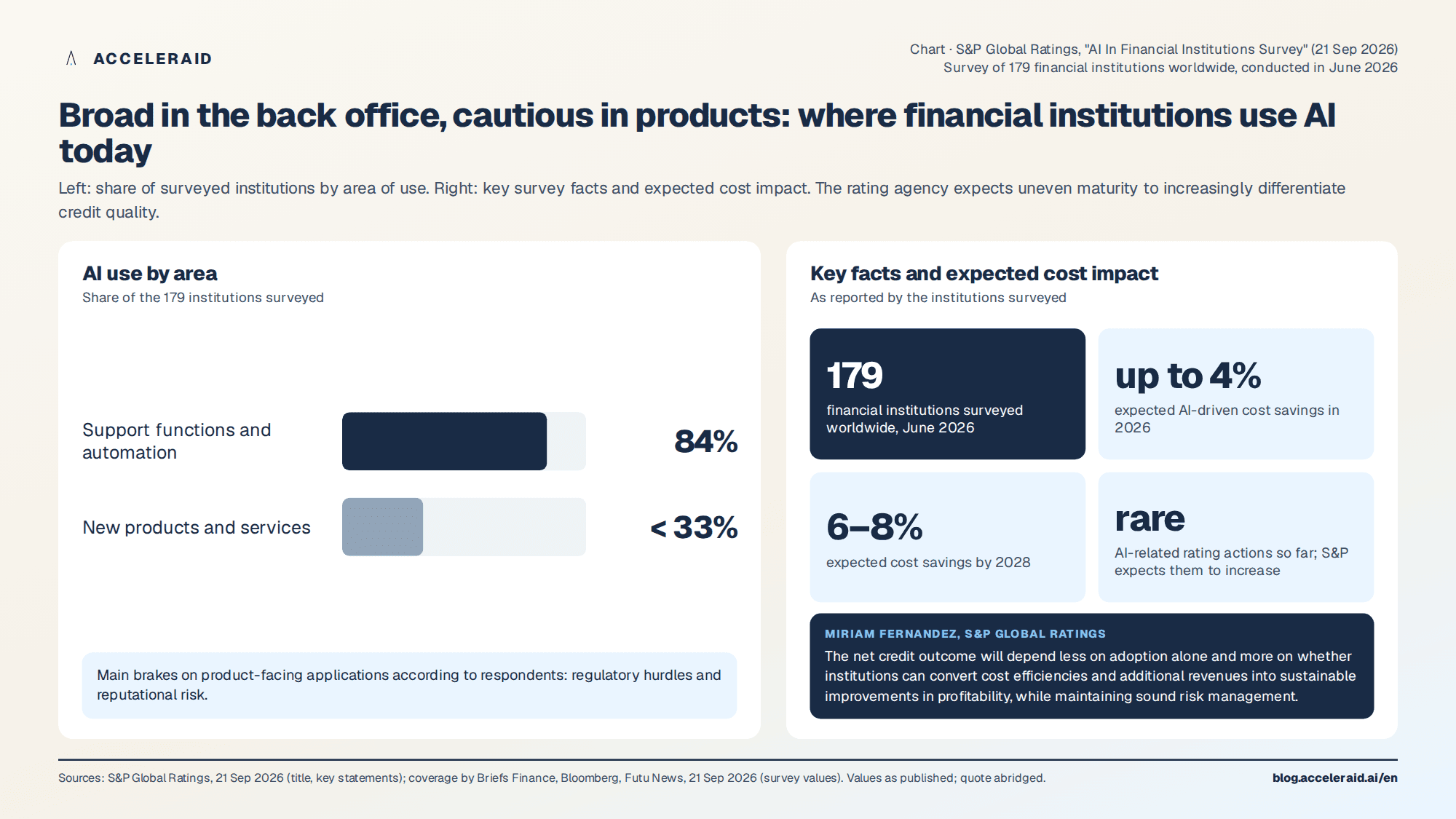
About 84 percent of institutions use AI for support functions and automation.
Fewer than one in three use AI to develop or offer new products and services.
Regulatory hurdles and reputational risk are named as the main brakes on product-facing applications.
Institutions expect AI-driven cost savings of up to 4 percent this year, rising to roughly 6 to 8 percent by 2028.
Miriam Fernandez, who leads AI research at S&P, sums it up: the net credit outcome will depend less on adoption alone and more on whether institutions can convert cost efficiencies and additional revenues into sustainable improvements in profitability that create a competitive advantage over peers, while maintaining sound risk management.
Why a rating agency looks at governance
At first glance it seems unusual for a credit opinion to depend on the maturity of an AI strategy; at second glance it is consistent. A rating assesses the ability to service obligations over time. That ability draws on earnings power, cost base, risk profile and operational stability. AI touches all four:
Cost base: Automation in back-office work, document processing and customer service lowers unit costs; this is the lever almost every institution is pulling today.
Earnings power: Better customer engagement, faster credit decisions and new products raise revenues; here the majority still holds back.
Risk profile: AI models in fraud detection and credit assessment can reduce losses; poorly governed models increase them.
Operational stability: Dependence on a few model and cloud providers, AI-enabled cyberattacks and model failures are new operational risks.
S&P notes that institutions with mature AI strategies, strong governance frameworks and deep integration of AI in core operations appear better positioned to capture efficiency gains, generate revenue and strengthen risk management. The logic: not the bank that has AI is assessed better, but the bank that has it under control.
Supervisors taking the same direction gives the finding extra weight. BaFin has been the market surveillance authority for AI in finance since July 2026 (our analysis), and the ECB expects institutions to submit action plans against AI-enabled cyberattacks by the end of October (details in our piece on the supervisory letter). Governance homework done for the supervisor is done for the rating agency as well.
The cost side is the easy half
Four percent cost savings this year, six to eight percent by 2028: these are expectations reported by the institutions, not measured outcomes. Still, they fit the large banks' interim reviews, with productivity gains among developers and in case handling (our review of the big banks' reports). These savings are available to everyone because they rest on standard tools anyone can buy, so they create little lasting differentiation. If every bank cuts costs by six percent, the relative gap stays the same.
Differentiation arises where fewer than one in three respondents is active today: in products, pricing and customer contact, exactly where the hurdles are highest. Regulatory requirements for transparency and fairness, the reputational risk of a flawed customer dialogue and customers' trust all limit the pace. Deloitte's August survey found that 83 percent of bank customers would be anxious about an AI agent acting on their finances without approval (what bank customers will let generative AI do). Revenue impact in customer contact is therefore a design project, not an automation project: which decisions does the system make, which does it propose, where does a human confirm?
From pilot to rating impact
Translated into a review logic, S&P's statements yield four questions a rating analyst will ask, and to which an institution needs robust answers.

First: how mature is the strategy? Is there a target picture tying AI applications to revenue and cost goals, or a collection of pilots? A strategy measured by the number of use cases is none.
Second: how robust is the governance? Model inventory, accountabilities, approval processes, production monitoring, handling of third parties: these are also the requirements of the EU AI Act and of supervisors. Gaps here are a compliance problem and a credit problem.
Third: how deeply is AI integrated into core processes? S&P names this explicitly as a feature of well-positioned institutions. An assistant drafting text for employees is support; a model preparing credit decisions or steering customer engagement is core. Only the latter moves the numbers, and only it demands the full governance programme.
Fourth: is impact measured and converted into profitability? This is Fernandez's central question. Cost savings must show up in expenses and revenue effects in results, over years rather than once.
An American Bankers Association survey of 250 banks from March 2026 shows how far the industry still is from that point: early use cases are narrow, internal and efficiency-focused, generative AI remains tightly controlled, and confidence in near-term benefits is low, mainly because of data security, accuracy and regulatory concerns (ABA Banking Journal, 14 Sep 2026). The advantage, the ABA expects, will go to banks that build understanding and governance capabilities through controlled use.
What banks should do now
The S&P analysis is not a call for speed at any price. It suggests bringing together things that run separately in many institutions.
Keep the AI inventory and governance in one file. Supervisors require an AI inventory; the rating agency asks about governance maturity. Both belong in one documentation with clear accountabilities and production monitoring.
Measure impact per use case. Every productive use case needs a metric that reaches financial control: processing time saved, losses avoided, additional sales. Otherwise AI remains a cost line.
Open up customer contact deliberately. Personalisation, next best action and customer value management are where revenue impact is created. Clear approval steps beat full automation here. McKinsey showed in September that banks in the top quartile of personalisation achieve markedly more products per customer (our analysis of the McKinsey numbers).
Manage dependencies. Sourcing AI capability from a single model or cloud provider is a concentration risk S&P is likely to file under operational readiness (model independence as an architectural principle).
Prepare the story for investors. Rating conversations and investor presentations will include AI questions; a coherent account of strategy, governance, integration and impact turns a review question into an argument.
Five takeaways
S&P Global Ratings declares the deployment and management of AI a future differentiating factor for the creditworthiness of financial institutions; AI-related rating actions have been rare so far but will increase.
The survey of 179 institutions shows broad use for support and automation (84 percent) but little in products and services (fewer than one in three).
Expected cost savings of 4 percent this year and 6 to 8 percent by 2028 are available to everyone and therefore create little advantage; differentiation arises in products and customer engagement.
According to S&P, what matters is not adoption but the conversion of efficiency and additional revenue into sustained profitability with sound risk management.
Governance maturity, integration into core processes and measurable impact are what supervisors and rating agencies alike will examine; documenting them together does both jobs at once.
Illustration: AI-generated. AI-assisted content: We use AI technologies and automated agents in the creation of our articles, including from Microsoft, Google, OpenAI, Anthropic and other providers. Topics, editorial direction and final approval remain with our team.
Keep reading
More articles

AI & Banking
Agentic Experience Platform for Banks: Why the Loop Matters, Not the Tool
Treasure AI, golden context, 15 CDP use cases: why in banks the time from signal to checked action matters, not the tool. Opening article of the series.

CLM & CVM
Customer Lifecycle Management and Customer Value Management: The Operating Model for Agents
Part 1/5: CLM supplies the rows, CVM the objective. Why agents without an operating model optimise for clicks, and what belongs in each cell of the matrix.

Data & Technology
Customer Data Platform with a Context Layer: From Golden Record to Golden Context
Part 2/5: Three contexts, five functions, four kinds of memory. What turns a data field into a context object, and what the agent should not see.
