Data & Technology
Pontes Is Live: What Settling Tokenised Transactions in Central Bank Money Means for Banks
Since 21 Sept 2026 the Eurosystem settles tokenised wholesale transactions in central bank money. How Pontes works and what banks should do now.
•
acceleraid Editorial Team
•
4 min read
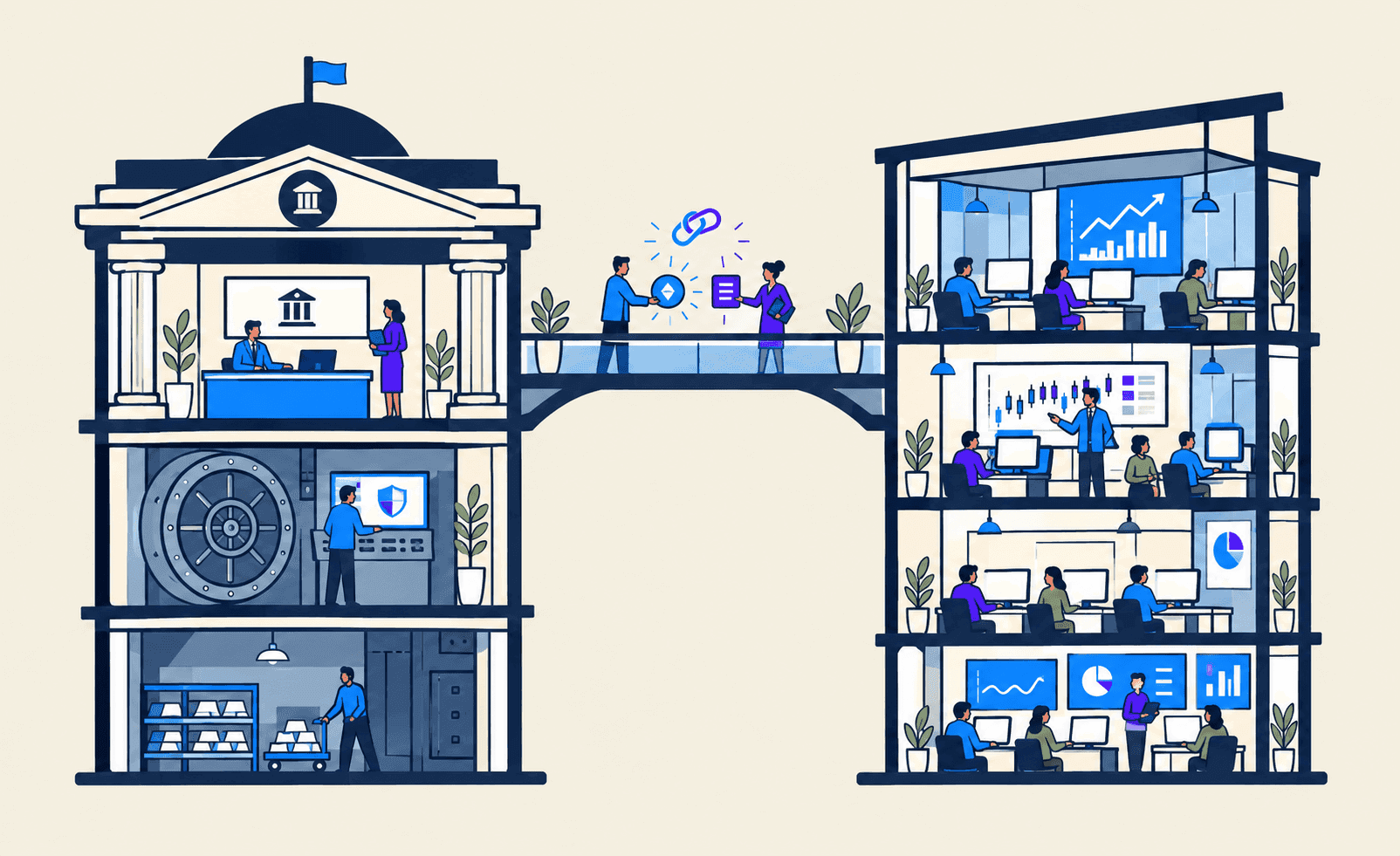
Since 21 September 2026, banks in the euro area have been able to settle tokenised securities transactions in central bank money. On that day the Eurosystem launched Pontes, a bridge between the market's DLT platforms and the central banks' TARGET Services. The news sounds technical, and it is. But it answers the question on which the tokenisation of financial instruments in Europe has been stuck: what do you pay with?
What Pontes actually does
Whoever buys a tokenised security needs money on the other side that changes hands just as quickly and just as finally. Until now the options were stablecoins or tokenised bank deposits; in both cases the buyer carries the issuer's risk. Pontes provides central bank money instead. According to the ECB's description, the solution consists of five elements:
A single Eurosystem offering that consolidates the three interoperability solutions trialled in the 2024 tests.
A dual settlement model: the cash leg can move either as a cash token on the Eurosystem's DLT platform or directly in T2, the real-time gross settlement system.
Finality in T2: the payment is final once the corresponding transaction has completed in T2.
The Hash-Link mechanism for delivery versus payment: the securities leg and the cash leg either both settle or neither does.
End-to-end automation from the platform through to T2, to reduce manual intervention.
Any institution with T2 access can participate. Eligible DLT operators are authorised central securities depositories, operators of DLT settlement systems under the EU pilot regime, overseen payment systems, central counterparties and credit institutions. The launch press release lists among the first market participants ABANCA, BayernLB, Caisse des Dépôts, Cecabank, Deutsche Bank, DekaBank, DZ Bank, the European Investment Bank, KfW, Memo Bank, NRW.BANK, Santander and Société Générale; the DLT operators are Axiology, Cashlink, Clearstream and SWIAT. The Deutsche Bundesbank has also onboarded as a market participant.
The road here and the road ahead
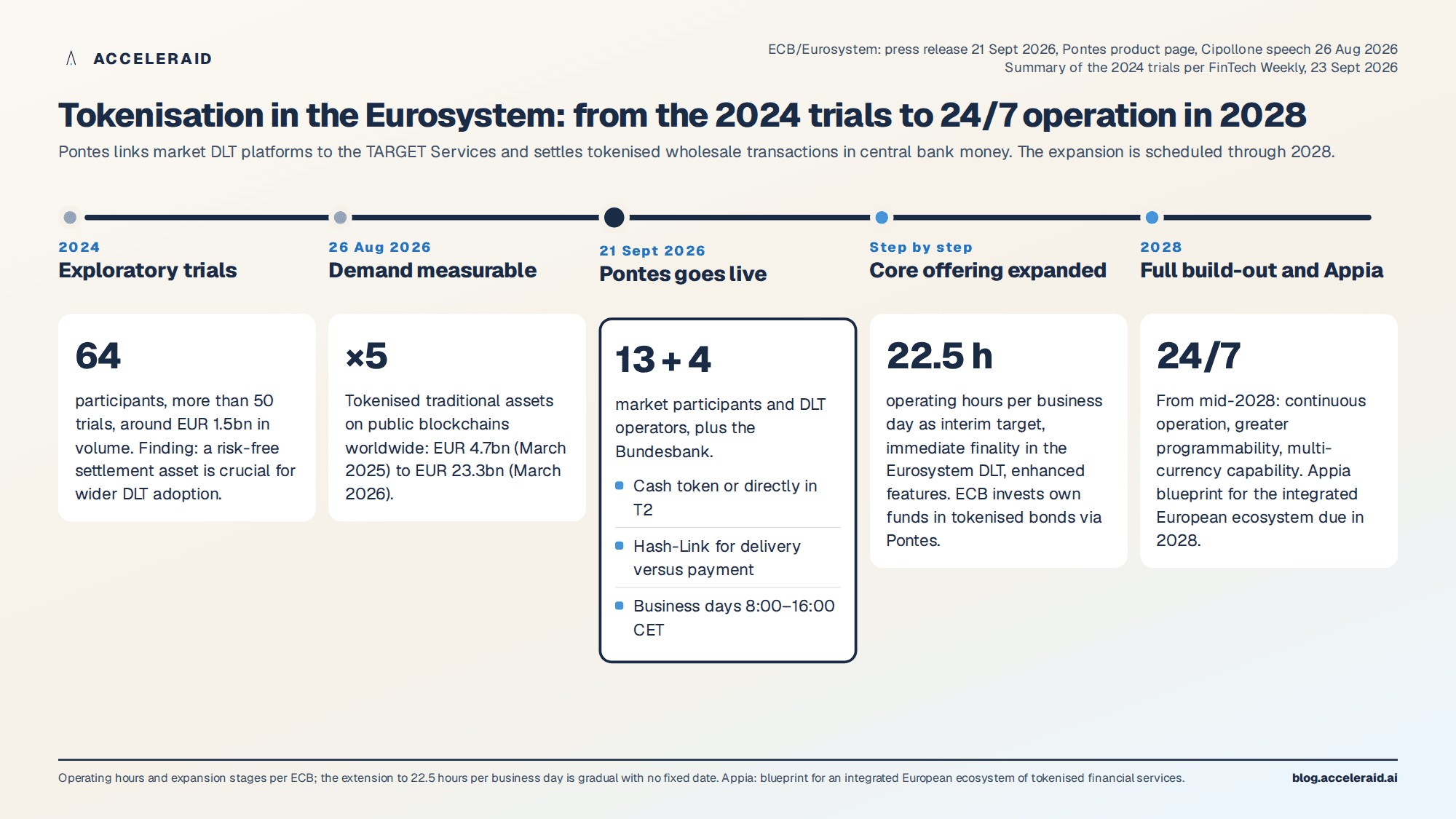
Pontes builds on the 2024 trials: more than 50 tests with 64 participants and a volume of around EUR 1.5 billion, as FinTech Weekly summarises. The demand is now measurable. According to ECB Executive Board member Piero Cipollone in his speech of 26 August 2026, the stock of tokenised traditional assets on public blockchains grew worldwide from EUR 4.7 billion at the end of March 2025 to EUR 23.3 billion at the end of March 2026, roughly fivefold.
Settlement option | Who carries the risk? | Availability today |
|---|---|---|
Stablecoin | Buyer carries issuer risk | 24/7, predominantly US dollar |
Tokenised bank deposit | Buyer carries the issuing bank's risk | Depends on bank and platform |
Pontes (central bank money) | No issuer risk | Business days, 8:00 to 16:00 CET, expansion until 2028 |
The limitation sits in the last row. At launch, Pontes operates on business days from 8:00 to 16:00 with a core set of services. Cipollone announced that operating hours will be extended step by step to 22.5 hours per business day, with 24/7 operation, greater programmability and multi-currency capability by mid-2028. In parallel, Appia, the programme for an integrated European ecosystem of tokenised financial services, is to deliver a blueprint in 2028. The ECB itself intends to invest a small part of its own-funds portfolio in tokenised bonds from public-sector issuers and settle them via Pontes.
Why this matters beyond the trading floor
Pontes is an infrastructure for wholesale transactions; retail customers will never see it. For banks, the launch nevertheless has three consequences that reach beyond the settlement department.
First, the argument towards corporate clients shifts. Treasurers who want to use tokenised bonds, money market funds or collateral previously had a choice between a private money token and abstaining. Now the bank can make an offer that works with the safest settlement asset in the euro area. Whoever approaches these clients early positions itself for a business that, in Cipollone's words, is meant to change the architecture of the financial system, not just its speed.
Second, the question of connectivity moves closer. Every bank with T2 access is eligible, but connecting to a DLT platform, integrating with position-keeping and reporting systems, and building the delivery-versus-payment processes are projects that take months. Experience with the retail digital euro shows that banks make better use of the time before an obligation by testing processes than by waiting.
Third, what we described for Wero in retail banking applies to the wholesale side too: launching an infrastructure is not a result. What counts is how many clients actually use it, which transactions run through it, and whether the bank learns something about its clients in the process. In corporate banking, too, adoption is a lifecycle that has to be measured.
Five takeaways
Pontes has been live since 21 September 2026 and allows tokenised wholesale transactions to settle in central bank money, either as cash tokens or directly in T2.
The Hash-Link mechanism ensures delivery versus payment; finality arises in T2 and therefore within the existing legal framework.
At launch, 13 market participants and four DLT operators are connected; operations run on business days from 8:00 to 16:00 for now.
The expansion is scheduled: longer operating hours, 24/7 operation with multi-currency capability from mid-2028, plus the Appia blueprint in 2028.
For banks, the work on connectivity, processes and the conversation with corporate clients who want to use tokenised instruments starts now.
Illustration: AI-generated. AI-assisted content: We use AI technologies and automated agents in the creation of our articles, including from Microsoft, Google, OpenAI, Anthropic and other providers. Topics, editorial direction and final approval remain with our team.
Keep reading
More articles

AI & Banking
Agentic Experience Platform for Banks: Why the Loop Matters, Not the Tool
Treasure AI, golden context, 15 CDP use cases: why in banks the time from signal to checked action matters, not the tool. Opening article of the series.

CLM & CVM
Customer Lifecycle Management and Customer Value Management: The Operating Model for Agents
Part 1/5: CLM supplies the rows, CVM the objective. Why agents without an operating model optimise for clicks, and what belongs in each cell of the matrix.

Data & Technology
Customer Data Platform with a Context Layer: From Golden Record to Golden Context
Part 2/5: Three contexts, five functions, four kinds of memory. What turns a data field into a context object, and what the agent should not see.
