CLM & CVM
Personalization Series No. 2: URL Parameter Personalization
Discover how URL parameter personalization boosts conversions by tailoring landing pages in real time to ad campaigns and search terms.
•
acceleraid Editorial Team
•
4 min. read

In our ongoing series on personalization techniques for increasing conversions, today we look at the option of personalizing content via URL parameters.
This method can be combined particularly well with advertising channels and advertising messages. With this strategy, we use our personalization engine to adapt a customer's website or landing page so that, depending on the advertising channel previously visited or the search previously made, users are served the information relevant to them in real time.
What is URL parameter insertion?
URL parameter insertion is an advanced personalization method in the field of website conversion optimization. It uses URL variables, e.g. from Google AdWords campaigns, to display content dynamically depending on where the user is coming from, or which parameters are passed along.
This creates a tailored user experience that increases relevance and improves conversion rates.
How does the personalization work?
Let's take as an example a Google Ads campaign with an ad and the following fictitious link:
www.bestekreditkartederwelt.de/knallerangebot?utm_source=sea&utm_medium=paid&utm_campaign=freecard&utm_term=visacard
Process
A person sees a Google ad for their search term “fee-free credit card”
When the link is clicked, the destination URL stored in the ad is called up, including the attached parameters
The landing page reads these parameters
Based on the parameters, the personalization engine shows the user the corresponding content, or a fallback if no parameter is attached or the parameter is unknown
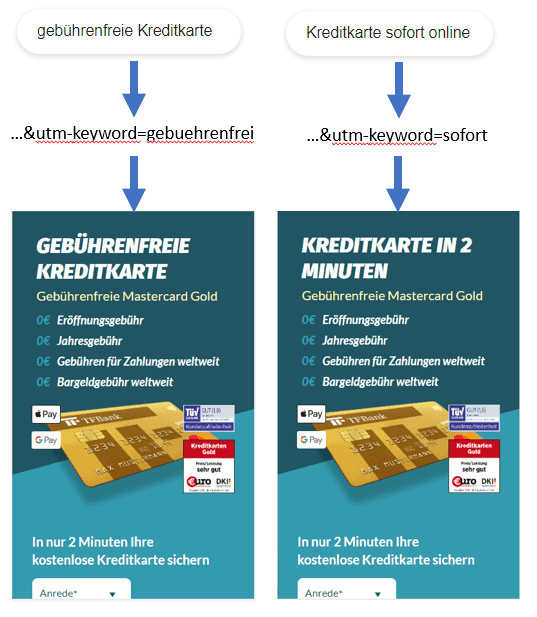
URL parameter insertion with keywords in Google – simplified example
What options are there for URL parameter personalization?
The possibilities are very broad: for every advertising channel where you can design the URL yourself, any parameters can be attached and correspondingly structured content can then be displayed on the landing page. Here are a few examples that have proven particularly effective in practice:
Dynamic insertion of the search term: The website adapts the welcome text based on the user's search term. For example, it could simply say: “Welcome! If you are looking for [search term], you've come to the right place!”
Product display: On e-commerce websites, product images or descriptions are displayed depending on the item the user searched for. If someone searches for “Visa credit card” or responds to a campaign for a Visa credit card, images or information about the Visa card are highlighted.
Use of campaign visuals: Images used in advertising campaigns are also displayed on the landing page to create continuity and recognition.
Demographic differentiation: The website content can be adapted according to the user's demographic information, such as age or gender. This allows different messaging for different target groups.
Categorization of campaign content: The website can identify different advertising campaign categories and display corresponding content. If the messaging distinguishes between informative and emotional messages, for example, this type of messaging can also be continued on the landing page.
Differentiation by USP: Similar to categorization by campaign content, personalization can be based on the USP the user is particularly interested in: if, for example, a product benefit is especially important to the user and they respond specifically to an ad about it, personalization will highlight that product benefit on the landing page.
Success story “Automotive” results:
In our case study of an automotive customer, we used the keywords of the Google campaign to personalize the landing page accordingly, through a combination of the campaign visuals used and the campaigns deployed in Google Ads, with the following result:
Conversion uplift of 26% through personalization compared to the regular landing page
Conclusion
Personalization based on search results or campaign visuals that a user responds to is an efficient method to demonstrably increase performance and improve the customer experience
Browser vendors are making efforts to block URL parameters (e.g. Apple blocks URL parameters in Safari's private mode), so it remains exciting to see which personalization techniques will be usable in the coming years.
For this method, it is fundamentally important to analyze the customer's existing structure, for example of the campaigns to be personalized, and to develop individual solutions in order to achieve the corresponding efficiency.
As experts with over 10 years in the field of personalization, we have the experience and knowledge to develop appropriate personalization concepts together with you.
Our software analyzes in just 200 milliseconds what the page must look like for each target group to deliver an optimal experience. Contact us for an optimization analysis and a tailored offer to address your needs and target groups. We are happy to help you increase your conversion rates and fully exploit the potential of your website.
Read on
Where to go next.
From the blog

CLM & CVM
The AI Decision Engine Business Case: What Banks Can Calculate Before Go-Live

CLM & CVM
Next Best Action in Banking: Ten Use Cases with Trigger, Check Rule and Success Measure

CLM & CVM