CLM & CVM
Exit-Intent Triggers in Banking: Stopping Drop-offs and Increasing Conversions
Learn how different exit-intent triggers can boost your conversion rate – including practical examples and best practices.
•
acceleraid Editorial Team
•
2 min read

Exit-intent and pop-up banners are essential tools for intercepting users in the banking sector before they abandon a transaction, leave the site, or fail to complete important steps. Whether it’s account opening, loan application, or investment platform—tailored exit-intent strategies can be crucial in retaining prospects, generating leads, and increasing revenue.
However, it is not the banner alone but the right trigger that determines conversion performance.
Exit-Intent Triggers: The Rules of the Game for Banks
In banking, it is especially important to build trust and not overwhelm users. That’s why exit-intent pop-ups must be used subtly yet effectively—with intelligent triggers that understand user behavior.
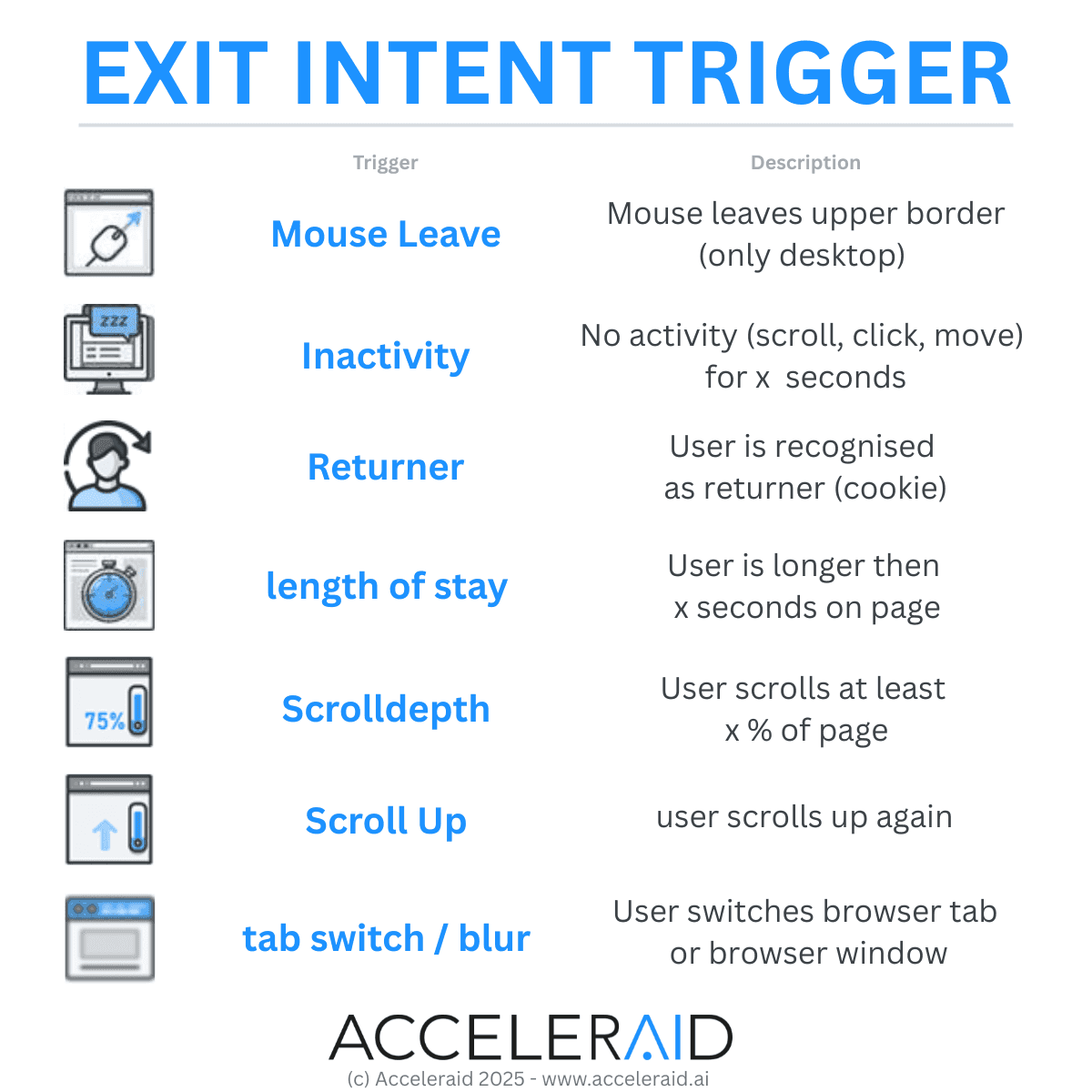
Explanations:
Mouse Leave: Recognizes when the user moves the mouse off the page (desktop only). Important for forms such as loan applications or account openings.
Inactivity: On sensitive pages, a discreet reminder can help when the user is inactive for a longer period, e.g., “Your session is about to expire—do you need assistance?”
Returner: Personalized offers or security notices for returning users.
Length of stay: Pop-up triggered after a longer time spent on the page, e.g., to clarify open questions on complex products.
Scrolldepth & Scroll Up: Particularly useful in content marketing for banking topics (guides, explanatory articles) to activate leads.
Tab switch / blur: Detects when the user switches to a competitor; an opportunity for targeted offers or support links.
Tip: In banking, combining triggers is sensible to avoid overwhelming sensitive users but still convert them in time.
Banking Practical Examples for Exit-Intent Pop-ups
Loan Completion and Financing Applications
Trigger combination: Mouse Leave + Inactivity (15 seconds)
Use: Users who are about to abandon forms. The pop-up can offer support via a free hotline or chat.
Message: “Any questions about your loan application? Our experts are here for you.”
Account Opening on the Website
Trigger: Length of stay + Returner
Use: When customers spend a long time on sign-up or return, a reassuring pop-up is shown—with privacy info or benefits for new customers.
Message: “Welcome back! Open your account now—safe and fast.”
Investment and Retirement Advice
Trigger: Scrolldepth (75%) + Scroll Up
Use: Users who almost finish reading advisory texts and product info receive an offer for a free consultation appointment.
Message: “Interested in personalized financial advice? Book your consultation now.”
Abandonment on Pricing and Tariff Pages
Trigger: Tab switch / blur + Inactivity (10 seconds)
Use: When users switch to comparison portals, a pop-up appears enticing them with a special offer.
Message: “Stay with us—secure your individual conditions.”
Conclusion: Exit-Intent Strategies as a Booster for Banks
Exit-intent pop-ups are not a nuisance but an opportunity to support customers especially at critical moments. Through the precise selection of triggers, conversions increase, customer satisfaction grows, and users feel understood and supported.
For banks: Appropriate triggers in the right context increase not only the completion rate but also strengthen loyalty and trust.
Want a tailored strategy for your situation to convert potential leads? Contact us!
Keep reading
More articles

AI & Banking
Agentic Experience Platform for Banks: Why the Loop Matters, Not the Tool
Treasure AI, golden context, 15 CDP use cases: why in banks the time from signal to checked action matters, not the tool. Opening article of the series.

CLM & CVM
Customer Lifecycle Management and Customer Value Management: The Operating Model for Agents
Part 1/5: CLM supplies the rows, CVM the objective. Why agents without an operating model optimise for clicks, and what belongs in each cell of the matrix.

Data & Technology
Customer Data Platform with a Context Layer: From Golden Record to Golden Context
Part 2/5: Three contexts, five functions, four kinds of memory. What turns a data field into a context object, and what the agent should not see.
